
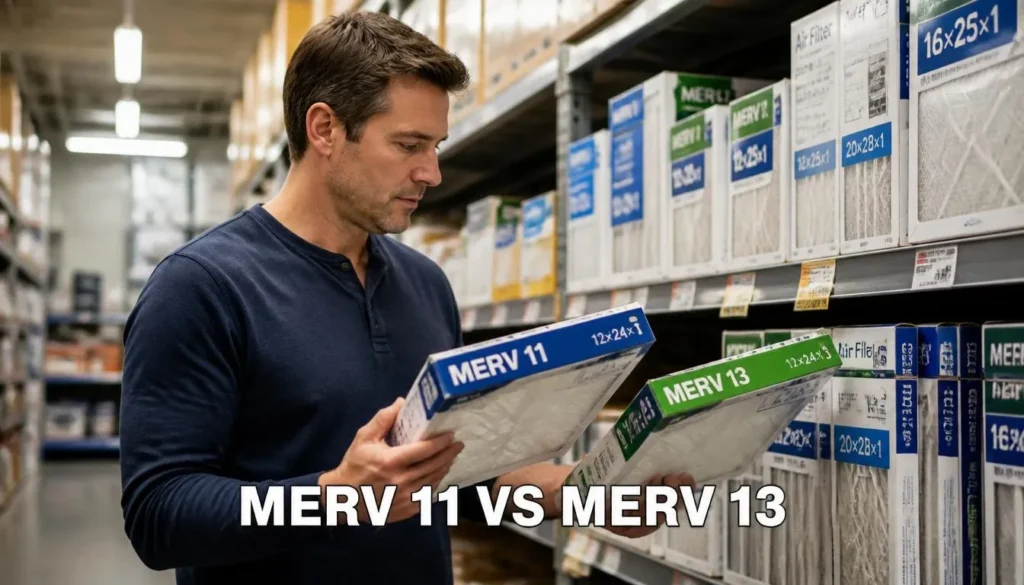
MERV 11 vs MERV 13 (Minimum Efficiency Reporting Value ratings) is a choice between easier airflow and finer particle capture. Pick the highest-rated filter your system can handle, and stay with MERV 11 if your equipment limits are tight or unclear. A higher number on the 1 to 16 scale traps more particles but can also add resistance to airflow.
Below you will see the EPA’s capture numbers side by side, what pressure drop does to a system, and how to test your own setup before you buy. Shelf labels often shorten the pair to MERV 11 vs 13, but the advice stays the same. You will know which filter to buy and when to skip the upgrade.
Key Takeaways
- MERV 13 catches at least 50% of the smallest particles the EPA lists. MERV 11 catches at least 20%.
- The EPA suggests MERV 13 or the highest rating your system can handle, with frequent filter changes.
- Extra airflow resistance is the real cost of MERV 13, not the sticker price.
- Check your filter slot depth and blower limits first, and ask a heating and cooling technician when unsure.
MERV 11 vs MERV 13 at a Glance
MERV 13 is the better filter if your system can run it, and MERV 11 is the safer pick if airflow is tight. The EPA’s chart shows the biggest gap in the smallest particles, where MERV 13 catches at least 50% and MERV 11 catches at least 20%.
Those sizes are measured in microns (one micron is about 1/100th the width of a human hair). The chart gives each filter a minimum average capture rate in three size ranges. A higher rate means fewer particles slip past the HVAC (heating and cooling) system in your home, provided that the filter fits the equipment.
The table below sets the two filters side by side on seven points:
| Factor | MERV 11 | MERV 13 |
| Capture, 0.3 to 1.0 micron | At least 20% | At least 50% |
| Capture, 1.0 to 3.0 microns | At least 65% | At least 85% |
| Capture, 3.0 to 10.0 microns | At least 85% | At least 90% |
| EPA upgrade advice | Fine when MERV 13 does not fit | Matches the advice directly |
| Airflow resistance | Lower, in general | Higher, in general |
| Filter change habit | Follow manufacturer advice; check often if dusty | Follow manufacturer advice; check often if dusty |
| Best fit | Older or weaker blowers, 1-inch slots | Systems cleared for MERV 13, thicker filters |
What the Extra Capture Buys You
The step from MERV 11 to MERV 13 matters most for the finest particles, because that is where the two filters differ the most in laboratory testing. In the smallest size range, MERV 11 filter efficiency is at least 20%, while a MERV 13 filter reaches at least 50%. That is a floor two and a half times higher than the lower filter provides.
In the middle and large ranges the gap shrinks, because both filters already catch larger particles well. The middle-range floors are 65% and 85%, and the largest-range floors are 85% and 90%, so a MERV 13 filter adds the most where the particles are smallest.
Filters between the two follow the same pattern. A MERV 12 filter lists at least 35%, 80% and 90% in the three ranges. That answers the merv 11 vs merv 12 question: MERV 12 sits halfway between them in the smallest range. In a merv 8 vs merv 11 vs merv 13 line-up, MERV 8 lists no minimum for that range, so the smallest particles are where the three filters part ways. If your choice is MERV 8 or MERV 12, our MERV 8 vs MERV 12 comparison covers that pair directly.
The EPA values are minimums, so a particular MERV 11 filter may beat the chart. You can only count on the floor, and testing methods differ between manufacturers. The published rating is therefore a safer yardstick than any promise printed on the box.
The merv 11 filter vs merv 13 gap is bigger on paper than in daily use for one reason. Furnace and HVAC filters, as the EPA notes, clean air only while the system is running. Actual particle removal depends on filter efficiency, airflow through the filter and blower runtime.
Pressure Drop and Whether Your System Can Take MERV 13
Pressure drop is the push-back a filter gives the air moving through it, and it is the main cost of a tighter filter. According to the Pacific Northwest National Laboratory (PNNL), most residential systems perform efficiently at no higher than 0.4 or 0.5 inches of water column. That figure is the total static pressure (the resistance the blower must overcome), and the filter typically accounts for 20% to 50% of it.
The merv 11 vs merv 13 pressure drop depends on more than the rating alone. PNNL compares three MERV 7 filters at the same airflow, and the 4-inch filter dropped 0.12 inches of water column compared with 0.20 for the 1-inch filter. That is about 40% less resistance from thickness alone, with the rating unchanged.
Too much pressure drop can cause real trouble, because PNNL warns it can lower the system’s efficiency, overheat a furnace, freeze the cooling coil, or burn out the blower motor. So is MERV 11 too restrictive for most homes? Rarely, because the EPA says most furnaces and HVAC systems can accommodate a MERV 13 filter provided that the filter is replaced frequently.
In a merv 8 vs merv 13 swap the added resistance is the bigger worry, and thicker filters help. The EPA’s Indoor airPLUS bulletin says thicker or wider filters generally create less static pressure. A deeper MERV 13 filter can therefore be considerably easier on a blower than a 1-inch one.
Cost and Filter Life
The merv 11 vs merv 13 cost question has two parts, which are the shelf price and how often you replace the filter. Shelf prices vary considerably by brand and size, so compare furnace filters in the exact size that your equipment requires. The EPA says manufacturers typically recommend replacement every 60 to 90 days, and that pace sets your yearly spend.
The EPA ties MERV 13 to upkeep, because most systems can take one provided that the filter is replaced frequently. PNNL adds that you should change filters every three months or sooner if you have four or more occupants, pets, indoor smoking, allergies, or nearby construction.
Size is the last cost check, because PNNL notes that residential filters are generally one to four inches thick. Confirm the size before you buy, use the designated slot, and leave the slot cover untaped so that you can change the filter without a fight.
How to Check Your System Before You Switch
You can check whether your equipment suits a MERV 13 filter with a few straightforward steps before you buy. The EPA advises that you consult a professional HVAC technician when you want to be certain that a filter will work with your system.
Follow these five steps before you commit to a MERV 13 filter:
- Read the equipment label or the manufacturer’s manual for the highest MERV rating or filter depth that the system is designed to accommodate.
- Measure the filter slot and note its depth, because residential filters generally run from one to four inches thick.
- Check that the airflow arrow points toward the HVAC equipment, and keep the slot cover untaped.
- Confirm that the specific MERV 13 filter meets your equipment’s airflow and pressure-drop limits. If those limits are unclear, ask a technician to measure static pressure and verify airflow.
- Mark your calendar to check the filter at 60 days, and change it at once if it looks dirty.
If airflow drops or the furnace shows signs of overheating, stop running the system and have an HVAC technician diagnose the problem before you resume. Thicker filters generally create less static pressure, so a technician may suggest a deeper filter cabinet.
MERV 11 vs MERV 13: Which Should You Choose?
Choose MERV 13 when your equipment is rated for it, and choose MERV 11 when airflow is the limiting factor. The EPA’s advice is the same idea in one line: pick a filter rated at least MERV 13 or as high as your system can accommodate.
Choose MERV 13 if:
- Your equipment or manual allows MERV 13 or higher.
- You want the highest capture in the smallest size range, where MERV 13 lists at least 50%.
- The specific MERV 13 filter fits your cabinet and meets your system’s pressure-drop limit.
- You will change the filter every 60 to 90 days, or sooner.
Choose MERV 11 if:
- Your blower is older or small, or you cannot confirm that it handles MERV 13.
- A technician or the equipment specification confirms that your system cannot take the available MERV 13 filters.
- You want airflow safety first, and MERV 11 still lists at least 65% in the middle size range.
If MERV 11 is your ceiling, a portable air cleaner with a HEPA (high-efficiency particulate air) filter can add cleaning where you spend time. The EPA says HEPA filters capture at least 99.97% of 0.30 micron particles, and they sit outside the MERV scale.
How We Research
We check every claim against primary sources. Federal agencies like the EPA and CDC come first. Certification bodies like NSF and AHAM come next. We verify each standard number against the issuing body. We review this guide on a set schedule.
Why Trust This Guide
Puritisimo covers only water and air quality. Our guidance is editorial and independent. We cite every health figure so you can check it. We never present a promotional claim as fact.
Making the Right Call for Your Furnace
MERV 13 has higher minimum capture, while airflow resistance depends on the specific filter and operating airflow. Check your equipment limitations, filter depth and replacement schedule before you shop for air filters for home use. A technician can confirm the limit in one short visit, if you are unsure. If you are also weighing merv 8 vs merv 11, or reading fpr vs merv on a store label, treat the EPA chart as your common ruler. In the end, the MERV 11 vs MERV 13 decision is about fit first and capture second.
Frequently Asked Questions
What is the difference in MERV 11 vs MERV 13 filters?
MERV 11 vs MERV 13 is mainly a difference in fine-particle capture and airflow resistance. MERV 13 captures at least 50% of the smallest particles, against at least 20% for MERV 11. The tighter MERV 13 filter also tends to restrict airflow more, so it needs a system that can handle it.
Can my HVAC handle a MERV 13 filter?
Most systems can, but not all. The EPA says most furnaces and HVAC systems can accommodate MERV 13 when the filter is replaced frequently. Check your equipment manual and filter slot depth, confirm the filter’s pressure drop, and ask a technician if you are unsure.
What are the differences between MERV 8 and MERV 13 filters in home HVAC systems?
MERV 13 captures far more fine particles. In the middle size range the EPA floors are at least 20% for MERV 8 and 85% for MERV 13, and MERV 8 lists no minimum for the smallest range. The trade-off is more airflow resistance, so thicker filters and frequent changes help.
Is MERV 11 too restrictive for my system?
Usually not. MERV 11 sits below the MERV 13 level that the EPA says most systems can accommodate, so it rarely causes airflow trouble by itself. A dirty filter or a thin slot can still restrict air in an otherwise healthy system, so change the filter every 60 to 90 days.
What is the difference between MERV 5 and MERV 11 air filters?
MERV 5 lists a minimum only for the largest particle range, at least 20%. MERV 11 adds minimums of at least 20% for the smallest range and 65% for the middle range. It reaches at least 85% for the largest range, which makes it a substantially finer filter.
References
- EPA. What is a MERV rating? Indoor Air Quality.
- EPA. Guide to Air Cleaners in the Home. Indoor Air Quality.
- Pacific Northwest National Laboratory. High MERV filters. Building America Solution Center.
- EPA Indoor airPLUS. Filtration technical bulletin. 2019.
Medical Disclaimer: This content is for informational purposes only. It is not a substitute for professional medical advice, diagnosis, or treatment. If you have concerns about your water quality or air quality and their effects on your health, consult a qualified healthcare professional.

