
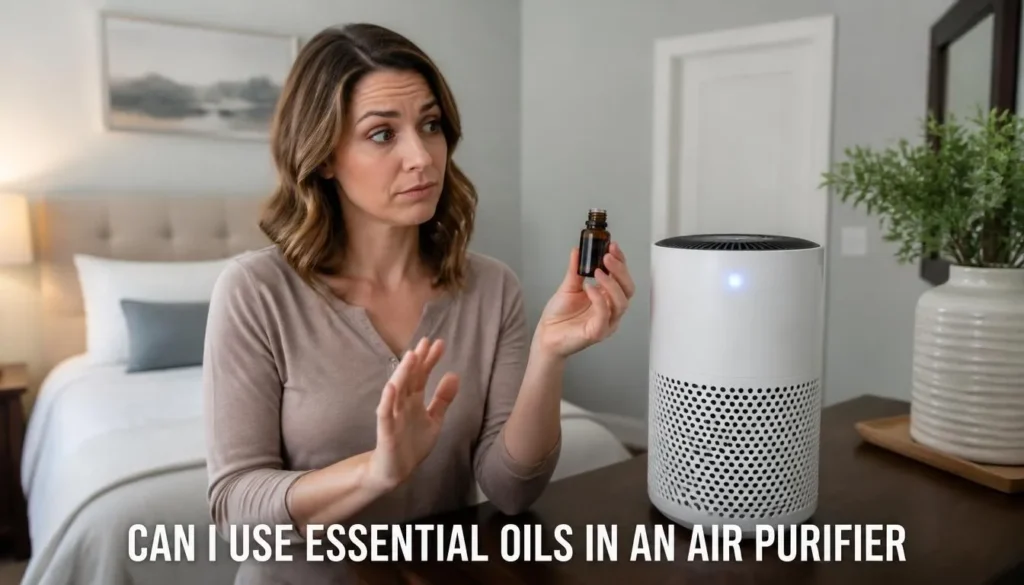
Usually no: oil never goes on an air purifier filter or intake. Oil can clog the filter fibers and fill the carbon that traps odors, so the unit cleans less over time. A few models have a dedicated aroma pad, and only that pad is safe. Scent in the same room is a separate question, with real limits.
This guide settles whether you can use essential oils in an air purifier setup, where a separate diffuser fits, and what pets and lungs need. You will know what to try, what to skip, and how to freshen a room without hurting your filter.
Key Takeaways
- Never put oil on an air purifier filter or intake. Oil clogs fibers and fills carbon.
- Filters remove particles and some gases. Most purifiers add no scent and have no place for oil.
- Use oil in a separate diffuser, or only in a dedicated aroma pad the manual allows.
- Birds, cats, and people with breathing problems need extra caution around diffused oils. Ventilate the room.
Can I Use Essential Oils in an Air Purifier? The Short Answer
An air purifier cleans air by pulling it through filters, so most models cannot hold scent. Oil never belongs on the filter or intake. A separate diffuser in the same room is different, with limits.
Think of the filter as a sponge for dust and gases. Oil is sticky and gives off vapor, so it can damage the filter and restrict airflow. A purifier also cannot tell a scent you like from a smell you want gone. Read more on what an air purifier does before you add anything to it.
Scent also affects the air itself. According to the EPA, indoor levels of many VOCs (volatile organic compounds, gases that evaporate easily at room temperature) can run up to ten times higher than outdoors. Studies of aromatherapy rooms found that terpenes and total VOCs rose while oils were in use. More scent means more gas in the room, not less.
What Oil Does to Filters, Airflow and Dust
A HEPA filter (a dense mesh of fine fibers that traps tiny particles) works because air moves freely through it. Oil that lands on those fibers leaves a sticky film. The film narrows the gaps. Oil buildup can restrict airflow and damage the filter, though the effect depends on the filter, the amount of oil, and the fan controls.
The carbon layer has a different job. Activated carbon (a charcoal-like material full of tiny pores) holds gas molecules on its surface. Scent molecules are gases, so the carbon treats them as pollution to catch. Research on aromatherapy rooms found that terpenes and total VOCs rose while oils were in use. To the carbon, a pleasant scent is just another gas.
Oil on a filter causes these problems:
- Clogged airflow: the sticky film closes the gaps between fibers, so the unit moves less air.
- Carbon capacity: adsorbed scent compounds use some of the carbon’s limited capacity. Replacement timing depends on exposure and the amount of carbon.
- Dust buildup: oil on the filter can trap dust and lint, adding to the buildup.
Follow the maker’s replacement schedule, and change the filter early if it smells of oil or looks stained. A clogged unit moves less air and removes less from the room.
Can I Use Essential Oils in an Air Purifier Made for Aroma Pads?
Only if the maker says so. A few models have a dedicated aroma pad or tray, and the manual explains how to use it. Use only that pad, as the manual says. If your manual does not mention one, assume the answer is no. Never add oil to the intake or filter, and do not make your own pad.
A diffuser and a purifier do opposite jobs. A diffuser turns oil into a fine mist and puts it in the room. A purifier pulls air through filters to take things out. The same mix-up shows up in the air humidifier vs air purifier debate: a humidifier adds water vapor, while a purifier removes particles and gases.
Here is how each option stacks up:
| Option | Goes in the purifier? | What to know |
| Oil drops on the filter | No | Clogs the fibers and fills the carbon |
| Oil at the air intake | No | Pulls oil into the whole unit |
| Maker’s pad for your model | Only if the manual says so | Use only the pad sold for that exact model |
| Separate diffuser in the room | Not applicable | Keep it away from the intake and run it briefly |
Pets, Lungs and Air Chemistry: Why Scent Is Not Clean Air
Scent is not the same as clean air. Essential oils give off VOCs (volatile organic compounds, gases that evaporate easily). According to the EPA, exposure to VOCs can cause eye, nose, and throat irritation, headaches, and nausea. The EPA also says little is known about effects at the levels usually found in homes, so this is a reason for care, not alarm.
A 2012 study in Building and Environment found that ozone (a lung-irritating gas) reacted with terpenes (scent compounds in many oils). The mix formed formaldehyde and fine particles, even at low ozone levels. That study ran in a spa, not a home. Treat it as a hint about ventilation, not a measurement of your living room.
Some devices make ozone as a side effect. The EPA notes that ion generators and some electronic air cleaners can produce ozone, a lung irritant. If you scent a room, skip ozone-making cleaners and choose a filter-based unit.
Pets need extra care. A case series of 443 dogs and cats exposed to concentrated tea tree oil found serious nerve effects, such as tremors and poor balance. Cats and birds may be more sensitive, so ask a vet before you diffuse. If anyone at home has asthma, or a pet has breathing trouble, ask a doctor or vet before you diffuse anything.
Puritisimo’s editorial view: ventilation helps more than any choice of oil. Open a window while you diffuse and keep sessions short. If your goal is clean air, scent adds nothing to it.
Fresher Air Without Oil: A Simple Order of Steps
Odors usually have a source, such as a damp towel, a trash can, or a pet bed. Scent covers a smell but does not remove it, so a better plan starts at the source and uses the purifier for what it does well.
Work through these steps in order:
- Find and remove the source of the smell. Wash, dry, or throw out whatever causes it.
- Open windows or run an exhaust fan for a short time to move stale air out.
- Run the purifier with a clean filter and a carbon stage (the layer that traps odor gases).
- If you want scent, use a separate diffuser in another room, for short periods, away from pets and the purifier intake.
- Change filters on the maker’s schedule, and sooner if the unit smells stale.
A musty smell often means moisture. A purifier traps mold spores (tiny seeds that float in air), but it does not stop mold growing on a damp wall. For air purifier and mold problems, fix the leak or the humidity first.
Size matters too. An air purifier compact enough for a desk suits a small space, but its carbon layer is small, so heavy scent or smoke can fill it fast. Match the unit to the room before you rely on it.
How We Research
We check every claim against primary sources. Federal agencies like the EPA and CDC come first. Certification bodies like NSF and AHAM come next. We verify each standard number against the issuing body. We review this guide on a set schedule.
Why Trust This Guide
Puritisimo covers only water and air quality. Our guidance is editorial and independent. We cite every health figure so you can check it. We never present a promotional claim as fact.
Keep the Scent Out of the Machine
Oil never goes on an air purifier filter or intake. Oil can clog the fibers and leave the unit cleaning less. A few models have a dedicated aroma pad, and only that pad is safe. For other scent, use a separate diffuser briefly with a window open. Take extra care with birds, cats, dogs, and breathing problems. Learn how to use an air purifier in the right spot for your room. When in doubt, leave the oil out. That is the full answer to whether you can use essential oils in an air purifier.
Frequently Asked Questions
Can I use essential oils in an air purifier?
You can use essential oils in an air purifier only if the model has a dedicated aroma pad. Oil never goes on the filter or intake. Only that pad, used as the manual says, is safe. Other scent belongs in a separate diffuser, so check your manual first.
What is the best oil to use in an air purifier?
A few models have a dedicated aroma pad. Use only the oils that model’s manual allows, and only on that pad. If your purifier has no such pad, add no oil. For room scent, run a separate diffuser briefly with a window open. Skip diffusers around birds.
Is inhaling essential oils safe for your lungs?
Diffused oil can irritate the airways in some people. Essential oils release VOCs, which can irritate the eyes, nose, and throat. People with asthma or other breathing problems should ask a doctor first. Short sessions in a ventilated room lower exposure, and pets, especially birds, need separate care.
How do I naturally purify the air in my house?
Start with the source of the odor. Remove what causes it, open windows when outdoor air is fine, and keep a clean filter running in a purifier sized for the room. A filter-based purifier does the real cleaning. A diffuser only changes how the room smells.
Can you put essential oils in an air humidifier?
Only a humidifier whose maker says it takes oil can hold essential oils. Many ordinary models are not built for it, and oil can harm the tank and parts in some of them. Diffuser-style units and aroma trays are made for oil. A standalone purifier usually has no water tank, though purifier-humidifier combos do. A tank alone does not mean oil is allowed.
References
- EPA. Volatile Organic Compounds’ Impact on Indoor Air Quality. U.S. Environmental Protection Agency. Accessed 2026.
- Huang HL, et al. Effects of essential oils on the formation of formaldehyde and secondary organic aerosols in an aromatherapy environment. Building and Environment. 2012;57:120-125.
- Khan SA, et al. Concentrated tea tree oil toxicosis in dogs and cats: 443 cases (2002-2012). Journal of the American Veterinary Medical Association. 2014;244(1):95-99.
- EPA. What Are Ionizers and Other Ozone-Generating Air Cleaners? U.S. Environmental Protection Agency. Accessed 2026.
Medical Disclaimer: This content is for informational purposes only. It is not a substitute for professional medical advice, diagnosis, or treatment. If you have concerns about your water quality or air quality and their effects on your health, consult a qualified healthcare professional.

