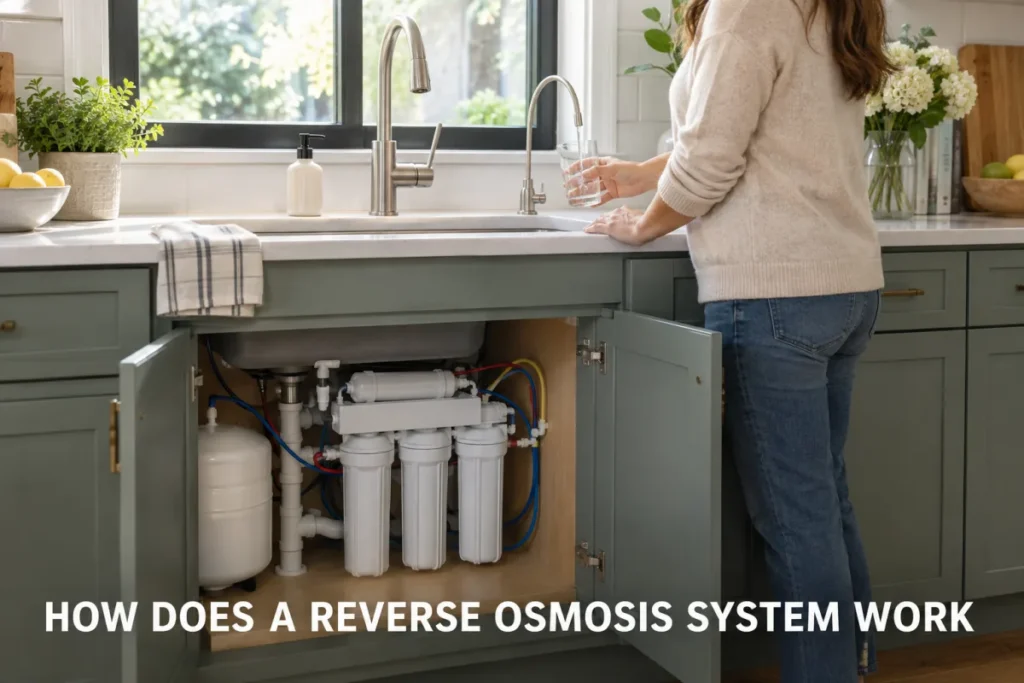
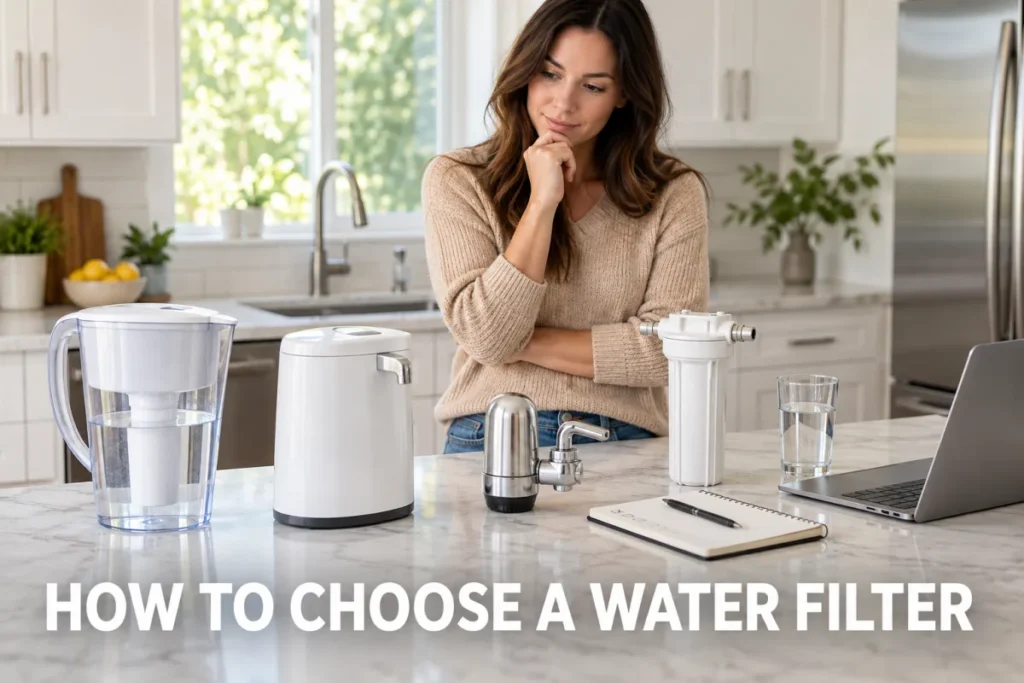
Choosing a water filter comes down to one choice: matching a certified filter to the exact pollutant your water contains. That choice has nothing to do with which brand has the best reviews. That means testing your water first and finding what needs to come out. Then pick a filter type built for that pollutant and size it to cover a single tap or the whole house.

By the end, you will know the five-step process professionals use and which filter technology handles which pollutant. You will also know how a whole-house pick differs from a well-water pick. That framework works whether your water comes from a municipal supply or a private well.
Key Takeaways
- Test your water first; the results show exactly which pollutants your filter needs to target.
- Reverse osmosis removes the widest range of pollutants; carbon filters mainly target chlorine, taste, and odor.
- Whole-house systems need at least 10 GPM (gallons per minute) of flow; under-sink units only treat the kitchen tap.
- Well water needs its own test panel for iron, bacteria, and hardness before you pick a filter.
5 Steps to Picking the Right Water Filter
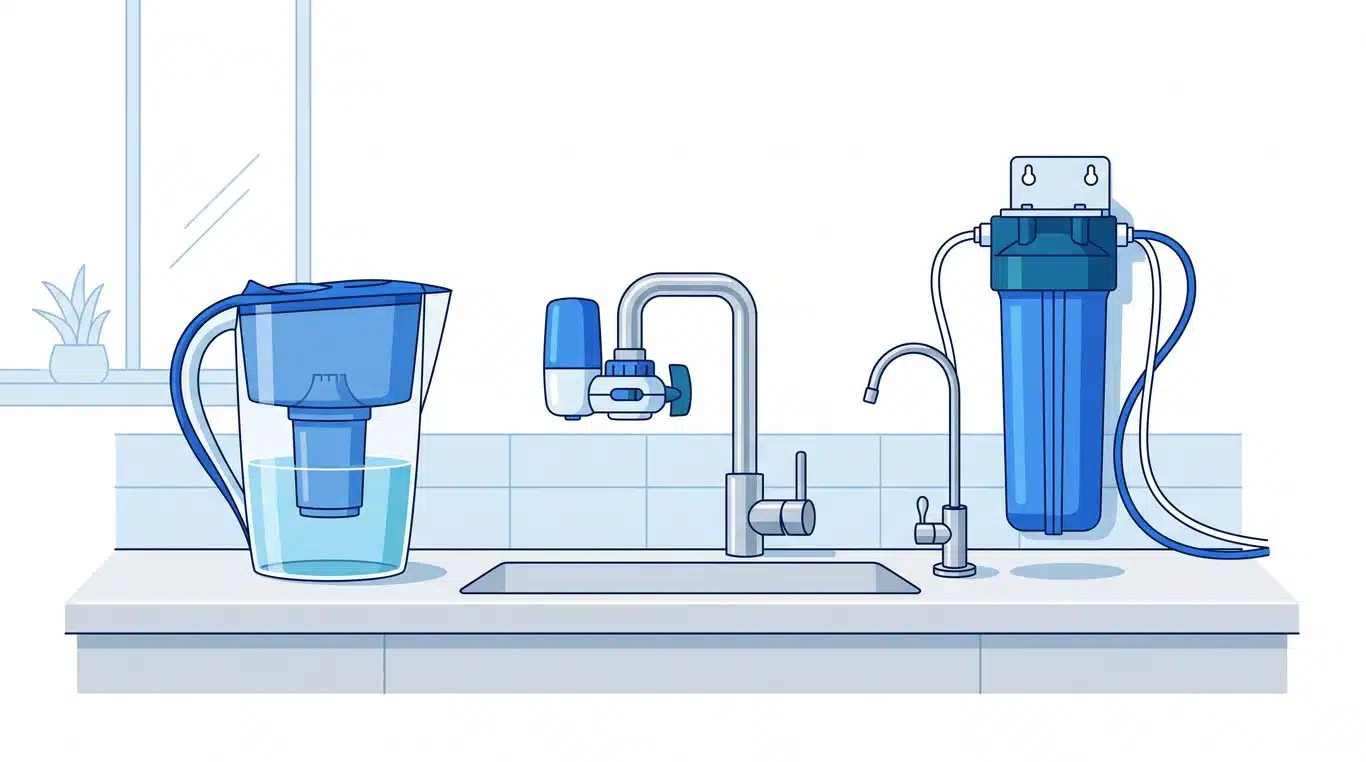
Choosing the right water filter comes down to matching a certified technology to a pollutant you already know is in your water. It has nothing to do with guesswork or brand loyalty. NSF/ANSI (the independent standards that certify water treatment equipment) is the label to check. It is not a company’s own claims.
- Test your water: a home test kit or your utility’s Consumer Confidence Report (CCR, the water quality report utilities must publish every year). It shows what is in your supply.
- Find the pollutants: pin down what needs to come out. Common targets are lead, chlorine, PFAS (per- and polyfluoroalkyl substances, a group of persistent industrial chemicals), hardness minerals, or bacteria.
- Pick a filter type: point-of-use (POU) options like a pitcher, faucet mount, or under-sink unit treat a single tap. Point-of-entry (POE) systems treat the whole house instead.
- Verify the certification: confirm NSF/ANSI certification for that exact pollutant. Never accept a blanket ‘NSF certified’ claim. The CDC recommends NSF/ANSI Standard 53 certified filters for lead removal. That is one of the few times a federal health agency names a specific filtration standard by number.
- Match flow and cost: match the flow rate to your household size. Use GPM for a whole-house system or GPD (gallons per day) for reverse osmosis. Then weigh the ongoing filter-replacement cost.
Matching Filter Types to What Is in Your Water
The filter type you choose determines what leaves your water, not the brand on the housing. Reverse osmosis (RO, which forces water through a fine membrane), activated carbon, and sediment filters each target a different pollutant group. So do ultraviolet (UV) light, ceramic, and ion exchange. None of them removes everything on its own. The type you choose when picking a water filter for your home should follow what your test results flagged. It should not follow brand name or price.
Whole-house sediment-and-carbon cartridges are one of the most budget-accessible certified options in that category; my PUREPLUS whole-house filter review covers how NSF 42 applies to a dual-media 5-micron design.
The NSF/ANSI 53 Health Effects standard certifies filters to reduce more than 50 named pollutants. Those include lead, parasitic cysts, and industrial solvents. It also cuts PFAS (per- and polyfluoroalkyl substances, a group of persistent industrial chemicals). The reduction goes to below 20 parts per trillion. NSF/ANSI 58, the reverse osmosis standard, needs to cut total dissolved solids (TDS). The cut must be at least 75 percent. A filter labeled only “NSF certified” without naming a standard number proves nothing. It has not shown it removes anything specific to your water.
The same certification process governs multi-stage under-sink systems; my iSpring RCC7 reverse osmosis review covers what NSF/ANSI 58 verification actually means for an under-sink RO unit.
Reverse osmosis clears Cryptosporidium and Giardia. So does any filter with an absolute pore size of 1 micron (about 1/100th the width of a human hair) or smaller. These chlorine-resistant parasites are not fully inactivated by disinfection alone. The distinction that trips up most buyers is nominal versus absolute pore size. A nominal 1-micron filter lets some particles that size slip through. An absolute rating blocks them consistently.
A faucet-mount filter from an established brand makes that certification check straightforward; my PUR Plus review covers the two separate certifying bodies the unit is verified against and what each one actually confirms.
How the six common filter types stack up against what you are likely to find:
A 6-stage under-sink RO system certified to NSF/ANSI 58, with a built-in alkaline remineralization stage, is one of those six types; my iSpring RCC7AK write-up covers what that certification means for dissolved-solid reduction and what the alkaline stage adds after the membrane.
| Filter Type | What It Removes | What It Misses | Best For |
| Activated Carbon | Chlorine, taste and odor compounds, some VOCs | Total dissolved solids, most heavy metals, bacteria | Municipal tap water with a chlorine taste |
| Reverse Osmosis | 90 to 99 percent of TDS, plus lead, arsenic, and PFAS | Nothing major, but wastes several gallons per gallon produced | Water with dissolved metals or high TDS |
| Sediment | Dirt, rust, and sand particles | Dissolved chemicals and pathogens | Pre-filtering well water or older pipes |
| UV | Bacteria and viruses | Chemicals, metals, and sediment entirely | Microbiologically unsafe well water |
| Ceramic | Bacteria and cysts through fine pores | Dissolved chemicals and most metals | Backup or travel filtration |
| Ion Exchange | Hardness minerals (calcium, magnesium) and some heavy metals | Chlorine, sediment, and bacteria | Hard water and scale prevention |
Choosing a Water Filter for Your Whole Home
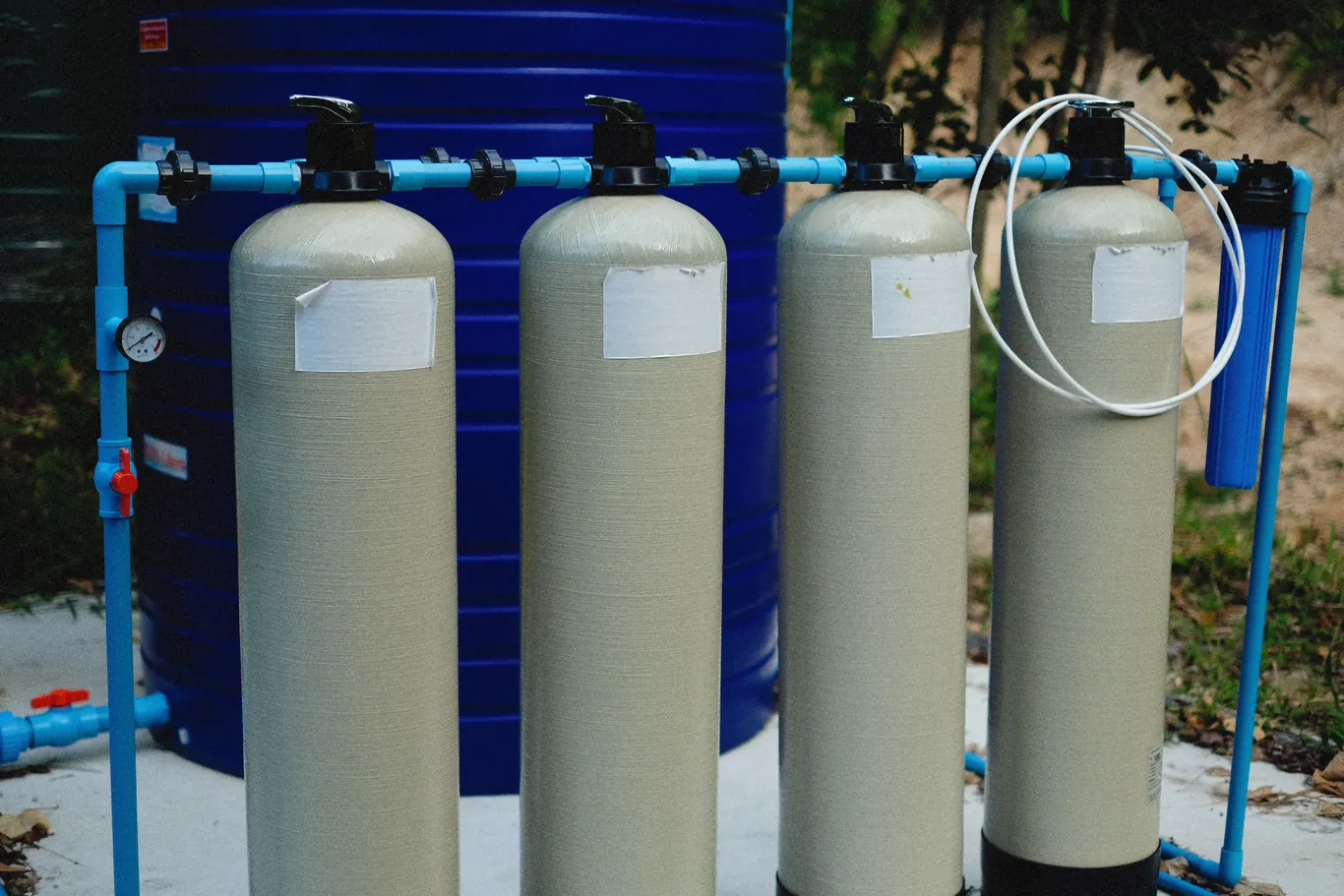
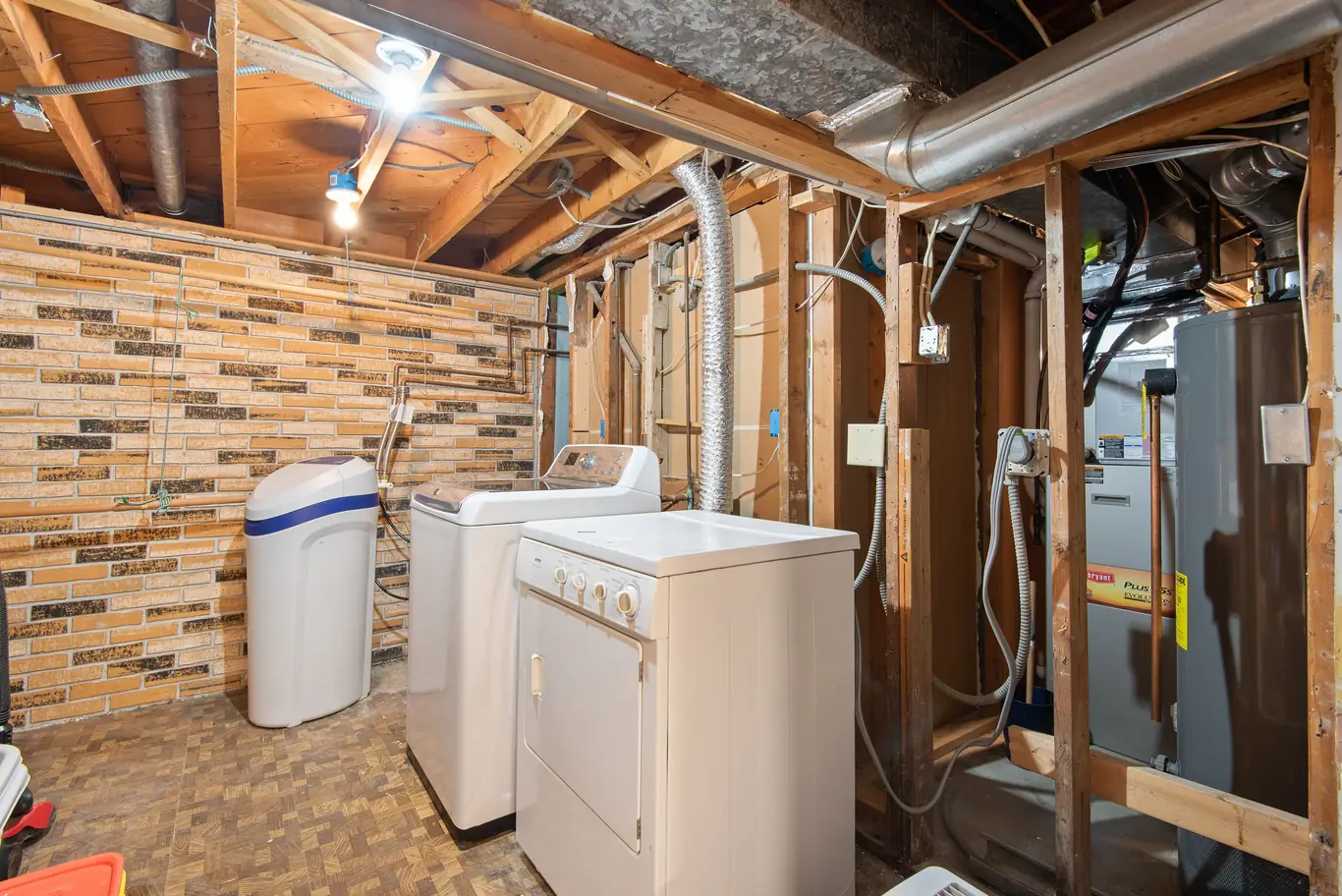
A whole-house system treats every tap, shower, and appliance from one point of entry. This is what most people mean by a water filter for the entire home, or the whole home. It handles chlorine, sediment, and general hardness across the whole supply. It will not remove dissolved lead or PFAS. A dedicated reverse osmosis unit under the kitchen sink handles that instead. Pair the two if your test flagged a metal or PFAS pollutant.
Run through this checklist before buying a whole-house unit:
- Flow rate: match gallons per minute (GPM) to your home. One to two bathrooms need at least 10 GPM. Three or more need 15 to 20 GPM, or pressure drops when multiple fixtures run at once.
- Chlorine capacity: the system should handle water at or below the EPA’s maximum residual disinfectant level of 4.0 mg/L. That is the ceiling utilities are allowed to add.
- What it will not fix: dissolved pollutants like lead and PFAS pass through a standard carbon or sediment stage. They need a separate under-sink RO unit.
- Installation: whole-house systems cut into the main line. Professional installation is recommended over a do-it-yourself job.
- Media life: tank-based carbon media typically lasts five to ten years before replacement. A small cartridge filter lasts only a few months. Knowing how to clean a water filter between service intervals also helps maintain flow.
Choosing a Water Filter for Well Water
Private wells fall outside the Safe Drinking Water Act. Testing and treatment decisions rest with the homeowner rather than a utility. About 15 percent of U.S. households get their water from a private well. None of those wells are checked by a regulator the way a municipal supply is.
Because no agency verifies well water, testing has to come first. The well-specific panel covers iron and manganese, which stain fixtures and clog media. It also covers total coliform bacteria, hardness, and sulfur, which smells like rotten eggs even at safe levels. In agricultural areas, add arsenic or nitrate from runoff to the list. Waterborne illness from an untreated source is not rare either. An estimated 7.15 million cases occur across the United States every year.
Choosing a water filter for well water usually means stacking several stages. It rarely means picking a single unit. A typical stack starts with a sediment pre-filter for grit and an iron or manganese media tank if needed. A 20 micron filter catches large grit and lasts longer, which makes it the better choice for heavy sand or rust. A 5 micron filter blocks finer sediment but clogs faster; add that stage only if fine grit still gets through.
It finishes with ultraviolet light or chlorination for bacteria. A softener joins the mix if hardness runs high. This differs from a municipal buying choice. The pollutant profile stays unknown until the test results are back. Picking a filter type first just wastes money on the wrong stage. For a full comparison of certified home systems across well and city water, see our home water filtration guide.
Certifications, Cost, and Maintenance to Check Before You Buy
A label that reads “NSF Certified” is a specific, checkable claim, not vague branding. Certification needs independent lab testing plus annual, sometimes unannounced, facility audits. Buyers can verify the exact brand and model in NSF’s public database. A filter that instead says “tested to NSF standards” has skipped that audit step. It proves nothing on its own.
Ongoing cost varies more by category than by brand. A pitcher or faucet-mount filter uses the cheapest replacement cartridges but needs the most frequent swaps. Changing a refrigerator filter follows a similar schedule, usually every six months. An under-sink carbon or reverse osmosis system costs more per year to maintain. It treats far more water per cartridge change. A tank-based whole-house system carries close to no annual cost since its media lasts five to ten years. The upfront unit and installation, though, cost more than either option.
Installation difficulty should factor into the choice as much as price. A pitcher needs no tools at all, and a faucet-mount unit screws on in minutes. An under-sink or whole-house system usually needs a professional. It ties into household plumbing rather than sitting on a counter. Consumer Reports’ guidance holds regardless of budget: test the water first. Then buy the filter certified to remove what that test found.
How We Research
We check every claim against primary sources. Federal agencies like the EPA and CDC come first. Certification bodies like NSF and AHAM come next. We verify each standard number against the issuing body. We review this guide on a set schedule.
Why Trust This Guide
Puritisimo covers only water and air quality. Our guidance is editorial and independent. We cite every health figure so you can check it. We never present a promotional claim as fact.
Making the Right Call for Your Home
The five-step framework holds regardless of what the test comes back with. Test the water, find exactly what needs to go, and pick a filter type built for that pollutant. Confirm the certification names the standard rather than just the brand, then match flow rate and budget to how the household uses water. A whole-house system and an under-sink unit solve different problems. Most households that treat more than chlorine and taste end up running both. For a closer look at a carbon pitcher that hits NSF 42 certification at the entry-level tier, my full breakdown of the Waterdrop PT-07B covers what that certification floor means in everyday use.
None of this replaces the test results. A guess about which brand looks trustworthy on a shelf is not a substitute. That discipline, testing first and matching certification to the number the test returns, is what makes choosing a water filter straightforward. It is what keeps the process from becoming guesswork.
Frequently Asked Questions
How to choose a water filter?
Choosing a water filter comes down to matching a certified technology to whatever your water test finds. It does not come down to a brand or price tag. Test first, find the specific pollutant. Then pick a filter type and certification built to remove it, sized to your flow rate and budget.
How do I know what water filter to buy?
The starting point is a water test, either a home kit or your utility’s Consumer Confidence Report. It is not a filter’s promotional claims. Once you know exactly which pollutants are present, you can match a filter type and certification built to remove that specific substance. That beats guessing at a generic best-seller.
What is the best type of water filter for drinking water?
No single filter is best across every water supply. Reverse osmosis, certified to NSF/ANSI 58, removes the widest range of pollutants. That includes dissolved metals and PFAS. A carbon filter certified to NSF/ANSI 53 covers most municipal-water concerns, like chlorine and lead. It does so at a lower cost. Households that want zero installation and full portability have a third path in gravity-fed countertop systems; my Royal Berkey countertop filter review covers one of the most widely used options in that format.
What is the healthiest way to filter tap water?
The healthiest approach matches certification to whichever pollutant poses the biggest health risk in your water, rather than chasing one universal technology. For lead specifically, the CDC recommends a filter certified to NSF/ANSI 53. For parasitic cysts like Cryptosporidium, an absolute one-micron or reverse osmosis filter does the job.
How do I choose a water filter for well water?
Well water needs its own test panel before you choose anything. Private wells are not regulated under the Safe Drinking Water Act, and no agency checks them for you. Test for iron, bacteria, hardness, and sulfur first. Then build a filter stack around whatever the results show, rather than buying a single generic filter.
References
- CDC. Lead Prevention, Drinking Water. 2024.
- EPA. National Primary Drinking Water Regulations. 2024.
- NSF International. What Is NSF Certification. 2024.
- CDC. Waterborne Disease Surveillance for Water-Associated Disease and Outbreaks Reported to CDC, United States, 2017-2023. Morbidity and Mortality Weekly Report Surveillance Summaries. 2024.
Medical Disclaimer: This content is for informational purposes only. It is not a substitute for professional medical advice, diagnosis, or treatment. If you have concerns about your water quality or air quality and their effects on your health, consult a qualified healthcare professional.