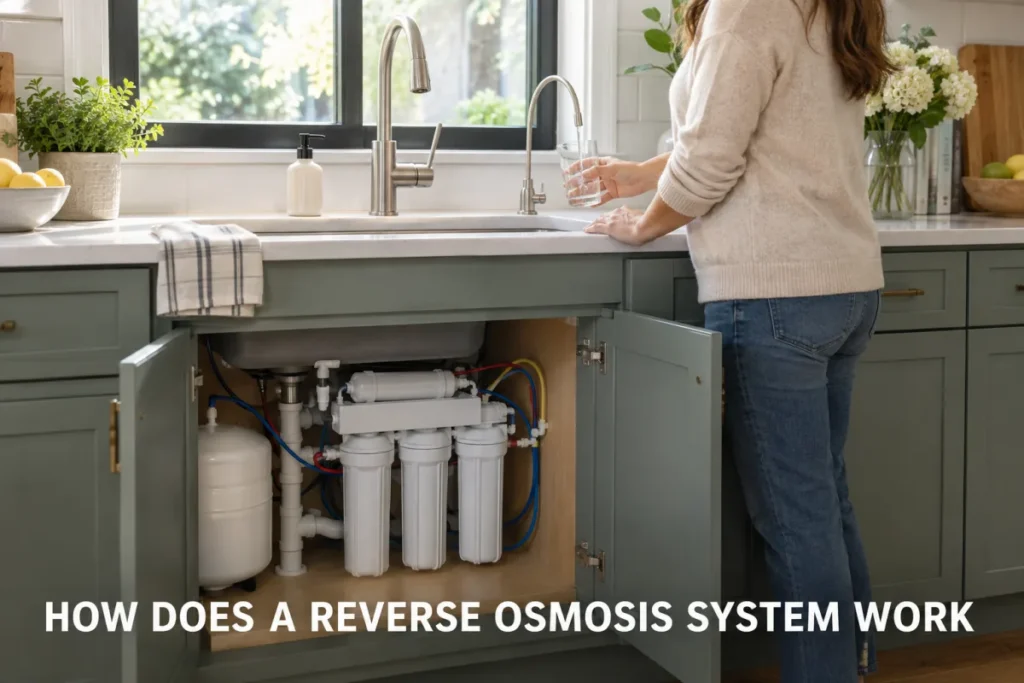

A water filter works by forcing water through physical and chemical barriers. These barriers trap or bind pollutants while letting water molecules pass through. That barrier might be a mesh screen, activated carbon, or a semipermeable membrane (pores so small that only water molecules fit through). Most household filters combine two or three of these stages in sequence rather than relying on one step.

By the end, you will know the different filter media at work, what each one removes well, and what it misses. You will also know the plain signs that a cartridge needs replacing before flow rate or taste tells you first, no guesswork needed.
Key Takeaways.
- Water filters work through physical straining, chemical adsorption, or ion exchange, sometimes combining all three stages.
- Reverse osmosis membranes have pores near 0.0001 microns (about one ten-billionth of a meter). That is small enough to block dissolved salts and heavy metals.
- Standard carbon filters remove chlorine and VOCs but do not cut fluoride, nitrates, or dissolved heavy metals.
- NSF/ANSI 53 certification is the benchmark for filters claiming to cut specific health pollutants like lead.
How Does a Water Filter Work? The Basic Process
Every water filter works the same basic way. Water enters at one end and passes through a barrier. That barrier is small enough or chemically active enough to catch what does not belong. The water exits cleaner than it went in. The CDC compares this to a kitchen colander. Pour water through, and anything larger than the holes stays behind while water passes straight through.
Multi-stage reverse osmosis systems layer several mechanisms on top of that basic principle; my iSpring RCC7 five-stage review covers how the five-stage design handles contaminants that physical filtration alone cannot catch.
After the physical straining stage, most filters add a chemical step. This step catches what a colander-style barrier cannot: dissolved gases, some metals, or organic compounds. Independent certification separates unverified claims from tested results. NSF/ANSI, the certification standard water treatment devices are tested against, covers three areas. NSF/ANSI 42 covers taste and odor. NSF/ANSI 53 covers health effects like lead and cysts. NSF/ANSI 58 covers reverse osmosis systems.
Water enters the housing, passes through a physical barrier that traps sediment.
The healthiest approach is choosing a filter certified to NSF/ANSI 53 for the specific pollutants in your water.
Faucet-mount clip-on filters can achieve NSF/ANSI 53 certification too; my PUR Plus faucet water filter review covers exactly which standards the unit carries and what each one verifies at the tap.
The CDC estimates roughly 7.15 million waterborne illnesses occur in the United States each year.
- Intake. Water enters the filter housing through an inlet port, tap connection, or pitcher reservoir.
- Sediment stage: a pre-filter or mesh screen traps rust, sand, and other visible bits before they reach finer media.
- Adsorption stage. Activated carbon binds chlorine, VOCs (volatile organic compounds, chemicals that evaporate easily and affect taste), and some pesticides.
- Exchange or membrane stage: resin beads swap sodium for calcium and magnesium. A reverse osmosis membrane blocks dissolved salts and heavy metals, depending on the system.
- Polishing stage. A final carbon block removes any taste or odor compounds the earlier stages missed.
- Output: filtered water exits through the tap, faucet, or pitcher spout, ready to drink.
A faucet-mount filter attaches to the aerator thread and runs water through a carbon block before it exits the tap, making it the most compact point-of-use option.
The Main Types of Water Filter Media and How Each One Works
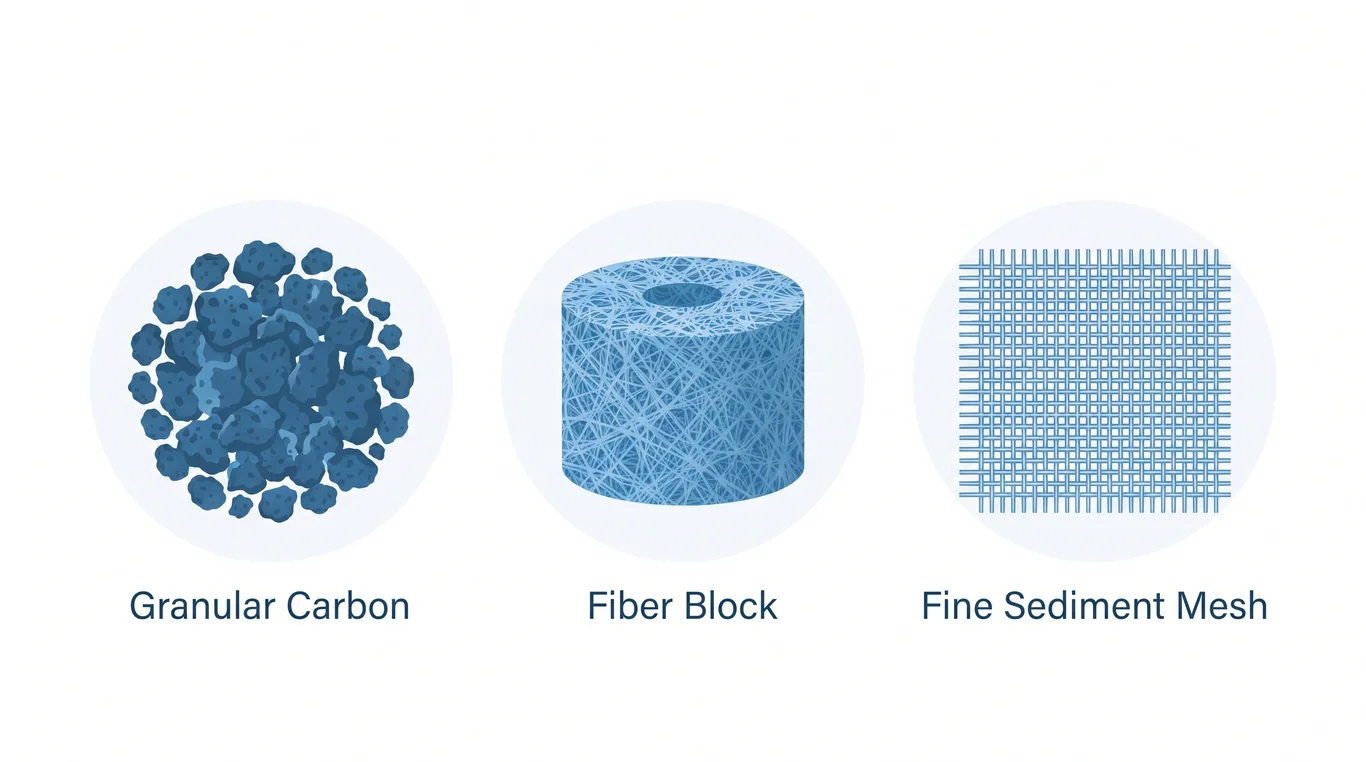
Every filter works through one or more of three ways: straining, adsorption, or ion exchange. The media inside the housing decides which one applies. A micron rating (a micron equals one millionth of a meter) is not as reliable as it sounds, either. A cartridge rated nominal at 5 microns only describes average results. One rated absolute at 5 microns guarantees a stated capture rate, often 99.9 percent, at that exact size.
Certification separates a vague results claim from an actual guarantee. NSF International keeps separate standards for different jobs. The CDC specifically recommends filters certified to NSF/ANSI 53 for cutting lead in drinking water, rather than any generic carbon filter.
The table below breaks down what each common filter media really does inside the housing:
| Filter Type. | How It Works. | What It Removes. | What It Misses. |
| Activated Carbon (GAC). | Loose carbon granules adsorb chemicals as water flows past them. | Chlorine, taste and odor compounds, some volatile organic chemicals (VOCs). | Fluoride, nitrates, dissolved heavy metals. |
| Carbon Block. | Compressed carbon forces water through a denser structure with more contact time. | Chlorine, sediment down to about 0.5 microns, some cysts. | Dissolved salts, most heavy metals. |
| Sediment. | A mesh or spun-fiber cartridge strains bits by size. | Sand, rust, silt, visible cloudiness. | Dissolved chemicals, bacteria, viruses. |
| Reverse Osmosis (RO). | Pressure forces water through a semipermeable membrane with pores near 0.0001 microns. | Dissolved salts, lead, arsenic, and many fluorinated factory chemicals with a rated membrane. | Some good minerals along with the pollutants. |
| UV (Ultraviolet Light). | UV light disrupts the DNA of germs as they pass through a clear chamber. | Bacteria, viruses, protozoa. | Chemicals, dissolved metals, sediment. |
| Ion Exchange (Softening). | Resin beads swap calcium and magnesium ions for sodium or potassium ions. | Water hardness minerals. | Chlorine, chemicals, pathogens. |
| Ceramic. | A porous ceramic shell has pores small enough to physically block germs. | Bacteria, protozoa, sediment. | Chemicals, dissolved salts, most viruses. |
| KDF (Copper-Zinc Alloy Media). | A redox reaction between copper and zinc breaks down chlorine and some heavy metals on contact. | Chlorine, some lead and mercury. | Sediment, dissolved salts, most organic chemicals. |
What Water Filters Remove, and What They Miss
Every filter cuts something. No single filter cuts everything. Standard activated carbon handles the pollutants that affect taste and immediate safety. A separate group slips through unless the filter carries a specific certification for it.
An under-sink RO system certified to NSF/ANSI 58 at the whole-system level is the format that covers that second group for dissolved lead, PFAS, and arsenic; my iSpring RCC7AK under-sink review covers a 6-stage option that meets that standard.
The gap matters more than it sounds. A 2023 USGS study found that at least 45 percent of U.S. tap water contains one or more PFAS (per- and polyfluoroalkyl substances, a group of long-lasting man-made chemicals) compounds. Standard carbon was not built to catch most of them. The CDC also estimates roughly 7.15 million waterborne illnesses occur in the United States each year. That is why pathogen removal counts as a core filter function, not a taste upgrade.
Here is the practical line between what standard carbon handles well and what needs a specifically certified technology:
- Chlorine, taste, and odor. Standard activated carbon cuts these well in nearly every home filter.
- Sediment and cloudiness. Any basic filter with a fine enough mesh catches these by size.
- PFAS (forever chemicals that resist breakdown): needs a membrane or media specifically rated for PFAS reduction, not general carbon.
- Fluoride and nitrates pass through most carbon filters and typically need reverse osmosis or a dedicated ion-exchange resin.
- Dissolved heavy metals and certain pathogens: need media certified to NSF/ANSI 53, not carbon alone.
The EWG Tap Water Database, for example, sets its own PFOA and PFOS guideline levels. Those levels sit roughly an order of magnitude below the EPA’s legal highest pollutant level (MCL). That gap reflects a health-based advocacy target, not a legal standard. A filter that meets the EPA’s rule is not automatically meeting EWG’s guideline too.
Whole-House Filters vs. Point-of-Use Systems
A whole-house system is also called a point-of-entry (POE) filter. It installs on the main line before water reaches any faucet, appliance, or shower. This setup is also called a water filter for the entire home, or a water filter for the whole home. One unit treats every fixture at once. Installing a POE system often means cutting into the main line, which is why it typically involves a plumber.
A replacement cartridge for a Big Blue housing achieves point-of-entry sediment reduction without the full system install cost; my PUREPLUS water filter cartridge review covers a 5-micron NSF 42 certified option in that format.
A point-of-use (POU) system treats water at a single fixture instead. That fixture might be a pitcher, a faucet-mount unit, or an under-sink cartridge. POU systems are often easier to install and swap, but they only protect the tap they sit on.
Many households end up running both. A whole-house POE unit handles chlorine, sediment, and hardness at the source. A certified POU or reverse-osmosis unit under the kitchen sink targets whatever the source water still needs for drinking. The CDC recommends matching filter choice to your specific water quality report rather than defaulting to a single all-purpose unit. Households that want neither a plumbed system nor a compact pitcher have a third option in gravity-fed countertop units; my Royal Berkey write-up covers how that format works in a household of two to four people.
How Does a Water Filter Work in a Fridge or Pitcher?

A refrigerator or pitcher filter uses the same adsorption principle as a whole-house carbon filter. It is just built into a much smaller cartridge. Water sits in contact with tightly packed carbon granules or a carbon block for a few seconds. As it passes through, the carbon binds chlorine, some VOCs, and taste-and-odor compounds along the way.
That short contact time is also the trade-off. A pitcher cartridge needs cleaning and replacing far more often than a whole-house tank. Fewer adsorption sites fill up faster during each use.
This is the same reason a refrigerator’s dispenser filter and a stand-alone pitcher filter perform almost the same way. Both depend on contact time, not on which company built the housing around the cartridge. If you want to see that principle applied to a specific certified pitcher, my Waterdrop PT-07B pitcher review covers the contact time, flow rate, and NSF 42 scope for that model.
Filter Maintenance and When to Replace Cartridges
Filter media does not fail all at once, it loses power gradually. Loose granular carbon can channel, meaning water finds a path around the media instead of through it. Every adsorption site eventually fills up and stops binding new pollutants. Carbon that sits wet and stagnant between uses can also grow bacteria. That is why a cartridge left unused for months should be replaced rather than reused.
This is also why the CDC advises replacing cartridges on a fixed schedule, not just when water flow slows down. A saturated filter does not necessarily fail outright. It simply stops performing the straining, adsorption, and exchange steps described earlier, which means pollutants it used to catch start passing through unnoticed. Ignoring that schedule does not just cut results. It can turn a stagnant filter into a source of contamination instead of a barrier against it.
How We Research
We check every claim against primary sources. Federal agencies like the EPA and CDC come first. Certification bodies like NSF and AHAM come next. We verify each standard number against the issuing body. We review this guide on a set schedule.
Why Trust This Guide
Puritisimo covers only water and air quality. Our guidance is editorial and independent. We cite every health figure so you can check it. We never present a promotional claim as fact.
The Bottom Line on How Filtration Works
Filtration comes down to one idea: force water past a barrier or through a reaction that traps what does not belong. The right type depends on what is really in your water, not on brand or price. A whole-house system handles chlorine, sediment, and hardness at the source.
A certified point-of-use unit, like an under-sink cartridge rated for that specific pollutant, closes the gaps carbon alone leaves for fluoride or dissolved metals. Checking your utility’s annual report first prevents paying for coverage you never needed. Once you know which pollutants matter for your tap, understanding how a water filter works becomes simple matching.
Frequently Asked Questions
How does a water filter work step by step?
How a water filter works comes down to four connected stages. Water enters the housing, passes through a physical barrier that traps sediment. It moves through activated carbon or another media that adsorbs chemicals, and exits as treated water. Each stage removes a different category of pollutant. That is why single-stage pitcher filters usually catch less than multi-stage systems.
What are the disadvantages of drinking filtered water?
The bigger drawback is not filtered water itself, it is inconsistency between technologies. Standard carbon filters do not cut fluoride, nitrates, or dissolved heavy metals. Reverse osmosis systems can strip good minerals like calcium and magnesium along with pollutants. Choosing a filter certified for the specific pollutant you are worried about closes most of that gap.
What is the healthiest way to filter water?
The healthiest approach is choosing a filter certified to NSF/ANSI 53 for the specific pollutants in your water. That matters more than picking a brand name. This standard confirms a filter really cuts health-effect pollutants like lead, cysts, and certain VOCs, not just chlorine taste. Checking your local water quality report first tells you which certification really matters for your tap.
What is the downside of water purifiers?
The biggest downside for reverse osmosis purifiers is waste water. Many residential RO systems send several gallons down the drain for every gallon of purified water produced. The membrane and pre-filters need scheduled replacement to keep performing. Skipping that maintenance is the most common reason a purifier’s output quietly declines over time.
Why is water filtration important?
Water filtration matters because tap water that meets legal limits can still carry pollutants. Current rules do not fully address every pollutant. The CDC estimates roughly 7.15 million waterborne illnesses occur in the United States each year. That shows filtration is not just a taste preference. Matching a filter to your specific water report closes gaps that treatment and aging pipes can reintroduce.
References
- CDC. About Choosing Home Water Filters. 2024.
- NSF International. Standards for Water Treatment Systems. 2024.
- USGS. Tap Water Study Detects PFAS Forever Chemicals Across the US. 2023.
- CDC. Waterborne Disease in the US. 2024.
Medical Disclaimer: This content is for informational purposes only. It is not a substitute for professional medical advice, diagnosis, or treatment. If you have concerns about your water quality or air quality and their effects on your health, consult a qualified healthcare professional.