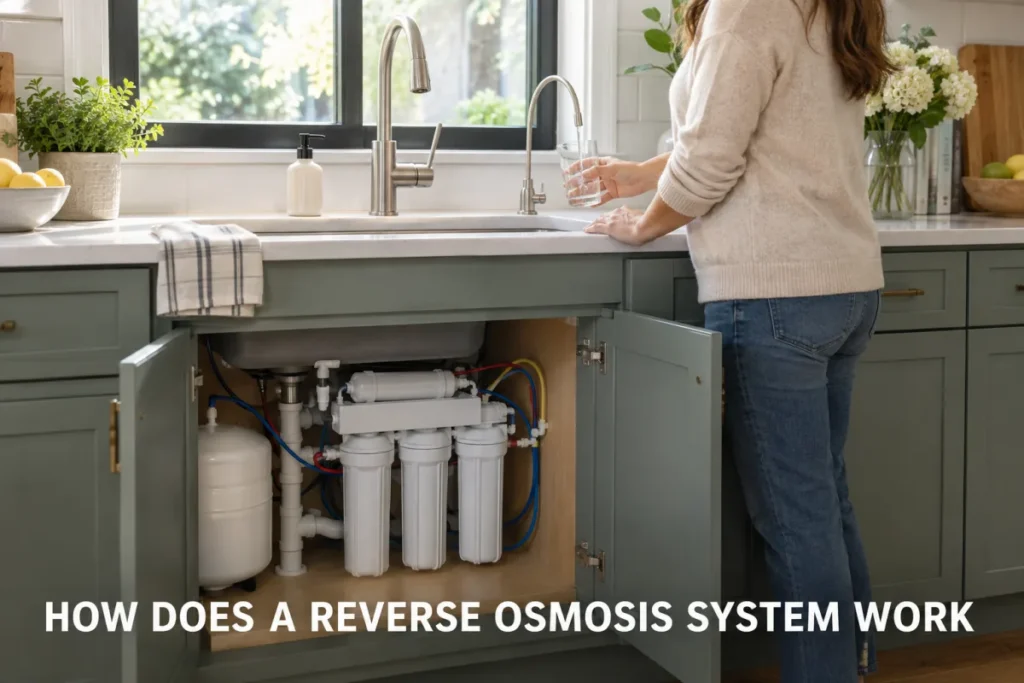
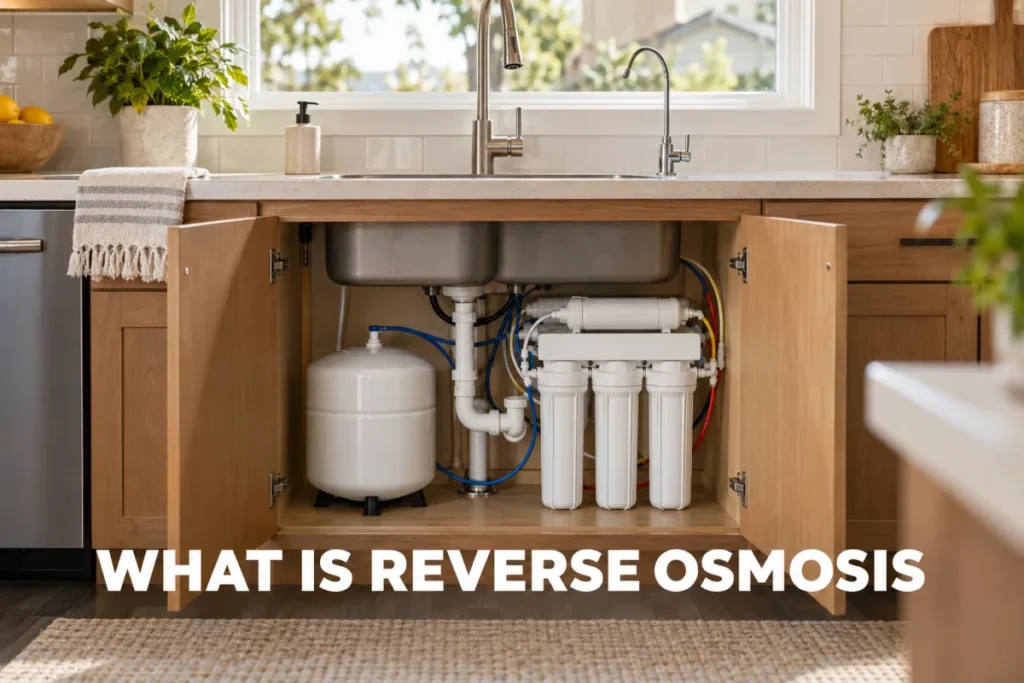
Reverse osmosis is a water purification process. It uses pressure to force water through a semi-permeable membrane. That membrane blocks dissolved salts and metals. It also blocks most other contaminants, while letting water molecules through. The rejected material leaves in a separate waste stream. The treated water ends up with far fewer dissolved solids than what went in. This is the core technology behind most under-sink and whole-house water filtration systems.

By the end of this guide, you will know how the membrane works. You will see how reverse osmosis compares with distillation. You will learn what it removes, from everyday minerals to trace industrial chemicals. You will also see whether the water it produces is safe to drink every day.
Key Takeaways
- Reverse osmosis pushes water through a membrane. Its pores measure near 0.0001 microns (smaller than a hair). That blocks salts and metals.
- Unlike distillation, RO (short for reverse osmosis) uses pressure and a membrane instead of boiling. That makes it faster, with less energy used per gallon.
- NSF/ANSI 58 is the certification standard. Certified systems must cut at least 75 percent of dissolved solids.
- RO strips beneficial minerals along with contaminants. That is why many systems add a remineralization filter (a filter that adds minerals back into treated water).
What Is Reverse Osmosis?

Reverse osmosis is a water treatment process. It uses external pressure to push water through a semi-permeable membrane. That membrane has pores narrow enough to block dissolved salts, metals, and other contaminants. Water molecules pass through to the other side.
Plain osmosis moves water toward the side with more dissolved material. It keeps moving until both sides even out. Reverse osmosis forces water the opposite way. It pushes from the concentrated side to the dilute side, against its natural direction. That reversal is why the process carries this name. The EPA describes this as producing a treated permeate stream on one side of the membrane. A reject stream forms on the other side.
Not every system labeled reverse osmosis performs the same. NSF/ANSI 58 is the industry standard for point-of-use water treatment systems. To earn that certification, a system must clear a strict bar. It has to remove at least 75 percent of total dissolved solids from challenge water.
The iSpring RCC7 is one of the under-sink units certified to that standard; my iSpring RCC7 five-stage RO review covers what NSF/ANSI 58 verification means for TDS reduction and lead removal in a real-world install.
The term reverse osmosis filter usually refers to the whole system, not just the membrane. Most residential units add a sediment pre-filter before the membrane. They also add a carbon post-filter after it. Together, these stages work as one system rather than a single part.
That is an effect the remineralization stage covered above can offset.
How the Reverse Osmosis Process Works
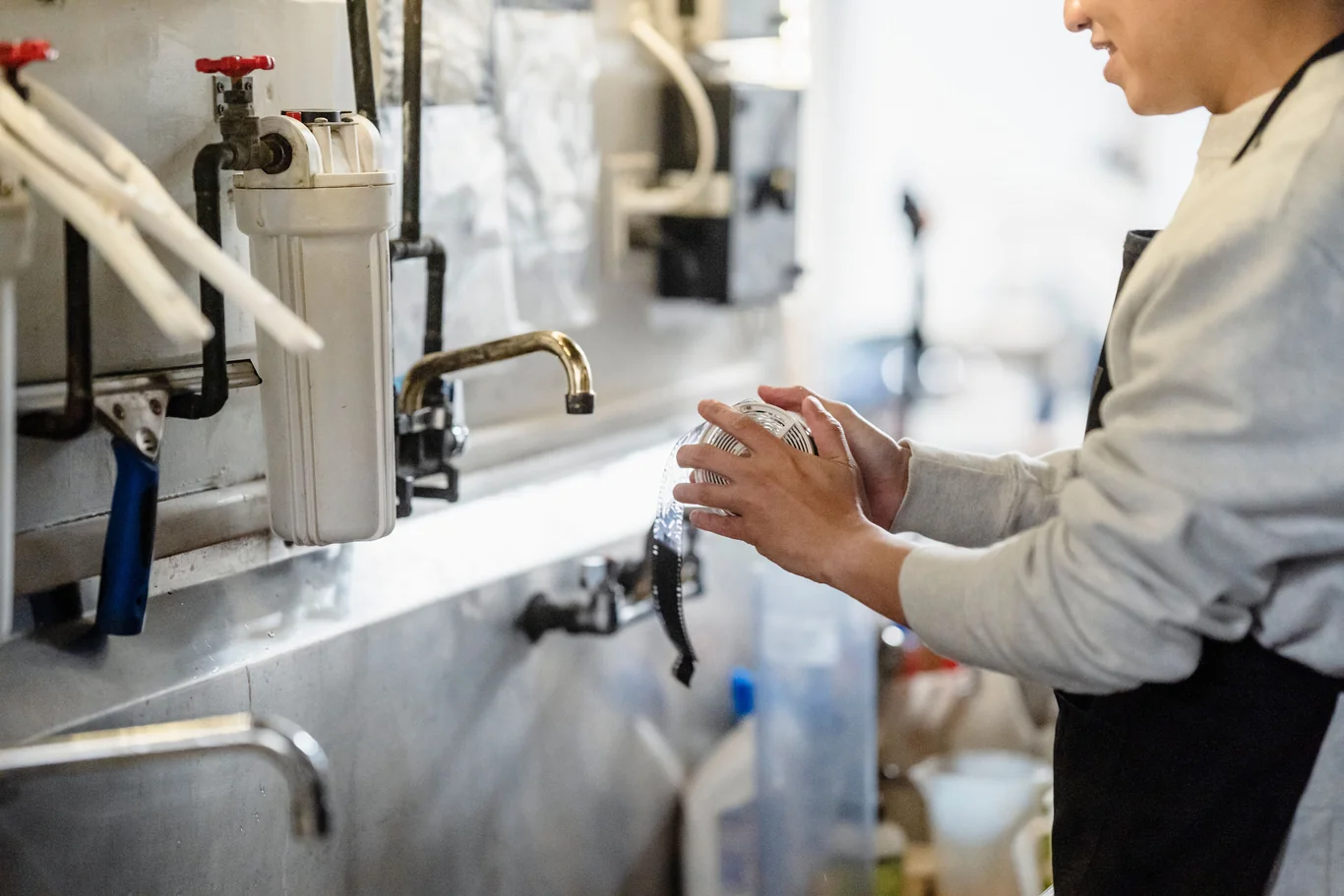
A working reverse osmosis system moves water through three sequential stages. Water moves through those stages before it reaches your glass, not through the membrane alone. According to the EPA, pressure forces water across a semi-permeable membrane. This creates two separate streams. One is a purified permeate stream, the treated water that passes through. The other is a concentrated reject stream, the leftover water carrying the filtered-out solids.
- Pre-filtration: water first passes through a sediment filter that strains out rust, sand, and dirt. Then it usually passes through a carbon filter. That filter pulls out chlorine and organic compounds that would otherwise damage the membrane.
- Membrane stage: a pump raises the water to about 40 to 80 psi. That is pounds per square inch. That pressure pushes it against a semi-permeable membrane. The membrane’s pores measure roughly 0.0001 microns. That is small enough to block dissolved salts, heavy metals, and most microorganisms. It still lets water molecules through.
- Post-filtration and storage: the purified water, called permeate, passes through a final carbon filter. This removes any lingering taste or odor. It then collects in a small storage tank, while the concentrated reject stream drains away.
Reverse Osmosis Water vs. Distilled Water: What’s the Difference?
Both processes produce water with very low total dissolved solids (TDS). But they get there in completely different ways. Reverse osmosis pushes water through a membrane under pressure. Distillation boils water and re-condenses the steam instead. That process leaves contaminants behind in the boiling chamber.
The mechanism gap shows up mainly in speed and energy, not in the final result. Distillation needs continuous heat to boil and re-condense water. That makes it slower and more energy-intensive per gallon. Reverse osmosis relies on pressure alone instead, and it runs continuously once installed. Both methods typically bring dissolved solids down to a similarly low level. That is why the two taste and perform almost identically, despite their different processes.
Here is how the two methods compare across the details that matter most:
| Feature | Reverse Osmosis | Distillation |
| Mechanism | Pressure forces water through a semi-permeable membrane | Water is boiled, then the steam is condensed back into liquid |
| Energy use | Low, typically needs only water pressure or a small pump | High, requires continuous heating to the boiling point |
| Speed | Continuous flow once the system is running | Slow, produces water one batch at a time |
| Minerals removed | Most dissolved minerals, salts, and metals | Nearly all dissolved minerals and metals |
| Typical install cost | Budget to mid-range for under-sink units | Mid-range for countertop units, higher for large-capacity models |
Benefits of Reverse Osmosis Water and Whether It Is Safe to Drink Daily
What is reverse osmosis actually removing from your water? The honest answer is a wide range of contaminants at once, not just one or two. That is what separates it from a basic pitcher filter.
- Broad contaminant reduction: field testing of real household systems found under-sink reverse osmosis units. They achieved near-complete removal of per- and polyfluoroalkyl substances (PFAS). These are persistent chemicals that resist breaking down in the environment. That compares with just 60 to 70 percent removal for standard carbon filters alone.
- Improved taste and odor: stripping dissolved solids and chlorine byproducts leaves water with a cleaner, more neutral taste. That is a real improvement over untreated tap water.
- No added chemicals: the process is purely physical. It filters water through pressure and a membrane, instead of dosing it with disinfectants or softening agents.
- Consistent output: once installed, an RO system treats every gallon the same way. That avoids the day-to-day variability of a pitcher filter, which weakens as its cartridge fills up.
Drinking reverse osmosis water every day is generally considered safe for most people. The mineral-loss concern is mostly about taste, rather than a measurable health risk. That is because you likely get most of your dietary minerals from food. This includes calcium, magnesium, and others. Tap water contributes relatively little by comparison.
Does Reverse Osmosis Remove Minerals From Water?
The same membrane blocks contaminants of all kinds. It cannot tell the difference between a dissolved lead ion and a dissolved calcium ion. That is why reverse osmosis strips out beneficial minerals, including calcium, magnesium, and potassium. Those go right alongside anything harmful. That is the main trade-off of the process. Broad protection against contaminants comes at a cost. That cost is the minerals that give tap water its flavor.
Losing those minerals changes taste more than it changes health outcomes for most people. That is because minerals from food and other beverages make up the majority of daily intake. Manufacturers address the flavor issue with a remineralization stage, an optional cartridge added after the membrane. It redissolves calcium and magnesium back into the water. NSF/ANSI 58 is the standard that governs point-of-use reverse osmosis systems. It recognizes remineralization as an optional post-treatment add-on, not a required part of the system.
Common fixes include inline mineral cartridges. Other options are alkaline filters that raise pH, or a mineral supplement made for drinking water. Each option restores some mouthfeel, without reintroducing the contaminants the membrane removed.
The iSpring RCC7AK builds one of those alkaline options into the system as its sixth stage; my iSpring RCC7AK alkaline review covers how that stage performs alongside the NSF/ANSI 58 certified membrane.
How Much Does a Reverse Osmosis System Cost to Install?
Total cost depends heavily on which type of system you choose. It also depends on how much plumbing work your installation involves. Countertop units need no tools at all. They connect directly to a faucet. You can typically set one up yourself in a few minutes. A faucet-mount filter is the most compact version: it screws onto the aerator thread directly and adds carbon filtration without a separate housing.
Under-sink systems sit in the middle of the range. Many people handle a basic under-sink install as a weekend DIY project. A setup that ties into existing plumbing, or needs a new faucet hole, is different. That kind of job is usually worth hiring a licensed plumber for. It comes with a moderate one-time labor cost.
Whole-house systems sit at the premium end of the range. They treat water at the point it enters your home. That typically calls for professional installation, permitting in some areas, and periodic servicing. Most buyers end up thinking in three tiers: budget countertop, mid-range under-sink, and premium whole-house. The right choice depends more on how much water you need treated than on cost alone.
How We Research
We check every claim against primary sources. Federal agencies like the EPA and CDC come first. Certification bodies like NSF and AHAM come next. We verify each standard number against the issuing body. We review this guide on a set schedule.
Why Trust This Guide
Puritisimo covers only water and air quality. Our guidance is editorial and independent. We cite every health figure so you can check it. We never present a promotional claim as fact.
Deciding If Reverse Osmosis Is Right for Your Water
Deciding whether reverse osmosis is worth installing comes down to what is already in your tap water. It also depends on how much you value consistency over convenience. A whole-house or under-sink unit tends to pay off fastest in one case. That is when a water test shows high TDS, PFAS, or lead readings.
Households with cleaner municipal supplies may see reverse osmosis differently. To them, it can be more of a taste and peace-of-mind upgrade than a necessity. Either way, pairing the membrane with a remineralization stage addresses the one real trade-off: mineral loss. That happens without giving up the contaminant reduction that makes the process worthwhile. Once you understand what reverse osmosis is and how it fits your specific water, the choice gets easier. It usually settles itself.
Frequently Asked Questions
What is reverse osmosis in simple words?
Reverse osmosis is a water treatment process that uses pressure to push water through a membrane. That membrane is fine enough to block nearly everything except water molecules. The result is water stripped of dissolved salts, metals, and other contaminants. It is ready to drink straight from the tap or a dedicated faucet.
Why is it called reverse osmosis?
Plain osmosis happens naturally. It moves water toward the side with more dissolved particles until concentrations even out. Reverse osmosis runs that process backward: applied pressure forces water from the concentrated side toward the diluted side. That goes against its natural direction. That is where the name comes from.
What is the downside of reverse osmosis?
The biggest downside is water waste. Older systems could send three to four gallons down the drain for every gallon of treated water. Modern permeate-pump designs bring that closer to one-to-one. The process also strips beneficial minerals along with contaminants. That is an effect the remineralization stage covered above can offset.
Is distilled water the same as reverse osmosis?
No. Reverse osmosis pushes water through a pressurized membrane. Distillation boils water and condenses the steam instead, relying on a completely different mechanism. Both typically bring dissolved solids down to a similarly low level. That is why the two taste and perform almost identically, despite their different processes.
Is it healthy to drink reverse osmosis water?
Yes, drinking reverse osmosis water daily is generally considered safe for most people. The mineral-loss concern is mostly about taste, not a documented health risk. That is because most people get the bulk of their dietary minerals from food and other beverages. Water itself contributes relatively little.
References
- EPA WaterSense. Point-of-Use Reverse Osmosis Systems. U.S. Environmental Protection Agency. 2024.
- ES&T Letters. Point-of-Use and Point-of-Entry Water Treatment for PFAS Removal in U.S. Households. American Chemical Society. 2020.
- NSF International. Standards for Water Treatment Systems (NSF/ANSI 58). 2024.
Medical Disclaimer: This content is for informational purposes only. It is not a substitute for professional medical advice, diagnosis, or treatment. If you have concerns about your water quality or air quality and their effects on your health, consult a qualified healthcare professional.