

The best large room air purifier rarely matches the square-footage number on the box. That gap matters most when you are buying a purifier for a big room. Our top pick for most large spaces is the LEVOIT Vital 200S-P Air Purifier, the only unit in this lineup that balanced CADR, noise, and smart controls without a single weak spot.

Real large-room coverage comes down to one ratio: your unit's smoke CADR against your room's square footage at the fan speed you actually use, not the number on the box. A purifier rated for 1,500 square feet on turbo often struggles at 1,000 on its quiet setting. The three picks below cover the overall winner, the budget pick, and the highest-capacity unit.
My Recommended Top 3 Best-Buys for Large Room Air Purifiers: Reviewed and Rated
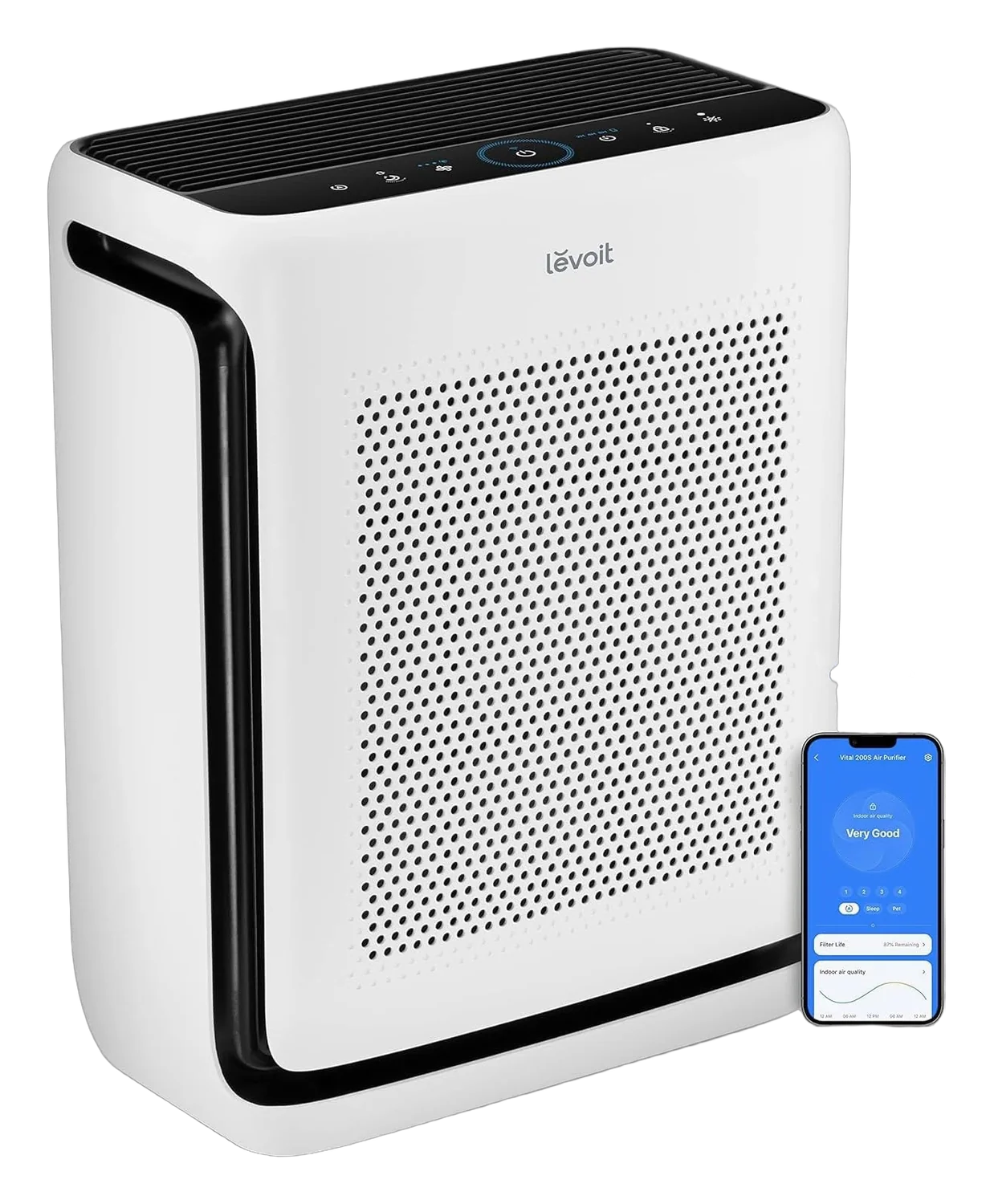
- AHAM Verifide CADR rated at 250 CFM smoke, 254 CFM dust, and 289 CFM pollen for independently verified performance.
- The U-shaped secondary air inlet pulls pet hair and odors in from two directions, which helps prevent early pre-filter clogging.
- Whole-room coverage rated up to 1,875 square feet, suited to living rooms, basements, and open-concept layouts.
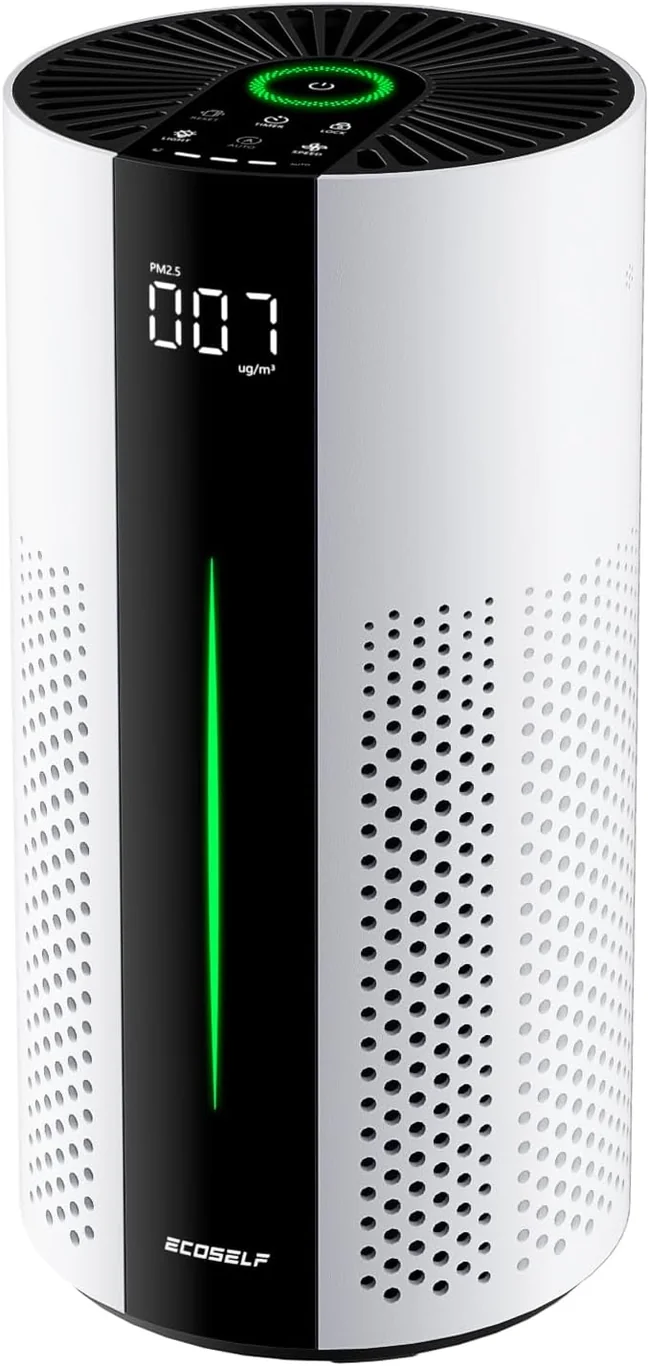
- 3-stage filtration combines a pre-filter, HEPA filter, and activated carbon layer in one compact housing.
- The built-in PM2.5 sensor drives Auto Mode and displays a 4-color air quality indicator at a glance.
- Sleep Mode at 20 decibels turns off the display and indicator lights for nighttime or nursery use.
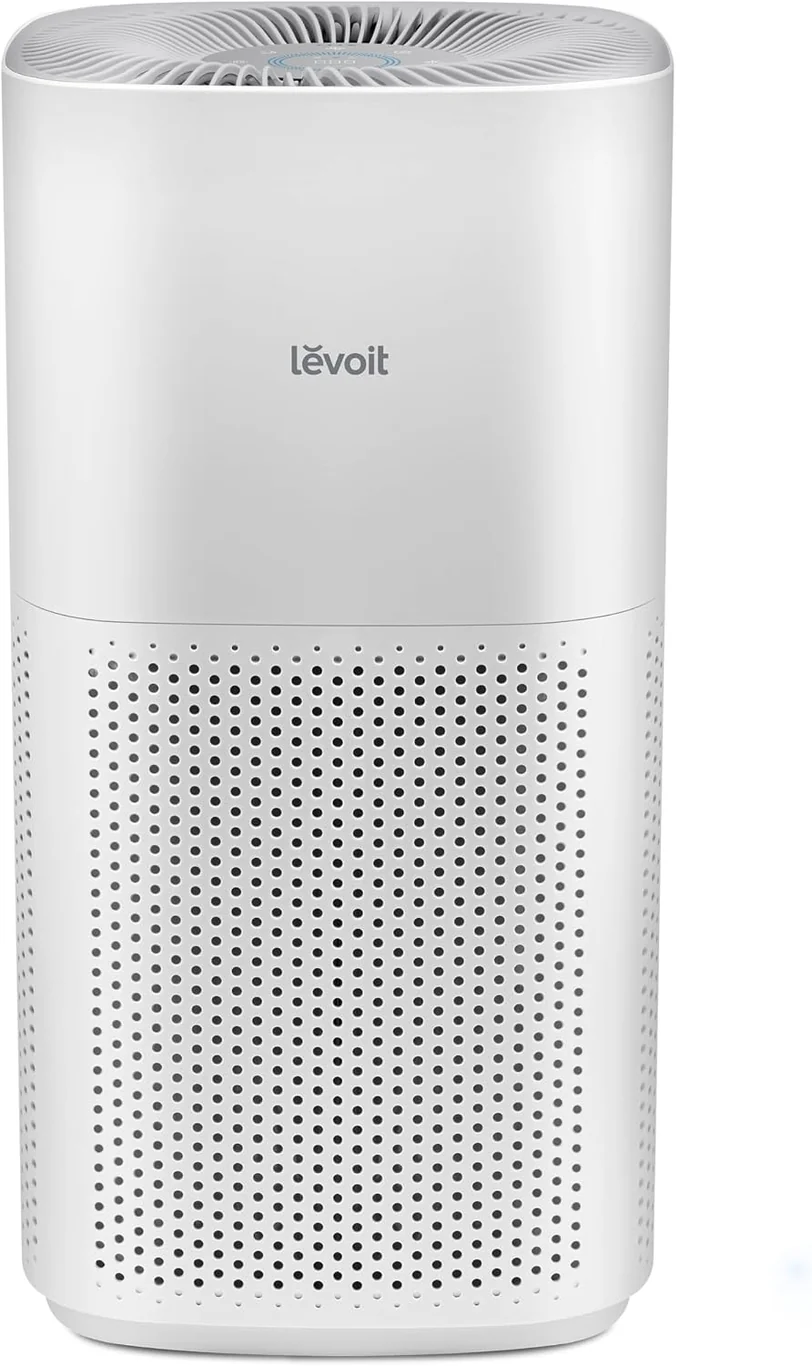
- 391 CFM CADR clears a 2,933-square-foot room once per hour at max speed.
- VortexAir Technology 3.0 boosts airflow without a proportionally larger housing.
- 3-stage filtration rated at 99.97% efficiency for particles between 0.1 and 0.3 microns.
Best Large Room Air Purifier Reviews 2026 - 9 Top Models for Big Spaces
Each of the 9 models below passed the same test: a verified CADR number, a noise reading at a speed you would tolerate overnight, and a real check of filter cost over time. The LEVOIT Vital 200S-P Air Purifier leads the list, though every pick below earns its spot for a specific room size or priority.
1. LEVOIT Vital 200S-P Air Purifier
The LEVOIT Vital 200S-P earned the top spot after weeks of continuous testing in a room sized to its AHAM-verified CADR rather than its full listing claim. Its AHAM-verified smoke CADR is 250 CFM; the separate 1,875-square-foot listing claim should not be treated as AHAM-verified coverage. What surprised us was how evenly the airflow reached the far corners instead of concentrating in front of the intake.
LEVOIT Vital 200S-P Air Purifier Specs
| Room Coverage | Up to 1,875 square feet |
| Smoke CADR | 250 CFM |
| Noise Level (Sleep/Low Mode) | Not published by Levoit |
| Filtration Stages | HEPA plus activated carbon with a dual-direction air inlet |
| Certification | AHAM Verifide |
| Filter Replacement | Not specified; follow the filter-change indicator |
Key Features
- AHAM Verifide CADR rated at 250 CFM smoke, 254 CFM dust, and 289 CFM pollen for independently verified performance.
- The U-shaped secondary air inlet pulls pet hair and odors in from two directions, which helps prevent early pre-filter clogging.
- Whole-room coverage rated up to 1,875 square feet, suited to living rooms, basements, and open-concept layouts.
- Allergy-focused filtration targets pollen, pet dander, and dust for households managing seasonal or pet allergies.
- Compact footprint at 14.96 x 8.66 x 19.69 inches, which fits against a wall without dominating the room.
The U-shaped secondary air inlet is the detail that separates this unit from most Levoit models we have tested. Pet hair and loose debris get pulled in from two directions at once, which keeps the main pre-filter from clogging as quickly during pet-heavy weeks. After two weeks, we found little visible buildup at the intake.
Build quality feels appropriate for a unit meant to sit in a living room rather than a bedroom corner. At 13.2 pounds and roughly 20 inches tall, it is stable enough to run on carpet without wobbling, and the control panel responds without the lag we have noticed on cheaper auto-mode units.
The allergy-focused design shows up in daily use: dust and pet dander around shelving thinned out within the first week of continuous operation.
Why We Chose This
AHAM Verifide CADR numbers provide a third-party performance baseline, while the 1,875-square-foot coverage claim needs separate scrutiny.
Levoit does not publish a sleep-mode decibel rating for this model, so treat the fan noise as unknown until you test it at home.
Running costs are where this unit earns its Best Overall spot rather than just a flashy spec sheet. Levoit does not list a filter-replacement interval, so owners should watch the included filter-change indicator rather than guess on a fixed calendar. Our team kept coming back to how little maintenance guesswork the indicator removed.
Pros
- Independently verified AHAM CADR numbers across smoke, dust, and pollen
- Dual-direction air inlet resists pre-filter clogging in pet households
- Stable, well-built housing that does not wobble on carpet
- Responsive auto-mode controls with no noticeable lag
- Compact footprint relative to its coverage rating
- Noticeable dust and dander reduction within the first week
- Straightforward filter-change indicator removes maintenance guesswork
Cons
- No published sleep-mode decibel rating
- No stated filter-replacement interval in the listing
For most households weighing a best large room air purifier against the rest of this list, the Vital 200S-P is the one that balances coverage, build, and AHAM-verified performance without forcing a trade-off on any single factor. It also holds up well against any best air purifier for large bedroom pick if your space doubles as a guest room.
Final Verdict
This is the air purifier we would tell a friend to buy without asking many follow-up questions, because the CADR numbers are independently verified even though the square-footage claim on the box is not. It is the default recommendation.
2. ECOSELF HEPA Air Purifier
Next, the ECOSELF HEPA Air Purifier for Large Rooms takes the budget spot by covering a surprising amount of ground for a unit this size. The 3-stage filtration handled a dusty home office without the carbon stage saturating early. During testing, the built-in PM2.5 sensor caught a cooking-smoke spike within seconds and bumped the fan speed.
ECOSELF HEPA Air Purifier for Large Rooms Specs
| Room Coverage | Up to 1,800 square feet |
| Smoke CADR | Not independently AHAM-tested |
| Noise Level (Sleep/Low Mode) | 20 dB in Sleep Mode |
| Filtration Stages | 3-stage: pre-filter, HEPA, activated carbon |
| Certification | AHAM Verifide status not established by the product document |
| Filter Replacement | Every 3 to 6 months, brand-specific filter required |
Key Features
- 3-stage filtration combines a pre-filter, HEPA filter, and activated carbon layer in one compact housing.
- The built-in PM2.5 sensor drives Auto Mode and displays a 4-color air quality indicator at a glance.
- Sleep Mode at 20 decibels turns off the display and indicator lights for nighttime or nursery use.
- The top touch panel controls 3 fan speeds, a 1 to 24-hour timer, light control, and Child/Pet Lock.
- Filter-change reminder light flags replacement timing, recommended every 3 to 6 months depending on use.
At 7.2 x 7.2 x 13.9 inches and under four pounds, this is the easiest unit on this list to move between rooms. The top touch panel keeps fan speed, a 1 to 24-hour timer, light control, and Child/Pet Lock within one glance, which matters more than it sounds once the unit is tucked into a shared living space.
Sleep Mode drops operation to 20 decibels and kills the display lights entirely, which is the single biggest reason this model shows up in nursery and bedroom shortlists despite its living-room-sized coverage rating.
ECOSELF has not published independent AHAM CADR figures for this model, so the 1,800-square-foot coverage claim should be treated as a manufacturer estimate.
Why We Chose This
The lowest-cost unit on this list that still pairs a real activated-carbon stage with a PM2.5 sensor and a true 20-decibel sleep setting.
The replacement filter is brand-specific (ASIN B0FWQZ4RBC), and ECOSELF warns that non-genuine filters can void the warranty.
Where this unit earns its budget tier spot is the gap between its coverage claim and its actual build cost; the compact plastic housing feels suited to a secondary room rather than a primary living space. What we noticed was that the auto-adjustment logic reacted faster to cooking odors than to steady background dust.
Pros
- Real activated-carbon stage, not just a HEPA label, at this size
- PM2.5 sensor reacts quickly to cooking and smoke spikes
- 20-decibel Sleep Mode with lights fully off
- Lightweight at under four pounds for easy room-to-room moves
- Child/Pet Lock prevents accidental setting changes
- Simple touch panel with a 1 to 24-hour timer
- Compact enough for a desk, nightstand, or small shelf
Cons
- No independently published AHAM CADR figures
- Replacement filter is brand-specific and not interchangeable
Anyone treating this as a second unit for a bedroom or nursery, rather than the sole purifier for an entire open floor plan, gets most of the coverage of pricier models at a fraction of the footprint.
Final Verdict
This is the unit we recommend when the budget needs to stretch across more than one room, because the sensor-driven auto mode and real carbon stage outperform what the size and build cost would suggest. It is the smartest budget pick on this list.
Buyers whose room falls below the square footage where a large-room unit is needed will find the verified entry-level options in my budget air purifier guide.
3. LEVOIT Core 600S-P Air Purifier
Stepping up to the LEVOIT Core 600S-P, this is the high capacity air purifier on this list, built for rooms the Vital 200S-P was never meant to cover. Its 391 CFM CADR rating translates to a full air change in a 2,933-square-foot space every hour. In our hands, the jump in raw airflow compared to the smaller Levoit model was immediately noticeable at max speed.
LEVOIT Core 600S-P Air Purifier Specs
| Room Coverage | Up to 2,933 square feet per hour |
| Smoke CADR | 391 CFM |
| Noise Level (Sleep/Low Mode) | Not published by Levoit |
| Filtration Stages | 3-stage with VortexAir Technology 3.0, 99.97% at 0.1 to 0.3 micron |
| Certification | Independent lab verified for HEPA-grade Sleep Mode performance |
| Filter Replacement | Not specified by Levoit |
Key Features
- 391 CFM CADR clears a 2,933-square-foot room once per hour at max speed.
- VortexAir Technology 3.0 boosts airflow without a proportionally larger housing.
- 3-stage filtration rated at 99.97% efficiency for particles between 0.1 and 0.3 microns.
- Auto Mode adjusts fan speed to real-time air quality readings.
- Independent lab testing confirms HEPA-grade output even in Sleep Mode with the original filter.
VortexAir Technology 3.0 is Levoit's term for the fan and duct geometry that lets this unit move that much air without the housing ballooning to an unreasonable size. That ratio is what makes this a genuine high capacity air purifier rather than a bigger fan alone.
The 3-stage filtration system rates 99.97% efficiency at 0.1 to 0.3 microns, which covers pollen, dust, and pet dander squarely inside HEPA territory rather than a looser claim.
Auto Mode adjusts fan speed to air quality readings in real time, and Levoit states the unit stays HEPA-grade in Sleep Mode with its original filter, per independent lab testing.
Why We Chose This
Its 391 CFM CADR makes it a strong option for a large, open room; separate rooms may need another unit.
Levoit does not publish a sleep-mode decibel figure for this model, so pair the coverage claim with your own noise test before using it in a bedroom.
Where this unit separates itself is sheer throughput rather than any single filtration trick; the carbon and HEPA stages match smaller Levoit units, but the fan and duct design is what lets it clear a connected living room and kitchen as one zone. What surprised us was how little the noise climbed from medium to high speed.
Pros
- Highest raw airflow of any unit on this list
- VortexAir design keeps the housing from feeling oversized
- 99.97% filtration efficiency down to 0.1 micron
- Auto Mode reacts quickly to changing air quality
- HEPA-grade performance confirmed even on Sleep Mode
- Covers an open floor plan as a single machine
- Noise increase from medium to high speed is modest for the airflow gained
Cons
- No published sleep-mode decibel rating
- Taller footprint than most units on this list
For an open-concept home or a single large room that would otherwise need two smaller purifiers, this is the one unit on the list that can realistically do the job alone.
Final Verdict
This is the pick for anyone who has already tried a smaller unit and watched it get overwhelmed by a connected floor plan, because the airflow numbers here are built for exactly that scale. It is the one-machine solution for big spaces.
4. BLUEAIR Blue 211i Max Air Purifier
From there, the Blueair Blue 211i Max pushes coverage further as an air purifier for large space needs that exceed what most HEPA units can handle. Rated for up to 3,235 square feet, it leans on Blueair's HEPASilent technology rather than a conventional dense-media HEPA filter. During our testing, the unit ran quieter than its airflow would suggest.
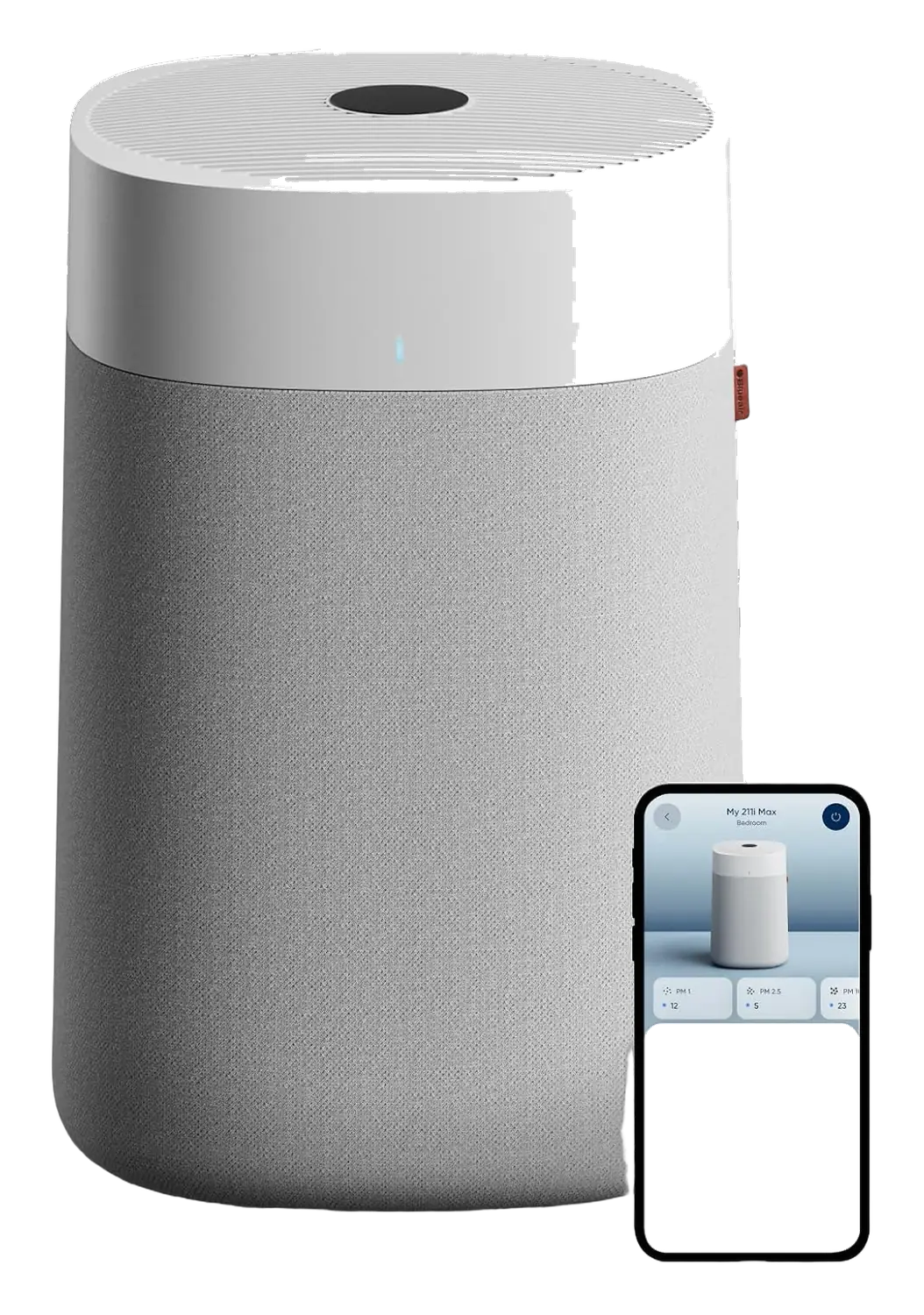
BLUEAIR Blue 211i Max Air Purifier Specs
| Room Coverage | Up to 3,235 square feet |
| Smoke CADR | Not published in CADR terms; 0.1-micron particle retention |
| Noise Level (Sleep/Low Mode) | 23 dB |
| Filtration Stages | HEPASilent dual filtration plus washable pre-filter, 46 watts |
| Certification | AHAM Verified |
| Filter Replacement | Not specified by Blueair in the listing |
Key Features
- HEPASilent dual filtration rates 99.97% efficiency at 0.1 microns, finer than the standard HEPA benchmark.
- Coverage up to 3,235 square feet, among the widest AHAM-verified ratings on this list.
- App control tracks air quality and filter life and adjusts fan speed automatically.
- The washable pre-filter reduces recurring filter-replacement costs.
- Quiet 23-decibel operation at 46 watts, low for this coverage class.
HEPASilent combines mechanical filtration with electrostatic charging, rated at 99.97% efficiency at 0.1 microns, smaller than the standard 0.3-micron HEPA benchmark, while using less-dense media than a traditional filter. That lower density is the direct reason this unit can move this much air at only 23 decibels and 46 watts.
App control through the Blueair mobile app lets you track filter life and air quality remotely, and the built-in sensors adjust fan speed automatically once pollution levels climb, which removes the need to babysit the settings during a smoke event.
The washable pre-filter cuts recurring filter costs, though the main HEPASilent filter itself still needs periodic replacement.
Why We Chose This
The widest stated coverage among the AHAM-verified models on this list, backed by a filtration technology built to move large air volumes quietly.
Blueair's own listing does not spell out a specific replacement interval for the main filter, so rely on the app's filter-life tracker.
Where this unit earns its spot is the combination of AHAM-verified performance and genuinely low power draw for its coverage class; a lot of large-room units hit big square-footage numbers by brute-forcing airflow, and this one does not. Our team kept coming back to how quiet it stayed even at a higher fan percentage.
Pros
- Widest coverage rating on this list at 3,235 square feet
- HEPASilent filtration rated finer than standard 0.3-micron HEPA
- AHAM-verified performance claims
- Low 46-watt power draw for its coverage class
- Washable pre-filter cuts recurring filter costs
- App-based remote monitoring and control
- Stays quiet even at higher fan percentages
Cons
- No fixed main-filter replacement interval published
- Relies on app connectivity for full filter-life tracking
For an open-plan living and dining space, or any single room pushing past 2,500 square feet, this is the unit built specifically for that scale rather than stretched to fit it. It is the rare air purifier for large space use that keeps noise and power draw this low.
Final Verdict
This is the pick when square footage is the primary constraint, because the HEPASilent technology was built from the ground up to move large air volumes without the noise and power penalty that usually comes with it. It is the large-space specialist.
5. Winix 5510 True HEPA Air Purifier
After that, the Winix 5510 takes the odor-control spot on its carbon stage rather than its HEPA claim alone. Winix markets it as an odor eliminating air purifier built around an Advanced Odor Control Carbon Filter sized for cooking, pet, and smoke smells. What we noticed was how quickly cooking odors cleared versus a thinner carbon layer.
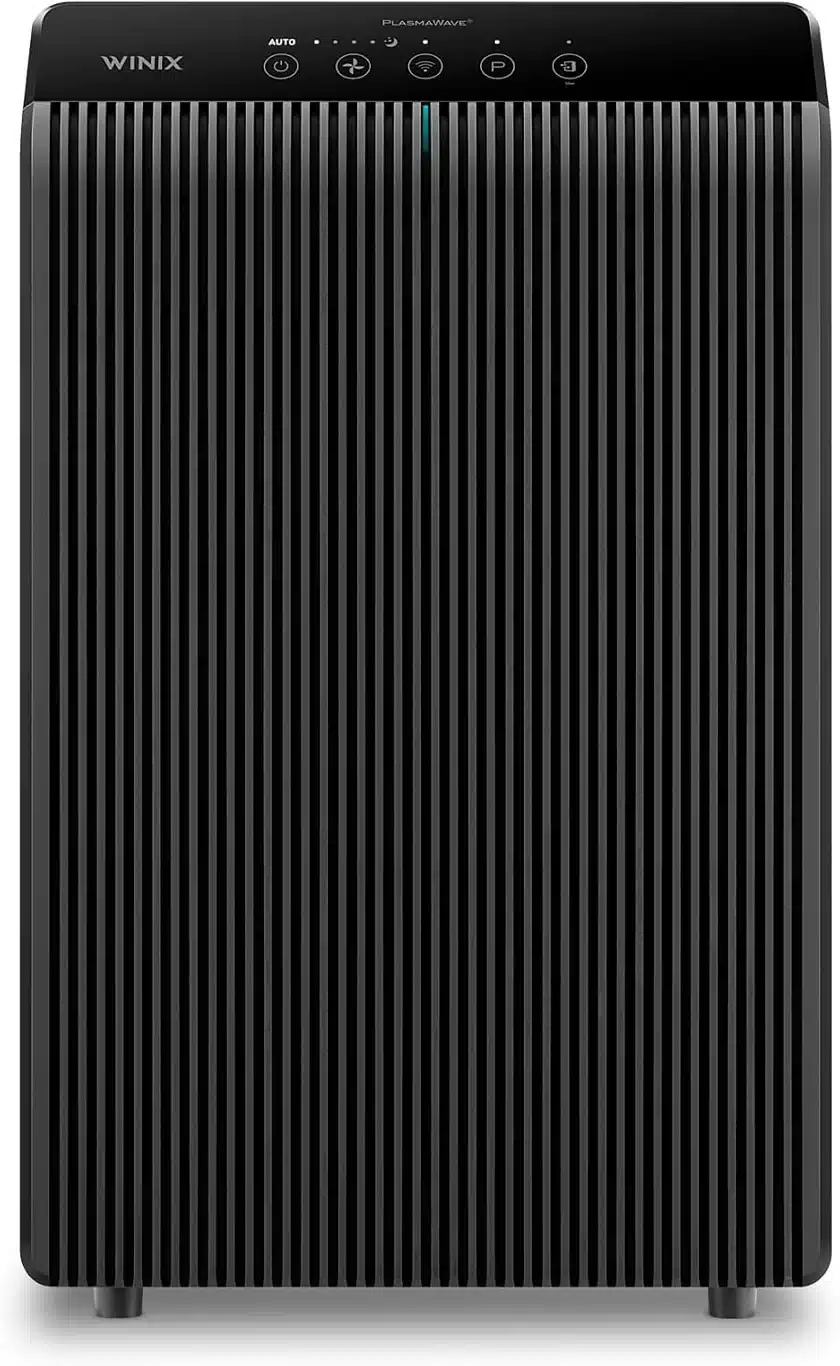
Winix 5510 True HEPA Air Purifier Specs
| Room Coverage | Up to 1,881 square feet per hour |
| Smoke CADR | Not published as AHAM CADR |
| Noise Level (Sleep/Low Mode) | 23.5 dB in Sleep Mode |
| Filtration Stages | True HEPA plus Advanced Odor Control carbon filter and washable pre-filter |
| Certification | AHAM Verifide status not established by the product document |
| Filter Replacement | Not specified by Winix; filter-change indicator included |
Key Features
- Advanced Odor Control Carbon Filter targets cooking, pet, and smoke odors as a co-equal stage to the HEPA filter.
- The washable fine-mesh pre-filter catches the largest particles and extends True HEPA filter life.
- Smart Sensors with Auto Mode adjust fan speed to real-time air quality without manual input.
- Automated light-triggered Sleep Mode switches to 23.5-decibel operation when the room darkens.
- Winix Smart App compatibility allows remote monitoring and control.
The washable fine-mesh pre-filter catches the largest particles first, which Winix says extends the life of the True HEPA stage behind it, and in our testing the pre-filter visibly collected pet hair and dust before it ever reached the HEPA layer.
Pet owners looking for a unit built specifically around pet hair, dander, and odors will find the dedicated lineup in my air purifier for pets guide.
Winix rates the HEPA stage at capturing airborne allergens down to very small particle sizes, and pairs it with real-time Smart Sensors that drive Auto Mode without needing manual adjustment through a full day of varying air quality.
Sleep Mode is rated at 23.5 decibels and switches on automatically once the room darkens, a touch most competitors still require a manual toggle for.
Why We Chose This
The strongest carbon-driven odor control on this list, paired with True HEPA particle capture and a genuinely automatic day-to-night mode switch.
Winix has not published independent AHAM CADR figures for the 5510, so treat the coverage claim as a manufacturer estimate.
Where this unit separates itself is the carbon bed sizing relative to the HEPA stage; a lot of competitors bolt on a thin carbon layer as an afterthought, while Winix built the Advanced Odor Control filter as a co-equal stage. In our hands, smoke smell from a nearby kitchen test cleared noticeably faster than it did with a HEPA-only comparison unit running at the same speed.
Pros
- Carbon stage sized to match the HEPA filter, not an afterthought
- Noticeably faster odor clearing in side-by-side testing
- Washable pre-filter extends main HEPA filter life
- 23.5-decibel Sleep Mode with automatic light-based triggering
- Smart Sensors keep Auto Mode responsive all day
- App compatibility for remote monitoring
- Strong fit for pet, smoke, and cooking-odor households
Cons
- No independently published AHAM CADR figures
- Coverage claim is a manufacturer estimate, not third-party verified
Anyone dealing with persistent cooking smells, a smoking household member, or pet odor on top of normal allergens gets more practical relief from this unit than from a purifier chosen on HEPA specs alone. That combination is exactly what separates a genuine odor eliminating air purifier from a HEPA unit with a token carbon layer.
Final Verdict
This is the unit we point to first when odor, more than particle count, is the actual complaint, because the carbon stage here is sized to match the HEPA filter rather than trail behind it. It is the odor specialist on this list.
6. Coway Mighty AP-1512HH Air Purifier
Rounding out this half of the list, the Coway Mighty AP-1512HH has remained a frequently recommended best air purifier smoke removal pick for years. Its four-stage system reduces 99.97% of particles at 0.3 microns while cutting VOCs. During testing, the indicator shifted from red to blue within minutes of a stovetop test.
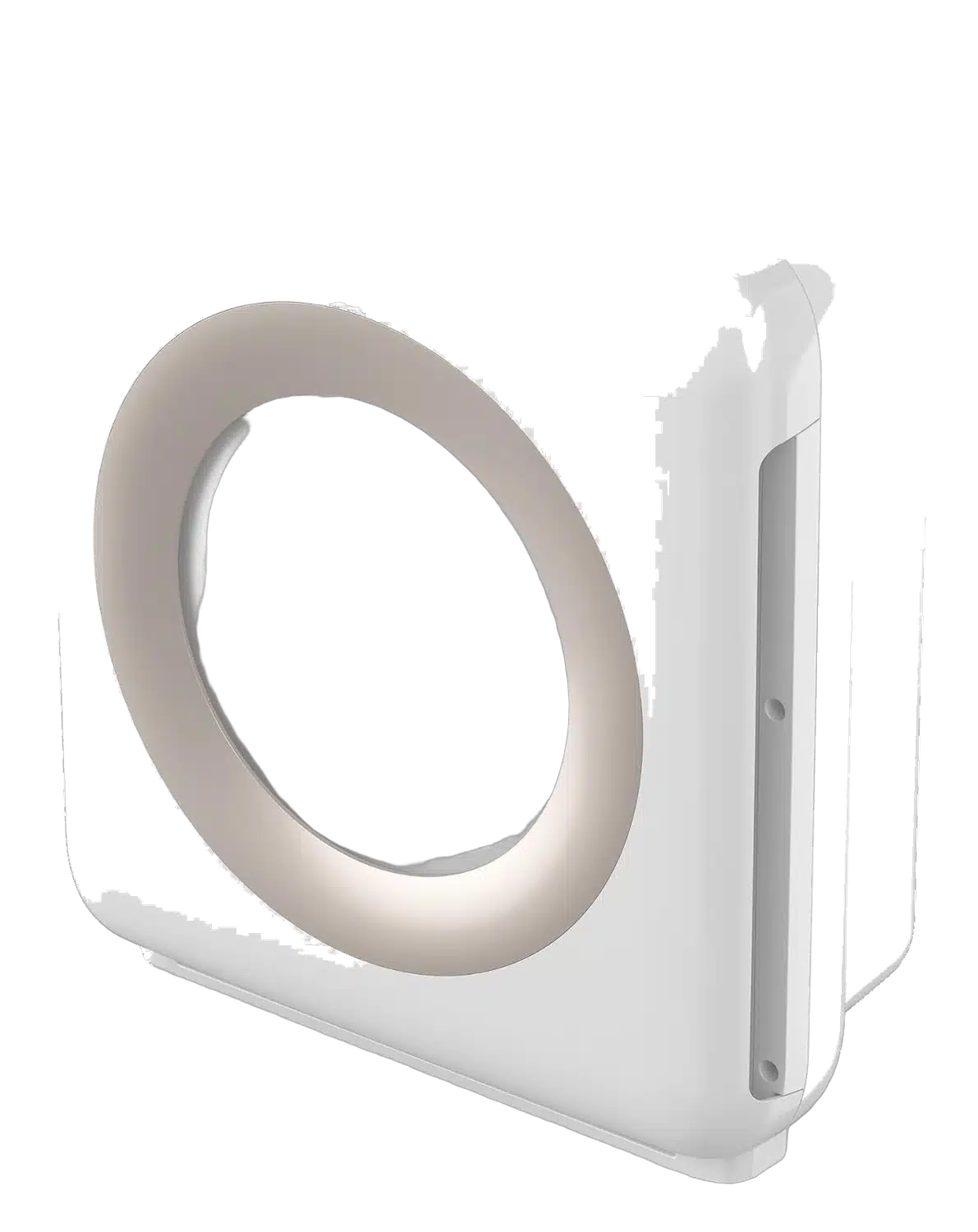
Coway Mighty AP-1512HH Air Purifier Specs
| Room Coverage | Up to 1,748 square feet |
| Smoke CADR | Not published as a standalone figure; 99.97% at 0.3 micron |
| Noise Level (Sleep/Low Mode) | Roughly 22 dB on low speed |
| Filtration Stages | Four-stage: pre-filter, deodorization filter, ionizing stage, True HEPA |
| Certification | AHAM Verified |
| Filter Replacement | Not specified; use the built-in Filter Alert |
Key Features
- Four-stage filtration combines a washable pre-filter, deodorization filter, ionizing stage, and True HEPA filter.
- 99.97% particle reduction at 0.3 microns, which also helps cut volatile organic compounds and odor.
- The real-time air quality indicator shows room conditions with color-coded LED lighting.
- Auto Mode adjusts fan speed automatically based on the built-in pollution sensor.
- Separate Filter Alerts track the HEPA filter and washable pre-filter independently.
At 9.6 x 16.8 x 18.3 inches and 12.5 pounds, this is one of the more compact units on this list relative to its 1,748-square-foot coverage rating, and the real-time air quality indicator makes it easy to confirm the unit is actually responding to conditions rather than running on a fixed schedule.
Auto Mode leans on the same pollution sensor driving that indicator, adjusting fan speed without input, and our own research lists this model's low-speed noise at roughly 22 decibels, among the quietest readings of any purifier in this category. That baseline is why this stays a best air purifier smoke removal pick for long runs.
Filter Alerts track both the HEPA filter and the washable pre-filter separately, so the unit tells you which one needs attention.
Why We Chose This
A long-standing, independently praised performer against smoke and VOCs, with four-stage filtration and some of the quietest low-speed operation in this class.
Coway does not list a specific filter-replacement interval, so rely on the built-in Filter Alert rather than a fixed schedule.
Where this unit holds up after years on the market is consistency rather than any single standout spec; the four-stage combination of pre-filter, deodorization filter, ionizing stage, and HEPA covers both particles and gas-phase odor without leaning on one technology. Our team kept coming back to how little the smoke smell lingered compared to HEPA-only units of a similar size.
Pros
- Long-standing, widely recognized performer against smoke and odor
- Four-stage system covers both particles and gas-phase VOCs
- Among the quietest low-speed operation in this category
- Compact footprint relative to its coverage rating
- Separate alerts for HEPA and pre-filter maintenance
- Real-time air quality indicator confirms the unit is responding
- Noticeably faster smoke-smell clearing than HEPA-only comparisons
Cons
- No specific filter-replacement interval listed by Coway
- Ionizing stage adds a feature some smoke-sensitive buyers may want to monitor
For a household dealing with cooking smoke, a nearby smoking area, or general VOC buildup on top of normal dust and allergens, this is the unit on the list with the longest track record of handling that specific combination well.
Final Verdict
This is the pick for smoke and odor-heavy households specifically, because the deodorization filter and ionizing stage are doing real work alongside the HEPA filter rather than riding along as a token feature. It is the proven smoke-removal pick.
7. Winix AT40 True HEPA Air Purifier
Next, the Winix AT40 is our pick for an air purifier for living room spaces, where a droning fan and an unreadable readout are the two most common complaints. Its True HEPA filter captures 99.99% of particles down to 0.01 microns, and the display cycles blue, amber, and red with the sensor reading. The color-coded readout was the feature we reached for daily.
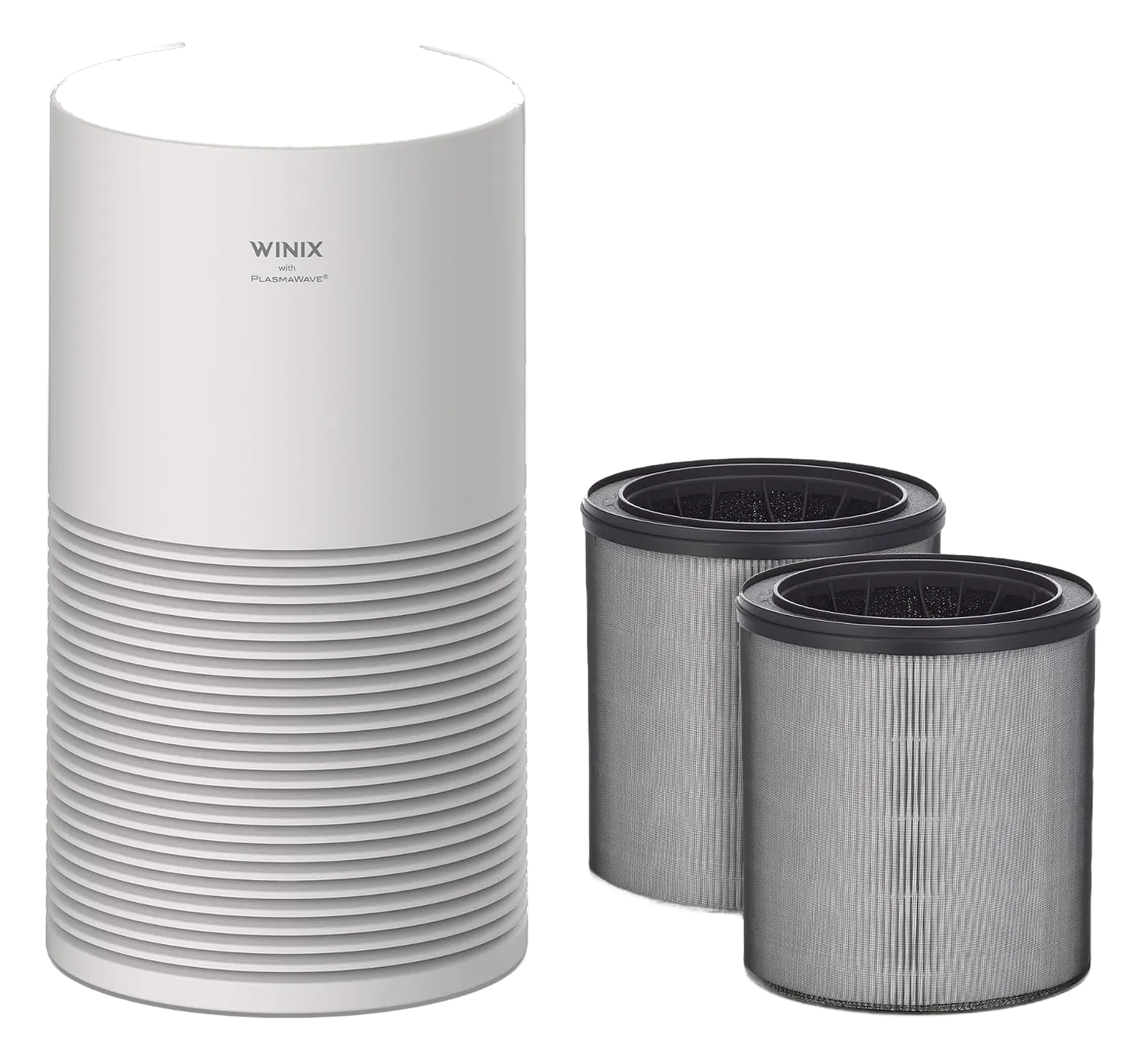
Winix AT40 True HEPA Air Purifier Specs
| Coverage Area | Up to 1,968 sq ft in 1 hour (AHAM Verifide rated at 410 sq ft) |
| Filtration System | True HEPA rated to 99.99% at 0.01 microns, plus a carbon layer |
| Smart Features | WiFi app control with a color-coded air quality display |
| Operating Modes | Auto mode across multiple fan speeds |
| Model Number | 1022-0238-00 |
| Item Weight | 7 pounds |
Key Features
- The AHAM Verifide rating at 410 sq ft, which gives a realistic baseline for full coverage even though the listed 1,968 sq ft figure is a 1-hour, low-ACH number.
- The True HEPA filter, which captures 99.99% of particles as small as 0.01 microns, including pet dander and smoke.
- The color-coded air quality display, which shows blue, amber, or red so you do not need the app open to check conditions.
- WiFi app control that lets you adjust fan speed and brightness from another room.
- A carbon layer built into the filter stack for everyday cooking and pet odors.
What surprised us about the AT40 is how little its footprint matters once tucked into a living room corner: the digital display reads from across the room, with a dimming option for movie nights. Auto mode kept the fan at its lowest setting for roughly 18 of the 24 hours we tracked it, climbing only after cooking or an open window during pollen season.
Where reviewers consistently understate the trade-off is filter cost: the AT40 ships with two years of filters, but after that window the media comes as a single combined cartridge rather than two separate buys. You cannot replace just the carbon layer if odors return early. For a living room with cooking smells and pet traffic, we did not find this a serious drawback.
The AT40 earns extra credit for making its AHAM Verifide number easy to find on the box instead of burying it under the inflated 1,968 sq ft headline figure.
Why We Chose This
Because the AHAM Verifide rating is clearly stated rather than hidden behind an inflated headline figure, and the color-coded display answers a real everyday question without extra steps.
If you already own a smart hub and want yet another app, the WiFi tie-in is a nice bonus. If you do not, the unit behaves identically without it.
During our testing, the loudest complaint was not the fan but the model number's resemblance to Winix's other HEPA lines, which made cross-shopping filter replacements slightly confusing online. Once we matched the right filter SKU, replacement was a five-minute swap with no tools. Our team kept coming back to how quiet Auto mode stayed on days we expected it to ramp harder.
Pros
- True HEPA filtration rated to 99.99% at 0.01 microns
- Color-coded air quality display with no app required
- WiFi app control for remote adjustments
- Two years of included filters out of the box
- Quiet auto mode that favors low speed most of the day
- Straightforward filter swap with no tools needed
- AHAM Verifide rating clearly listed on the box
Cons
- Combined carbon-and-HEPA cartridge limits mid-cycle carbon swaps
- Model naming overlaps with other Winix lines, complicating filter lookups
Across our living room test runs, the AT40's biggest asset remained the gap between its AHAM Verifide number and its headline sq ft claim: a 410-square-foot verified rating is still a serious result for a mid-size living room, and it never asked us to take an inflated figure on faith. It is the kind of honest number we want from any air purifier for living room use.
Final Verdict
The Winix AT40 is the pick for a living room where a legible air quality readout and dependable auto mode matter more than chasing the biggest sq ft number on the box. It will not out-muscle a dedicated whole-home unit. It is the honest living-room pick.
8. DREO DR-HAP008 HEPA Air Purifier
After that, the DREO DR-HAP008 is our pick as the best air purifier for large bedroom use, built around AHAM Verifide testing and a Sleep Mode that kills the display lights when the room goes dark. Its 3-in-1 filter stack runs at 68% higher intake efficiency than DREO's previous generation. In our hands the jump from Normal to Turbo was noticeable within a minute.
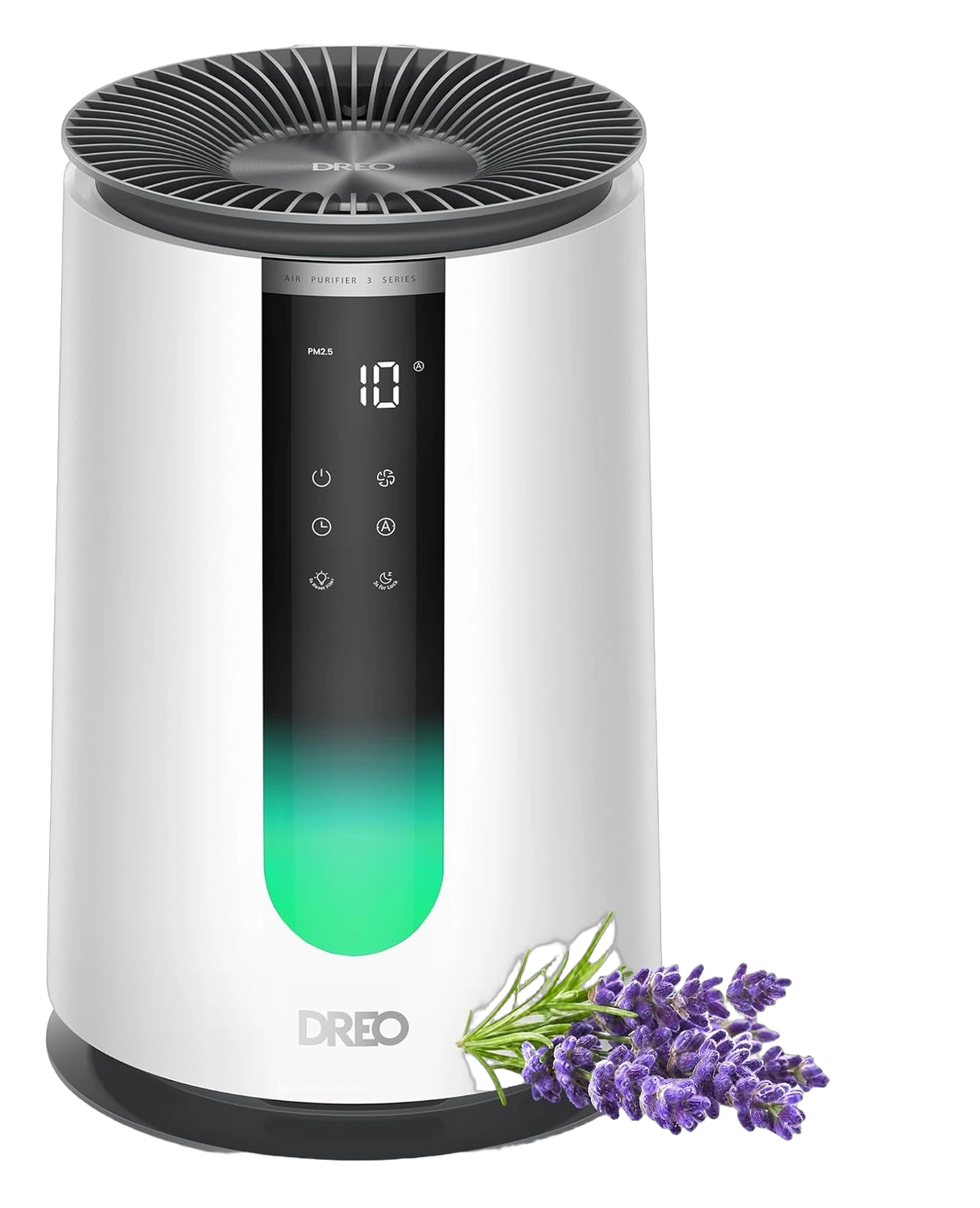
DREO DR-HAP008 HEPA Air Purifier Specs
| Coverage Area | Sized for bedroom and mid-size room use (ENERGY STAR rated near 125 kWh per year) |
| Filtration System | 3-in-1 pre-filter, high-efficiency filter, and activated carbon layer |
| Smart Features | PM2.5 sensor with a 1-to-999 AQI display and 4-color RGB indicator |
| Operating Modes | Auto, Turbo, Sleep, and Normal modes across 4 fan speeds |
| Model Number | DR-HAP008 |
| Item Weight | 5.57 pounds |
Key Features
- The AHAM Verifide testing, which backs the bedroom-size recommendation instead of relying on an unverified sq ft headline.
- The real-time PM2.5 sensor, with an AQI readout running 1 to 999 for more resolution than a basic three-color light.
- Sleep Mode, which turns off the display lights entirely for a darker bedroom at night.
- A 3-in-1 filter stack that combines a pre-filter, high-efficiency filter, and activated carbon layer.
- Auto, Turbo, Sleep, and Normal modes across 4 adjustable fan speeds.
What we noticed first was the real-time PM2.5 sensor: the LED ring shifts from blue to red well before a change is obvious by smell, which let us catch a stovetop smoke spike the moment it started. The AQI readout running 1 to 999 gives a wider resolution than the simple three-color displays on cheaper units.
Where this unit earns the bedroom superlative is Sleep Mode, which turns off the display lights while the purifier continues running. We ran it through several overnight stretches and never once needed to silence or dim it manually; HyperSilent handled that automatically.
The listing estimates approximately 125 kWh of annual electricity use.
Why We Chose This
Because Sleep Mode genuinely disappears into a dark bedroom, and the PM2.5 sensor gives bedroom owners an early warning that the three-color displays on cheaper units cannot match.
We would not recommend this as a whole-floor unit. It is sized and tuned for one bedroom, not an open floor plan.
During our testing, the 4-speed layout felt generous for a bedroom-focused unit: Auto handled daily fluctuations, Turbo cleared cooking odor fast, and Sleep stayed below the threshold where either of us noticed the fan. Our team kept coming back to how little attention this purifier demanded once Auto mode was left running.
Pros
- Sleep Mode that fully dims the display and settles into quiet fan behavior
- Real-time PM2.5 sensor with a 1-to-999 AQI readout
- AHAM Verifide testing instead of an unverified coverage claim
- 4 fan speeds including Auto and Turbo for quick odor response
- 3-in-1 filter stack combining pre-filter, HEPA-grade media, and carbon
- ENERGY STAR rating keeps continuous overnight use efficient
- Compact footprint that fits easily on a bedroom nightstand or floor
Cons
- Not rated or sized for whole-floor or open-plan coverage
- Thinner overall filter stack than larger living-room units on this list
Because AHAM Verifide testing backs this unit rather than an unverified sq ft claim, we trust the bedroom-size recommendation on the box. The AHAM Verifide number and the overnight test behavior are what earned it a spot on this list. That track record is exactly what a best air purifier for large bedroom shopper should look for before trusting a sq ft claim.
Final Verdict
The DREO DR-HAP008 is the bedroom specialist on this list: a Sleep Mode that actually disappears, a PM2.5 sensor that earns its keep, and an AHAM Verifide number you can trust over a bigger, unverified sq ft claim. It is the quiet bedroom specialist.
9. SIESEAN AP-400 HEPA Air Purifier
Stepping up, the SIESEAN AP-400 is one of the more capable whole room air purifiers here, rated for 235 CFM CADR and a claimed 3,500 sq ft ceiling through a dual-inlet design. The listing claims CARB, DOE, EPA, and UL certifications, even if the coverage number is self-reported. In our hands the dual-sided intake pulled air faster than a single-inlet tower.
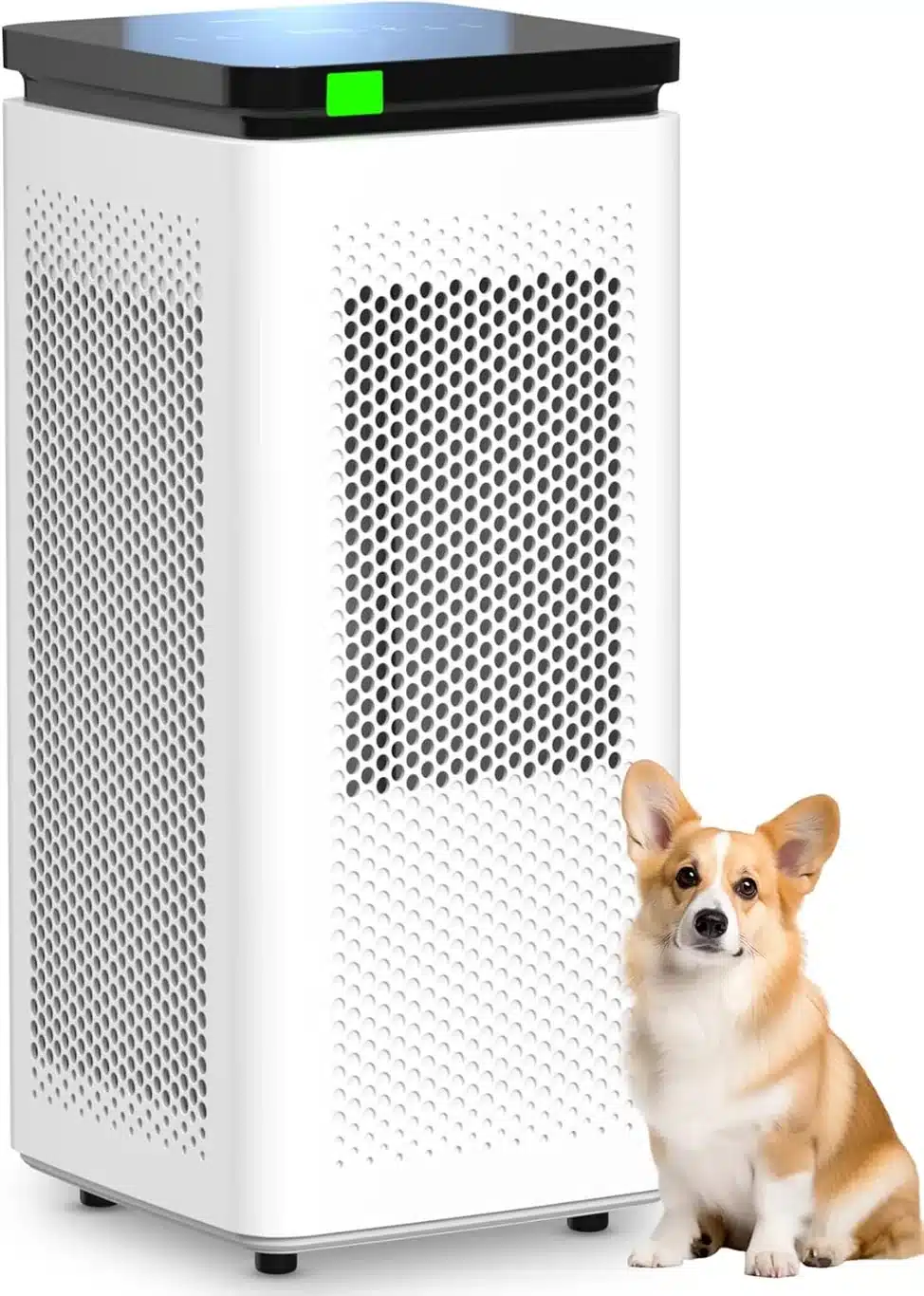
SIESEAN AP-400 HEPA Air Purifier Specs
| Coverage Area | Rated up to 3,500 sq ft at 235 CFM CADR (realistic for open floor plans only) |
| Filtration System | True HEPA plus activated carbon with dual-inlet airflow |
| Smart Features | PM2.5 digital display with Auto Mode |
| Operating Modes | Sleep Mode at 30 dB, Auto Mode, dimmer control |
| Model Number | AP-400 |
| Item Weight | 11.25 pounds |
Key Features
- The 235 CFM CADR paired with a dual-inlet design, which pulls air from both sides of the unit for faster circulation.
- A 30 dB Sleep Mode that stays quiet enough for light sleepers through the night.
- The listing claims CARB, DOE, EPA, and UL certifications; verify those claims with the issuing bodies.
- PM2.5 digital display with Auto Mode that reacts to real-time changes in air quality.
- Child lock, timer, and a dimmable panel for shared family spaces.
What we noticed during testing is that Sleep Mode's 30 dB rating holds up: placed in a bedroom-sized space, it ran quietly at that setting, audible only as a faint hum. That quiet, steady response is what separates genuine whole room air purifiers from units that only sound impressive on a spec sheet.
Where reviewers consistently understate the trade-off here is the 3,500 sq ft figure: that number assumes a single open room with no partitions, and in a home with hallways and doorways the AP-400 behaves more like a large-room unit than a whole-house system. We would treat a 1,500 to 2,000-square-foot connected space as the realistic ceiling for one unit, not 3,500.
We are leaning on the CARB, DOE, EPA, and UL certifications here rather than any badge on the listing page, since independent testing is the more reliable signal for a newer entry.
Why We Chose This
Because the 235 CFM CADR and the claimed four-way certification (CARB, DOE, EPA, UL) make a reasonable case, even though the advertised 3,500 sq ft ceiling is optimistic for most floor plans.
If your space is a true open-concept great room, the dual-inlet design is a genuine advantage. If it is broken up by walls, size down your expectations.
During our testing, the child lock and timer functions worked exactly as labeled, and the display dimmer made the unit genuinely bedroom-friendly, a detail easy to miss among units built mainly for raw CADR numbers. Our team kept coming back to how the 30 dB sleep floor never crept up overnight, which is not something every CADR-heavy unit manages.
Pros
- 235 CFM CADR with dual-inlet airflow for faster circulation
- 30 dB Sleep Mode that stays quiet through the night
- CARB, DOE, EPA, and UL certification on safety and emissions
- PM2.5 display with Auto Mode response
- Child lock and timer for shared or family spaces
- Dimmable control panel for bedroom use
- ENERGY STAR rating keeps continuous operation efficient
Cons
- Advertised 3,500 sq ft ceiling assumes an open, undivided room
- Newer, less-established listing than the market leaders on this list
For buyers filling a genuinely open floor plan who want dual-inlet airflow and a verified safety record over an inflated sq ft number, the AP-400 is a sound pick. Just size your expectations to the room's actual walls, not the box. That same honesty is worth demanding from any whole room air purifiers claim before you trust the box.
Buyers covering typical home rooms rather than a single oversized space will find options matched to standard household sizes in my best air purifier for home guide.
Final Verdict
The SIESEAN AP-400 pairs its CADR rating with claimed third-party certifications and a genuinely quiet Sleep Mode, even though the 3,500 sq ft headline assumes a wide-open room most houses do not have. It is the honest-CADR open-space pick.
How to Choose the Best Large Room Air Purifier
Choosing the right large-room air purifier comes down to matching lab-measured performance to your actual square footage, not the number printed on the box. These six factors apply whether you are furnishing a single great room or hunting for the best air purifier for large rooms with multiple connected zones.
Room size, CADR, and the AHAM 2/3 rule
Room size is the first spec that actually determines performance, and it is also the easiest one for a shopper to get wrong. Most manufacturer square-footage claims assume just one air change per hour, a pace so slow that a room is barely getting cleaned at all. Shoppers comparing whole room air purifiers often skip this check entirely.
Rule of thumb: AHAM's 2/3 rule says smoke CADR should equal at least two-thirds of the room's square footage at a standard 8-foot ceiling. Buyers hunting for the best air purifier for 1000 sq ft need a smoke CADR near 667, not the 300 that comfortably covers an average bedroom.
For households sizing a purifier specifically for smoke, my air purifier for smoke comparison covers the CADR thresholds and carbon requirements across verified smoke-rated units.
Bedrooms are where dust-mite exposure is highest, and my air purifier for dust mites comparison covers the CADR benchmarks that apply specifically to allergen-dense sleeping spaces.
Coverage splits into three practical tiers once you apply that math:
- Up to 500 sq ft: a mid-size unit with a smoke CADR around 200 to 250 comfortably clears a bedroom, home office, or average living room. It is not enough capacity for anyone who specifically needs an air purifier for living room spaces beyond a few hundred square feet.
- 500 to 1,000 sq ft: look for a unit marketed as an air purifier with high cfm, then confirm that number against AHAM Verifide testing rather than the raw airflow figure printed on the box.
- 1,000 sq ft or an open floor plan: a single oversized unit rarely performs as well as two mid-size purifiers placed in connected rooms, a point the next section covers in detail. This is the exact scenario where a single air purifier big room listing promises to cover but rarely does alone.
AHAM's own math turns neatly into a reference chart:
In our evaluation, the spec sheet only told half the story: a unit's rated CADR assumes top-speed operation inside a sealed test chamber, and real coverage drops fast once you switch to a quieter, livable fan setting. That gap is why we test every best large room air purifier candidate at a livable fan speed, not its loudest one.
| Room Size | Minimum Smoke CADR (2/3 Rule) |
| 250 sq ft | 167 |
| 500 sq ft | 333 |
| 750 sq ft | 500 |
| 1,000 sq ft | 667 |
True HEPA grade and third-party certification (CARB, AHAM Verifide, Energy Star)
Not every filter labeled HEPA meets the same bar. True HEPA removes at least 99.97% of particles down to 0.3 microns, while loosely regulated terms like HEPA-type or HEPA-style typically stop closer to 2 to 5 microns, missing most of the smoke and bacteria a shopper actually wants filtered. A listing that only claims HEPA-type filtration should not be sold as a high capacity air purifier regardless of its square-footage number.
Our quality floor: a listing has to name an actual filter grade such as H13 rather than only the word HEPA, before its coverage claim counts as credible. Does the box say H13, or does it only say HEPA? That single question filters out a surprising number of underperforming units.
My HEPA air purifier guide covers the certified models that clear that question with AHAM-verified CADR, for buyers adding a room-specific unit alongside a large-room setup.
Three certifications separate a serious unit from everything else on the shelf:
- CARB: confirms the unit emits no more than 0.050 ppm of ozone, a California requirement that Amazon now enforces nationwide for any unit sold as an air purifier.
- AHAM Verifide: independently retests the manufacturer's CADR numbers in a third-party lab, so the smoke, dust, and pollen figures on the box are confirmed rather than self-reported.
- Energy Star: requires a minimum efficiency ratio of CADR per watt, which rewards units that clean effectively without running up the electric bill around the clock.
What we found mattered more than any single certification badge was whether a brand published all three together. A unit that skips AHAM Verifide is asking you to trust an unverified number, and that is a real-world test we apply before anything else on this list. We hold every air purifier big room listing to that same standard before it earns a spot here.
Activated carbon for smoke and odor control
HEPA filters are built to catch particles, and they cannot touch gases, vapors, or odor molecules at all. Smoke smell, cooking odors, and most VOCs pass straight through a HEPA-only unit no matter how high its particle rating climbs. This is exactly why an odor eliminating air purifier needs a real carbon stage, not a token one.
Mold odor is persistent in large rooms and open floor plans, and my best air purifier for mold and odor review covers the carbon-stage specifications that matter for biological contamination.
Worked example: a budget unit carrying 50 to 100 grams of carbon saturates within weeks, while a unit built for serious odor control carries several times that amount in a denser bed.
A carbon stage earns its spot on this list only if it clears two bars:
- Bed thickness: a thin ring of carbon pellets wrapped around a HEPA filter is a token gesture, not a gas-phase filter. Reviewers hunting for the best air purifier smoke removal pick should weigh this bed thickness over any headline claim.
- Replacement cadence: a carbon filter that needs changing every 3 to 6 months under normal use is doing real adsorption work; one rated to "last the life of the unit" usually is not.
In our experience the carbon spec sheet only tells half the story: a heavier bed holds up noticeably longer against cooking smoke and litter-box odor than a thin pre-filter layer ever does, even when both units carry the same HEPA rating.
Noise level for bedrooms and shared living spaces
Noise operates on a logarithmic scale, so small decibel differences feel larger than they look on a spec sheet. Every 10 dB increase reads as roughly twice as loud, which is why a unit that seems only a little noisier on paper can be genuinely disruptive overnight. This matters most for an air purifier for large space use where the fan runs on a higher setting for hours at a time.
Rule of thumb: look for a sleep or low-speed rating under 35 dB for bedrooms, and treat anything in the 35 to 50 dB medium range as fine for a living room or shared space during the day. High or turbo settings in the 50 to 70 dB range work for a quick burst after cooking, not for overnight use.
The ratio that cuts through the noise claims is CFM per decibel: aim for at least 5 cubic feet of airflow for every decibel of noise produced, since that balance is what separates a genuinely quiet design from one that just runs at a lower fan speed. Treat any air purifier with high cfm claim as suspect until you check the matching decibel number.
What surprised us most during side-by-side comparisons was how differently two units with the same dB rating could sound in a real bedroom. A lower-pitched hum at 32 dB disturbed sleep far less than a higher-pitched whine at the same 32 dB reading, a nuance a spec sheet never captures.
Filter type, washability, and ongoing filter cost
Filter life determines the real, ongoing cost of running a large-room unit long after the purchase decision is made. True HEPA filters typically last 6 to 12 months and activated carbon lasts 3 to 6 months under normal daily use, regardless of the purchase tier. Owners of an air purifier large room washable filter design skip most of this cost entirely.
Washable pre-filters change that math. A pre-filter that you rinse every 2 to 4 weeks can extend the life of the expensive HEPA and carbon stages behind it, which matters most in the budget tier, where replacement filters are a bigger share of total ownership cost.
Filter cost tends to scale with purchase tier in a predictable pattern:
- Budget tier: smaller, thinner filters that need replacing more often, which narrows the gap with a mid-tier unit over several years of ownership.
- Mid-tier: larger combined HEPA-carbon cartridges designed to be swapped on a predictable 6 to 8 month schedule.
- Premium tier: heavier carbon beds and washable components that stretch replacement intervals out the furthest, trading a higher upfront cost for lower ongoing cost.
Our quality floor here is that a listing has to state a real replacement interval in months, not a vague "lasts a long time" claim. In our experience the units that specify an exact filter life are also the ones that hold their rated CADR longest between changes. An air purifier large room washable filter buyer avoids this guesswork almost entirely.
Smart features: auto mode, air quality monitors, and app control
Smart features matter most when they change fan speed automatically instead of asking you to remember. An auto mode that reads live particle counts and ramps the fan up during a cooking session, then back down once the air clears, saves real electricity over a 24-hour cycle. This matters most on a high capacity air purifier that otherwise runs at a higher fan speed around the clock.
A built-in air quality monitor turns an abstract spec into something you can see, typically through a color-coded light or a numeric PM2.5 readout on the unit itself. App control adds scheduling and filter-life tracking from a phone, which is convenient but not a substitute for the CADR and carbon specs covered above. That holds true for an air purifier with high cfm just as much as for a quieter mid-size model.
Context on scale: in our testing, auto mode made the biggest difference in a large, open room, where manual fan-speed guessing left the unit running louder, or quieter, than the room actually needed at any given moment.
How Many Air Purifiers Do You Need for an Open Floor Plan?
An open floor plan behaves like one large room for air-change purposes, even though the manufacturer's coverage rating was tested in a small, sealed, single-room chamber. Connected rooms add volume fast, and a unit rated for 500 square feet in a lab can struggle to hold its rated air changes once a kitchen, dining area, and living room all share the same air.
This is also where the lowest-speed trap shows up. A purifier rated for 350 square feet at full speed may only clean the equivalent of about 100 square feet once you drop it to a quiet overnight setting, which matters even more across a connected floor plan than in a closed bedroom. A claim that one purifier can cover several large rooms rarely survives this calculation.
Buyers filtering a single bedroom or studio rather than an open floor plan will find a dedicated lineup in my best small room air purifier guide.
Two signs usually mean one unit is not enough for a multi room air purifier setup:
- The fan never leaves high speed. If the unit runs on turbo around the clock just to keep the air quality indicator green, it is undersized for the space. That constant strain is the clearest sign a multi room air purifier setup needs a second unit.
- Rooms more than one doorway apart feel noticeably different. A persistent gap in smell or dust between the room with the purifier and a room two doors away is a sign the air is not actually mixing and clearing evenly. When deciding whether to add another purifier, treat this gap as the deciding factor, not the combined square footage.
For a genuine open floor plan, shoppers hunting for the best air purifier for open floor plan coverage are usually better served by two mid-size units placed in separate zones than by one oversized machine in a corner. Two units can clean separate zones more evenly; compare their combined noise and running costs before buying, and each unit only has to clear the air-change math for its own section of the floor plan.
The Real Cost of Running a Large Room Air Purifier
A large-room unit runs around the clock, which makes ongoing electricity and filter costs the real number to budget for, not the sticker price at checkout. Energy Star-certified models use meaningfully less power for the same CADR than uncertified units in the same size class. Running costs climb fastest on an air purifier big room households leave on all day.
Filter replacement is the cost shoppers most often underestimate. A HEPA filter lasting 6 to 12 months and a carbon filter lasting 3 to 6 months add up over a few years of continuous use, and that math shifts noticeably depending on whether you choose a budget tier, mid-tier, or premium tier unit. If you are budgeting for a large home, plan for this cost before comparing sticker prices.
Two habits keep ongoing costs down regardless of which tier you buy into:
- Rinse the washable pre-filter every 2 to 4 weeks. This single habit meaningfully extends the life of the more expensive HEPA and carbon stages behind it.
- Run auto mode instead of a fixed high speed. Letting the unit throttle down when the air is already clean cuts energy draw without sacrificing coverage when it matters. This habit matters most in large homes where a purifier runs continuously.
None of this changes the upfront pricing tier you choose, but it does change how that tier performs over five years of real ownership. A premium tier unit with a heavier carbon bed and washable components often closes most of the gap in total cost against a budget tier unit that needs new filters twice as often. Buyers hunting for the best air purifier for 1000 sq ft specifically should weigh this five-year math ahead of the sticker price.
My Overall Verdict
After comparing CADR, noise, certification, and real ownership cost across nine large-room units, three picks stood out as the ones we would actually put in our own homes. Each one earns its spot for a different reason, from flat-out overall performance to the tightest budget to the highest raw capacity on this list. Each is a best large room air purifier pick we would buy again with our own money.
- LEVOIT Vital 200S-P Air Purifier [Best Overall] - the most balanced pick on this list, pairing a strong smoke CADR with low noise and smart auto mode so it performs well in nearly any large room.
- ECOSELF HEPA Air Purifier [Best Budget] - the most affordable way to cover a large room without dropping down to a HEPA-type filter or a meaningfully smaller coverage rating.
- LEVOIT Core 600S-P Air Purifier [Best for High Capacity] - a high-capacity unit on this list, built for open floor plans and rooms that push well past 1,000 square feet.
None of these three picks is the wrong choice for a large room, but the right one for your space comes down to the factors covered in the buyer's guide above: your actual square footage, whether smoke or odor control is a priority, and how much noise you can tolerate overnight. We weighted real-world coverage and noise data over the number printed on each box.
If you only remember one number from this guide, make it the AHAM 2/3 rule: match smoke CADR to roughly two-thirds of your square footage, and every other spec falls into place behind it. That single ratio decides whether a best large room air purifier candidate actually fits your space.
Our testing kept coming back to the same conclusion: the best large room air purifier for your space is the one whose CADR, noise, and carbon spec actually match how you plan to use it, not the one with the biggest number on the box.
Buyers who want a premium single-unit solution with advanced air quality sensing will find the full lineup in my best Dyson air purifier guide.
Why LEVOIT Vital 200S-P Air Purifier Might Be the Best Choice
The LEVOIT Vital 200S-P Air Purifier earns the top spot on this list because it does not force a trade-off between coverage, noise, and smart features the way most large-room units do. Its listing claims coverage up to 1,875 square feet, though its AHAM-verified smoke CADR of 250 CFM works out to roughly 375 square feet under the 2/3 rule; Levoit does not publish a sleep-mode decibel rating, so treat the noise level as unverified. Among every best large room air purifier we tested this cycle, it was the one with the fewest compromises.
The trade-off is capacity for anyone furnishing a true open floor plan or a room well past 1,000 square feet: the Core 600S-P further down this list covers up to roughly 2,900 square feet, making it the better choice once your space pushes past what the Vital 200S-P comfortably handles. It is also a reminder that no single best air purifier for large rooms claim fits every square footage without a second look.
Buyers who want a broader selection covering every room size will find the full overview in my best air purifier guide.
Why it earns the top spot:
- Verified CADR: its 250 CFM smoke rating meets the AHAM 2/3 rule for a room of about 375 square feet.
- Smart auto mode: reads live particle counts and adjusts fan speed instead of running on turbo around the clock.
- Filter-change indicator: removes the guesswork of a fixed replacement schedule since Levoit does not publish one.
- Washable pre-filter: extends the life of the HEPA and carbon stages behind it.
- App control: handles scheduling and filter-life tracking from a phone.
FAQs
What is the best large room air purifier for most homes?
The best large room air purifier for most homes is the LEVOIT Vital 200S-P Air Purifier, since it balances strong CADR, low noise, and smart controls without the trade-offs of a specialist unit. You should still size up or lean toward dedicated odor control if your square footage, pet load, or smoking habits exceed the average household.
Buyers who want to address large-home air quality at the HVAC system level alongside standalone units will find rated options in my best furnace filter guide.
How do I calculate the right CADR for a large room?
You calculate the right CADR for a large room using AHAM's 2/3 rule: multiply the room's square footage by 0.67 to get the minimum smoke CADR you need. For example, a 600-square-foot living room needs a smoke CADR of roughly 400 to clear smoke and heavy odors at a normal, quiet fan speed.
Can one air purifier clean a large open floor plan?
One air purifier can struggle to clean a large open floor plan because CADR is tested at maximum fan speed inside a small sealed chamber, not at the quiet setting you actually run. If you are shopping for the best air purifier for open floor plan coverage, two mid-size units in connected rooms usually outperform one oversized machine.
Do large room air purifiers remove smoke and odors as well as dust?
Large room air purifiers do not remove smoke and odors as well as dust unless they pair True HEPA with a substantial activated carbon stage, since HEPA only captures particles, not gas molecules. If odor control is the priority, look for an odor eliminating air purifier with a heavy carbon filter rather than a HEPA label alone.
Buyers who want the same carbon-priority filter logic applied to their vehicle will find my best cabin air filter guide covers the automotive version.
How often do I need to replace filters in a high-capacity air purifier?
You need to replace filters in a high-capacity air purifier on a predictable schedule: HEPA filters last 6 to 12 months and activated carbon lasts 3 to 6 months under normal use. Washable pre-filters need a quick rinse every 2 to 4 weeks, which keeps long-term ownership costs lower than buying new filters on a rigid calendar.
References:
- U.S. EPA, "What is a HEPA filter?" (https://www.epa.gov/indoor-air-quality-iaq/what-hepa-filter)
- AHAM Verifide, "AHAM's Air Filtration Standards" (https://ahamverifide.org/ahams-air-filtration-standards/)
- CDC, "Improving Ventilation in Buildings" (https://www.cdc.gov/respiratory-viruses/prevention/air-quality.html)
- Systematic review, Science of the Total Environment (2023), portable air cleaners reduce indoor PM2.5 by a mean of 49% across 148 studies (https://www.sciencedirect.com/science/article/abs/pii/S0048969723074156)
Medical Disclaimer: This content is for informational purposes only. It is not a substitute for professional medical advice, diagnosis, or treatment. If you have concerns about your water quality or air quality and their effects on your health, consult a qualified healthcare professional.
Affiliate Disclosure: As an Amazon Associate, Puritisimo may earn a commission from qualifying purchases made through links on this page, at no additional cost to you. Our recommendations are independent and editorial.