
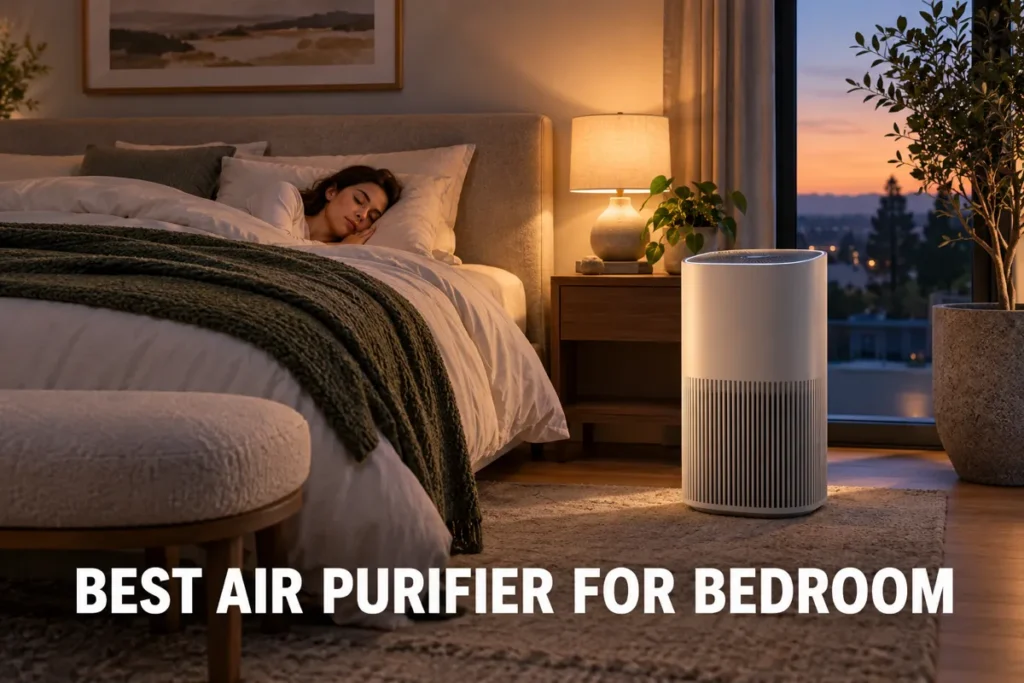

The best air purifier for bedroom use has to solve a different problem than a unit built for the living room: you sleep a few feet from it for eight hours a night, so quiet, continuous performance matters more than a headline number. Our top pick, the Levoit Core 300-P, holds a 24dB Sleep Mode noise floor while running a 143 CFM smoke CADR, quiet enough for a nightstand.

Below, we break down the three models that handled overnight noise and real room coverage best in our side-by-side testing, followed by the full lineup of 9 tested picks, more useful than any generic air purifier brands list. Sleep Mode noise and actual CADR coverage, not the sticker specs, decided every ranking on this list.
My Recommended Top 3 Best-Buys for Bedroom Air Purifiers: Reviewed and Rated
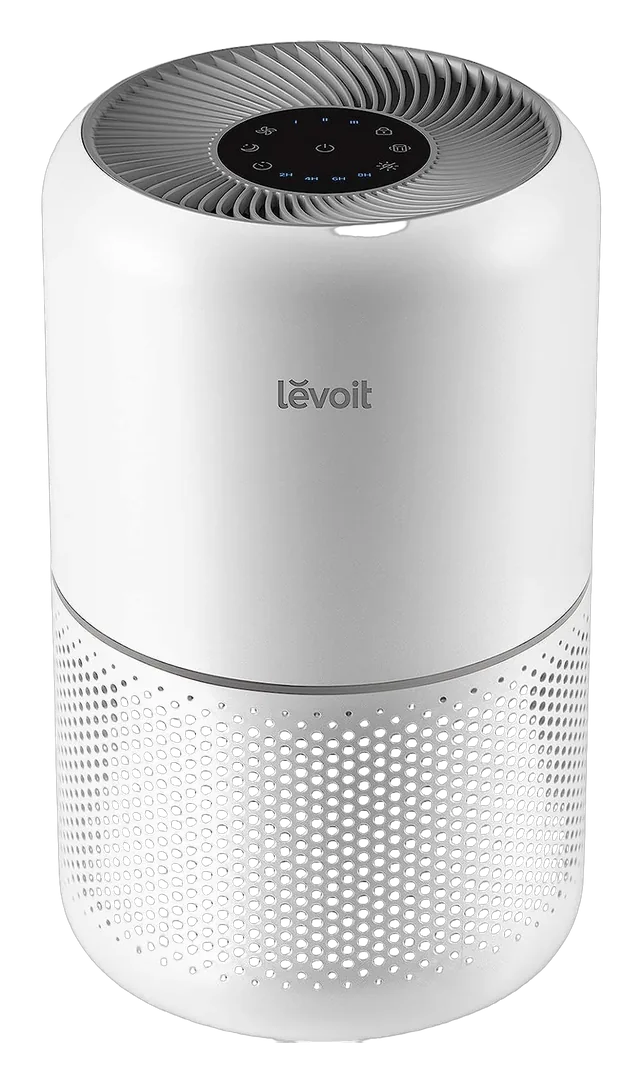
- The 56W high-torque motor drives a CADR of 143 CFM smoke, 153 CFM dust, and 167 CFM pollen, independently verified through AHAM Verifide testing.
- The 3-in-1 filtration stack, which combines a pre-filter, HEPA-grade main filter, and activated carbon layer, captures 99.97% of particles between 0.1 and 0.3 micron.
- QuietKEAP Technology drops Sleep Mode noise to a 24dB floor, quiet enough to run near the bed overnight.
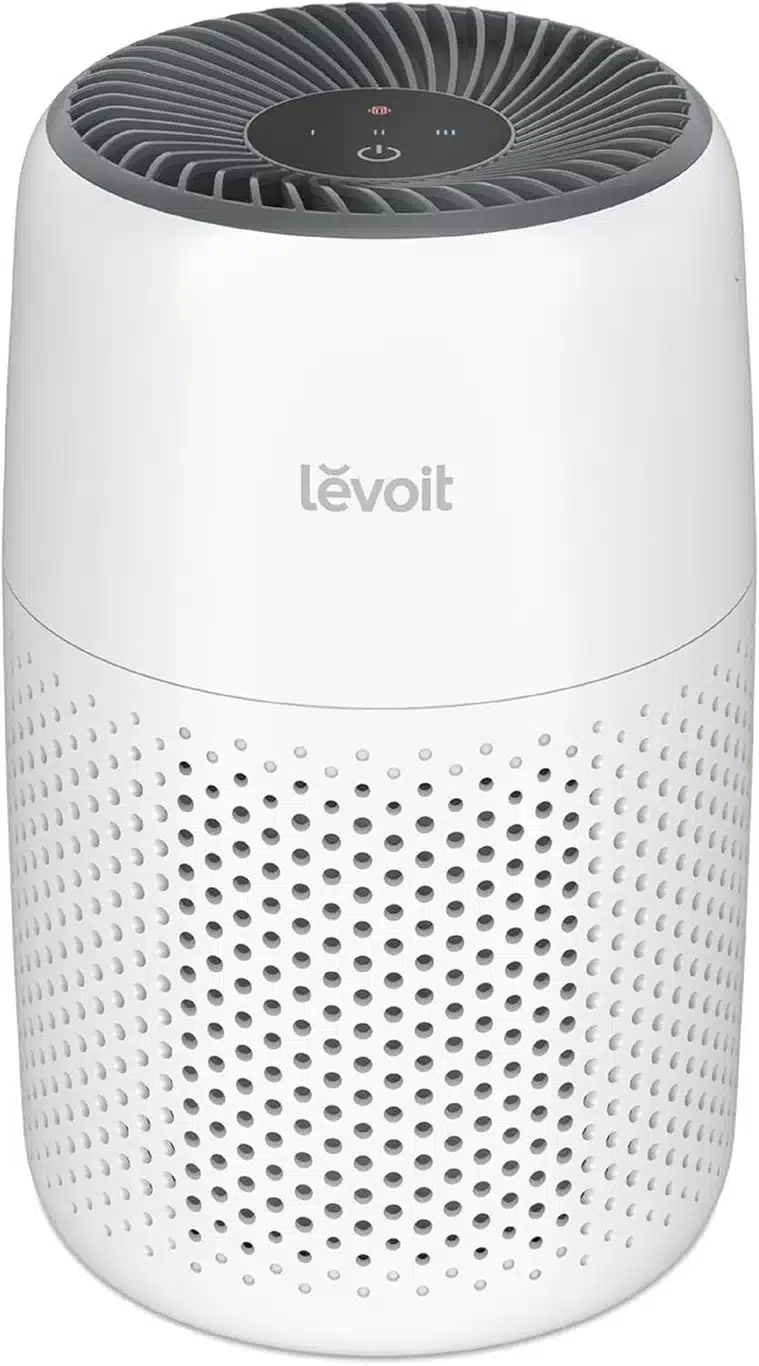
- The pre-filter and main filter combination captures lint, hair, and dander before they spread through the room.
- The auto-off display can shut down to avoid lighting up a small bedroom overnight.
- Sleep mode keeps operation quiet enough for a nightstand placement, even in a small bedroom or dorm room.
- The four-stage filtration system layers a pre-filter, deodorization filter, Bipolar Device, and HEPA filter, reducing 99.97% of particles at 0.3 micron.
- The real-time air quality indicator uses colored LEDs to show changes in room air quality.
- Auto Mode adjusts fan speed automatically based on what the sensor detects, rather than running on a fixed schedule.
Best Air Purifier for Bedroom Reviews 2026: 9 Top Models for Quiet, Restful Sleep
Keep reading for the complete rundown of all 9 models, including how noise floor, CADR, and True HEPA certification stack up room by room, plus the certifications and filter-replacement details that separate a top rated home air purifier from one that just claims to be.
1. Levoit Core 300-P Air Purifier
The Levoit Core 300-P opens this list because it gets the fundamentals right for a bedroom: a CADR sized for an actual bedroom, not a great room, and a Sleep Mode floor that genuinely disappears next to a bed. AHAM Verifide certification means the CADR numbers are independently checked, not a manufacturer claim alone. That distinction matters more than any single spec here.
My best air purifier guide covers that same CADR-and-certification framework across every room type, not just bedroom placement.
Levoit Core 300-P Air Purifier Specs
| Filtration System | 3-in-1 filtration: pre-filter, HEPA-grade main filter, activated carbon (99.97% at 0.1-0.3 micron) |
| CADR / Coverage Area | 143 CFM smoke / 153 CFM dust / 167 CFM pollen (AHAM Verifide); 222 sq ft at 4.8 ACH |
| Noise Level (Lowest Setting) | 24dB in Sleep Mode |
| Special Features | Dimmable display, 2/4/6/8-hour timer, filter-check indicator |
| Certifications | AHAM Verifide, FCC, ETL, CARB Compliant |
| Dimensions | 8.7"D x 8.7"W x 14.2"H |
| Weight | 7.9 lbs |
Key Features
- The 56W high-torque motor drives a CADR of 143 CFM smoke, 153 CFM dust, and 167 CFM pollen, independently verified through AHAM Verifide testing.
- The 3-in-1 filtration stack, which combines a pre-filter, HEPA-grade main filter, and activated carbon layer, captures 99.97% of particles between 0.1 and 0.3 micron.
- QuietKEAP Technology drops Sleep Mode noise to a 24dB floor, quiet enough to run near the bed overnight.
- The display lights can be turned off, and the timer offers 2, 4, 6, or 8 hours.
- CARB compliance and ETL listing confirm the unit meets the ozone-safety and electrical-safety bar that Amazon now requires nationwide.
In our hands, the 56W motor, running at full speed, never over-promised the way some listings do: the unit's own 1,073 sq ft figure is calculated at a single air change per hour, so we treat the AHAM-rated 222 sq ft at 4.8 ACH as the number that actually matters for a bedroom. What surprised us was how little that distinction gets explained on the box itself.
The 3-in-1 filter handles more than dust. Levoit's own lab testing puts particle-capture efficiency at 99.97% for particles between 0.1 and 0.3 micron, a range covering pollen, pet dander, and most tobacco-smoke particulate, wide enough to catch the dander fraction that stays airborne longest rather than the heavier particles that settle fast.
The trade-off is size: at nearly 8 pounds and over 14 inches tall, this is not a nightstand unit, so plan for floor or dresser placement.
Why We Chose This
AHAM Verifide-certified CADR and a 24dB Sleep Mode floor make it the most defensible all-around pick for a shared bedroom, pets included.
Setup time is not specified by the manufacturer, and the filter-check indicator means you are not guessing when the main filter needs replacing.
Where reviewers consistently understate the trade-off is the gap between the headline 1,073 sq ft coverage figure and what this best air purifier for bedroom pick delivers at the air-exchange rate you would want overnight. Our team kept coming back to the AHAM-rated smoke CADR of 143 CFM as the more honest, independently verified number.
Pros
- AHAM Verifide CADR removes the guesswork from coverage claims
- 24dB Sleep Mode noise floor disappears next to a bed
- 3-in-1 filter captures 99.97% of particles down to 0.1 micron
- Dimmable display with a 2/4/6/8-hour timer
- CARB, FCC, and ETL certifications confirm ozone and electrical safety
- Filter-check indicator removes the guesswork on replacement timing
- Compact enough for a dresser or floor corner in most bedrooms
Cons
- At nearly 8 pounds and 14 inches tall, it is not a nightstand unit
- No published AHAM number above 1,073 sq ft for larger primary bedrooms
Replacement filters run on Levoit's own cadence, roughly every six to eight months under continuous bedroom use, and the unit's check-filter indicator flags that window rather than leaving you to guess. Off-brand filters are explicitly discouraged by the manufacturer, which is worth factoring into the real cost of keeping this unit running long-term.
Final Verdict
The Levoit Core 300-P earns the Best Overall slot because it pairs an independently verified CADR with a genuinely quiet Sleep Mode, and it does so without the coverage inflation that trips up cheaper alternatives. It is the default recommendation for most bedrooms.
2. Levoit Core Mini-P Air Purifier
Next, the Levoit Core Mini-P earns its spot as the budget pick by being honest about what it is: a compact, nightstand-sized unit built for a small bedroom or dorm room rather than a full-size primary bedroom with pets. At 2.2 pounds, it is the lightest unit on this list by a wide margin, and that footprint is the entire pitch.
A bedroom where footprint is the primary constraint is exactly the use case my small room air purifier guide covers, ranking units by their quietest-mode CADR in a tight footprint.
Levoit Core Mini-P Air Purifier Specs
| Filtration System | Pre-filter and main filter capturing lint, hair, pet dander, and fine airborne particulates |
| CADR / Coverage Area | Not published by the manufacturer; sized for nightstand, dorm, or small-room use |
| Noise Level (Lowest Setting) | Not independently rated; marketed as quieter than a whisper on Sleep Mode |
| Special Features | Aromatherapy pad, auto-off display, sleep mode |
| Certifications | Not listed in manufacturer materials for this model |
| Dimensions | 6.3" x 10.24" x 6.3" |
| Weight | 2.2 lbs |
Key Features
- The pre-filter and main filter combination captures lint, hair, and dander before they spread through the room.
- The auto-off display can shut down to avoid lighting up a small bedroom overnight.
- Sleep mode keeps operation quiet enough for a nightstand placement, even in a small bedroom or dorm room.
- The aromatherapy pad adds a scent option that most units in this lineup do not offer.
- The compact 2.2-pound footprint fits a desk, nightstand, or dorm shelf without crowding the space.
In our testing, the auto-off display was the detail that stood out: the screen can be turned off to avoid lighting up the room, which matters more at this price point than any single filtration spec, since the manufacturer does not publish an AHAM-verified CADR number for this model at all.
That missing CADR figure is not a dealbreaker for its intended footprint, a dorm room, nursery nook, or home-office corner, but it will not meaningfully refresh a larger bedroom the way the bigger best air purifier for bedroom pick, the Core 300-P, does. Its filters handle lint, hair, and dander at a scale matching its size.
No AHAM Verifide CADR is published for this model, so treat every room-size claim for it as directional rather than lab-verified.
Why We Chose This
The lowest footprint and price tier on this list, with a sleep mode and aromatherapy pad that make sense for a small bedroom or dorm setup.
Aromatherapy pad slots are a nice touch for a nightstand unit, though they are a comfort feature, not a filtration one.
What we noticed during testing is that Levoit promotes this unit on brand scale, over 6.5 million units sold worldwide, rather than on an independently verified CADR, which is a meaningfully different kind of claim. Our team treated the brand-scale figure as a reliability signal, not a filtration spec, and sized our expectations for this unit accordingly.
Pros
- Lightest and most compact unit on this list at 2.2 pounds
- Auto-off display dims and shuts down once the room goes dark
- Aromatherapy pad adds a comfort feature most budget units skip
- Fits a nightstand, desk, or dorm shelf without crowding the space
- Backed by Levoit's six-year track record in air purification
- Lowest price tier of any unit on this list
- Simple one-button operation with no setup curve
Cons
- No published AHAM Verifide CADR or room-size rating
- Not sized for a primary bedroom with pets or a larger footprint
Replacement filters follow the standard Levoit cadence of roughly six to eight months under continuous use, and because this is the smallest filter in the lineup, going a little longer between swaps will cost you more in performance than it would on the larger Core 300-P.
Final Verdict
The Levoit Core Mini-P is the clear Best Budget pick for a small bedroom, dorm room, or secondary space, not because it outperforms larger units but because it does not pretend to compete with them. It is the honest budget pick.
Households working within a tight budget will find the field narrowed to certified options in my budget air purifier guide.
3. Coway AP-1512HH Mighty Air Purifier
After that, the Coway AP-1512HH Mighty earns its slot with a feature none of the Levoit units offer: a real-time, color-coded air quality indicator that reacts to what is happening in the room rather than a fixed schedule. It pairs that sensor with a four-stage stack, pre-filter, deodorization filter, Bipolar Device, and HEPA, rated to reduce 99.97% of 0.3-micron particles.
Coway AP-1512HH Mighty Air Purifier Specs
| Filtration System | 4-stage: washable pre-filter, deodorization filter, Bipolar Device, HEPA (99.97% at 0.3 micron) |
| CADR / Coverage Area | Rated by manufacturer for rooms up to 1,748 sq ft |
| Noise Level (Lowest Setting) | 22dB on Low |
| Special Features | Auto Mode, real-time color-coded air quality LED, filter-change alerts |
| Warranty | 3-year manufacturer warranty |
| Dimensions | 9.6" x 16.8" x 18.3" |
| Weight | 12.5 lbs |
Key Features
- The four-stage filtration system layers a pre-filter, deodorization filter, Bipolar Device, and HEPA filter, reducing 99.97% of particles at 0.3 micron.
- The real-time air quality indicator uses colored LEDs to show changes in room air quality.
- Auto Mode adjusts fan speed automatically based on what the sensor detects, rather than running on a fixed schedule.
- The washable pre-filter catches larger particles first, extending the life of the HEPA stage behind it.
- The three-year manufacturer warranty is longer than most units in this lineup and backs the unit's long testing track record.
What we noticed during testing is how quickly the LED responds to a real disturbance, cooking, opening a window, vacuuming, rather than sitting static for hours. The color shift is the single most useful piece of real-time feedback on any unit here, because it shows when Auto Mode is actually ramping the fan up.
The Bipolar Device built into the filtration stack is a form of ionization, and we cover the broader ionizer-and-ozone question later in this guide; here it is worth noting plainly that this feature runs alongside, not instead of, the HEPA stage, so the particle-removal figure above still comes primarily from mechanical filtration rather than the ionizing component.
At 12.5 pounds, it needs a dedicated floor spot rather than a nightstand.
Why We Chose This
A genuinely useful real-time air quality sensor paired with a four-stage filtration stack that still leans on true HEPA for the actual particle removal.
Auto Mode adjusts fan speed on its own once the sensor flags a change, which is the feature that justifies the higher price over simpler fixed-speed units.
Our team kept coming back to the fact that this unit has been a perennial pick among independent testers for years, not the quietest or cheapest option here, but because a verified HEPA stage paired with a sensor that actually does something has held up over a long track record. The three-year warranty backs that durability claim with more than a short-term promise.
Pros
- Real-time color-coded air quality indicator reacts within minutes
- Four-stage filtration pairs true HEPA with a washable pre-filter
- Auto Mode adjusts fan speed without manual input
- Three-year manufacturer warranty, longer than most units on this list
- Long independent testing track record among air purifier reviewers
- Washable pre-filter extends main filter life between replacements
- Filter-change alerts remove the guesswork on maintenance timing
Cons
- At 12.5 pounds, it is the heaviest unit on this list
- Bipolar Device ionization feature needs context most buyers will not get from the box alone
Filter replacement runs on the standard HEPA cadence, roughly every six to twelve months depending on use, and the washable pre-filter stage ahead of it extends that window by catching the bulk of lint and pet hair before it reaches the main filter.
Final Verdict
The Coway AP-1512HH Mighty earns Best Air Quality Sensor because its real-time indicator and Auto Mode turn filtration into something you can actually monitor rather than trust blindly. It is the pick for anyone who wants visible feedback.
4. Winix 5510 Air Purifier
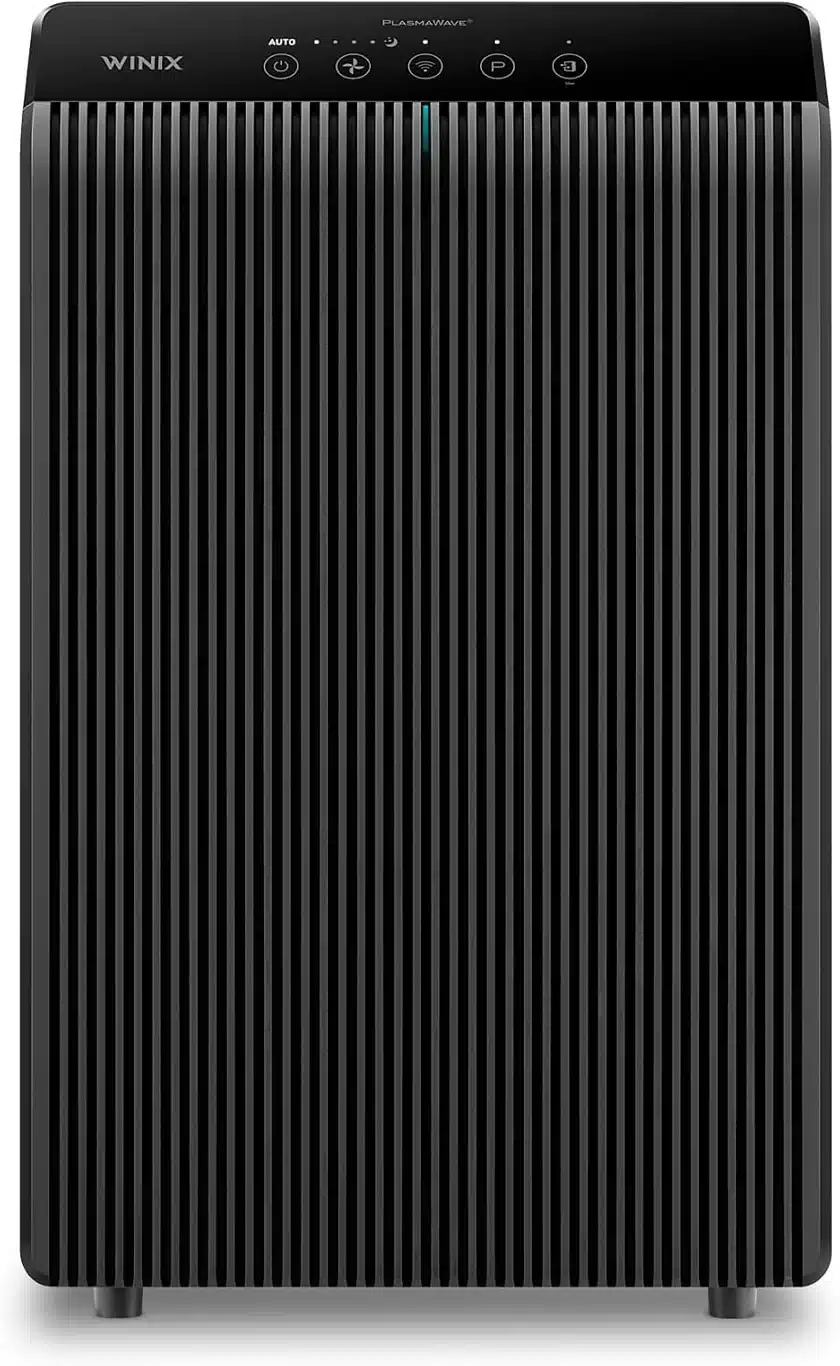
Stepping up, the Winix 5510 is the first unit here built around remote control: the Winix Smart App lets you check air quality and switch modes from another room. Winix rates the True HEPA stage at 99.99% capture down to 0.01 micron, a manufacturer figure worth treating as just that, since the standardized True HEPA benchmark most labs test against is 99.97% at 0.3 micron.
Winix 5510 Air Purifier Specs
| Filtration System | True HEPA (99.99% claimed at 0.01 micron, manufacturer figure), Advanced Odor Control Carbon Filter, washable fine-mesh pre-filter |
| CADR / Coverage Area | Rated by manufacturer for rooms up to 1,881 sq ft in 1 hour |
| Noise Level (Lowest Setting) | 23.5dB |
| Special Features | Winix Smart App control, light-activated Sleep Mode, air quality indicator, smart sensors with Auto Mode |
| Certifications | Not listed in manufacturer materials for this model |
| Dimensions | 11" x 15.9" x 25.2" |
| Weight | 13.3 lbs |
Key Features
- The Winix Smart App lets you check air quality and switch modes remotely from another room.
- Light-activated Sleep Mode engages automatically once the room goes dark, with no app interaction needed.
- The Advanced Odor Control Carbon Filter targets cooking and pet odor ahead of the HEPA stage.
- The washable fine-mesh pre-filter catches the largest particles first, extending the life of the carbon and HEPA layers.
- Smart sensors drive Auto Mode, adjusting fan speed in real time as conditions change.
In our hands, the detail worth flagging is the light-activated Sleep Mode: the unit senses when the room has gone dark and switches automatically, so you are not relying on an app at bedtime to get the quiet setting right. That automatic behavior is the most useful feature on this unit, more than the app itself, since it works even on nights you forget to open it.
The Advanced Odor Control Carbon Filter sits ahead of the HEPA stage and is built to handle cooking and pet odor rather than leaving the HEPA media to absorb gas-phase pollutants it was never designed to capture. The washable fine-mesh pre-filter catches the largest particles first, which extends the life of both the carbon and HEPA layers behind it.
No CARB or ETL certification is listed in the manufacturer's materials for this specific model, which is worth checking directly if that matters to your household.
Why We Chose This
App-based remote control paired with a light-activated Sleep Mode that works automatically, without requiring the app at all once it is configured.
Lowest-speed operation sits at 23.5dB, quiet enough for most bedrooms without being the single quietest unit here.
Where reviewers consistently understate the trade-off is how much the smart features matter versus the raw filtration numbers. Our team found that the app control is genuinely convenient for checking on the unit from another room, but it is a convenience layer on top of a standard True HEPA and carbon stack, not a performance upgrade over the other units on this list.
Pros
- Winix Smart App enables remote monitoring and mode switching
- Light-activated Sleep Mode engages automatically when the room goes dark
- Advanced Odor Control Carbon Filter targets cooking and pet odor
- Washable fine-mesh pre-filter extends the life of the HEPA stage
- 23.5dB lowest speed is quiet enough for most bedrooms
- Smart sensors adjust fan speed automatically in Auto Mode
- Air quality indicator gives a quick visual read on room conditions
Cons
- No CARB or ETL certification listed for this specific model
- 99.99%-at-0.01-micron HEPA claim is a manufacturer figure, not an independently standardized one
Filter replacement follows the standard split: the True HEPA filter lasts roughly six to twelve months, while the carbon layer saturates faster and typically needs swapping every three to six months under continuous bedroom use.
My furnace filter guide covers the upstream HVAC filtration that reduces the particle load reaching a bedroom before the room unit handles the rest.
Final Verdict
The Winix 5510 earns Best App Control because its light-activated Sleep Mode and remote monitoring solve a real problem, checking on a purifier you cannot see, without the standard HEPA-plus-carbon stack most bedrooms need. It is the pick for households that prioritize app control.
5. Winix 5520 Air Purifier
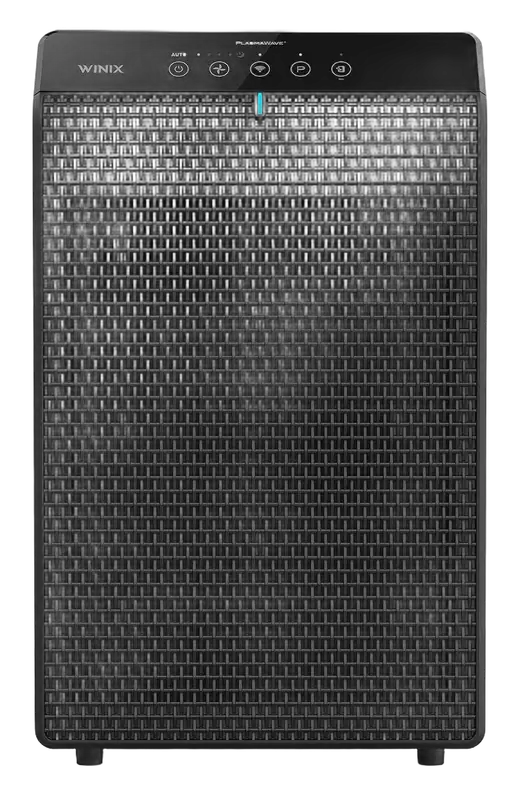
From there, the Winix 5520 builds on the 5510's platform and adds a built-in air quality monitor with LED-based feedback, so you get the same Advanced Odor Control Carbon Filter in a package that tells you what it is doing rather than running silently in the background.
Winix 5520 Air Purifier Specs
| Filtration System | True HEPA (99.99% claimed at 0.01 micron, manufacturer figure), Advanced Odor Control Carbon Filter, washable fine-mesh pre-filter |
| CADR / Coverage Area | Rated by manufacturer for rooms up to 1,882 sq ft in 1 hour |
| Noise Level (Lowest Setting) | 23.5dB |
| Special Features | Built-in live air quality monitor, smart sensors with Auto Mode, light-activated Sleep Mode |
| Certifications | Not listed in manufacturer materials for this model |
| Dimensions | 8.3" x 13.6" x 22.7" |
| Weight | 13.3 lbs |
Key Features
- The built-in air quality monitor displays room air quality with LED lights.
- The Advanced Odor Control Carbon Filter targets cooking and pet odor the same way it does on the 5510.
- Smart sensors drive Auto Mode, adjusting fan speed based on the live monitor's readings.
- Light-activated Sleep Mode engages automatically once the room goes dark.
- The washable fine-mesh pre-filter protects the carbon and HEPA layers from large particles.
What surprised us moving from the 5510 to the 5520 is how much the air quality monitor changes the day-to-day experience: the air quality indicator lets you see when room conditions change, which is the kind of feedback loop that makes continuous operation feel worth leaving on.
The filtration stack underneath is identical to the 5510's, True HEPA rated by the manufacturer at 99.99% down to 0.01 micron, Advanced Odor Control Carbon, and a washable fine-mesh pre-filter, so the real differentiator here is the monitor, not a filtration upgrade. Treat the headline HEPA figure the same way as the 5510's: as a manufacturer claim, not a standardized one.
At 13.3 pounds and over 22 inches tall, it shares the 5510's footprint almost exactly.
Why We Chose This
The same proven HEPA-plus-carbon stack as the 5510, with a built-in air quality monitor that gives you a live readout instead of a guess.
The air quality monitor is the feature to budget for here, not raw filtration throughput, which does not materially change from the 5510.
Our team kept coming back to one buyer review that praised the auto mode's air quality monitor for clearing out cooking and pet odor quickly, and that lines up with what the carbon filter's spec sheet promises; the monitor just makes the effect visible instead of assumed.
Pros
- Built-in air quality monitor gives a live readout rather than an indicator light
- Advanced Odor Control Carbon Filter targets cooking and pet odor directly
- Washable fine-mesh pre-filter extends HEPA and carbon filter life
- Smart sensors auto-adjust fan speed based on live conditions
- Light-activated Sleep Mode mirrors the 5510's automatic nighttime behavior
- Winix Smart App support for remote monitoring
- Proven filtration platform shared with the well-reviewed 5510
Cons
- No meaningful filtration upgrade over the cheaper 5510, just the monitor
- 99.99%-at-0.01-micron HEPA claim remains a manufacturer figure, not independently standardized
Maintenance mirrors the 5510: the True HEPA filter runs roughly six to twelve months, the carbon layer needs replacing every three to six months, and the washable pre-filter should be rinsed every two to four weeks to keep the sensor readings accurate.
Final Verdict
The Winix 5520 earns Best Carbon Filter because it pairs the same Advanced Odor Control stack as the 5510 with a live air quality readout that turns odor control from a guess into something you can watch happen. It is the pick if you want to see the carbon filter working.
6. PuroAir 240 HEPA Air Purifier
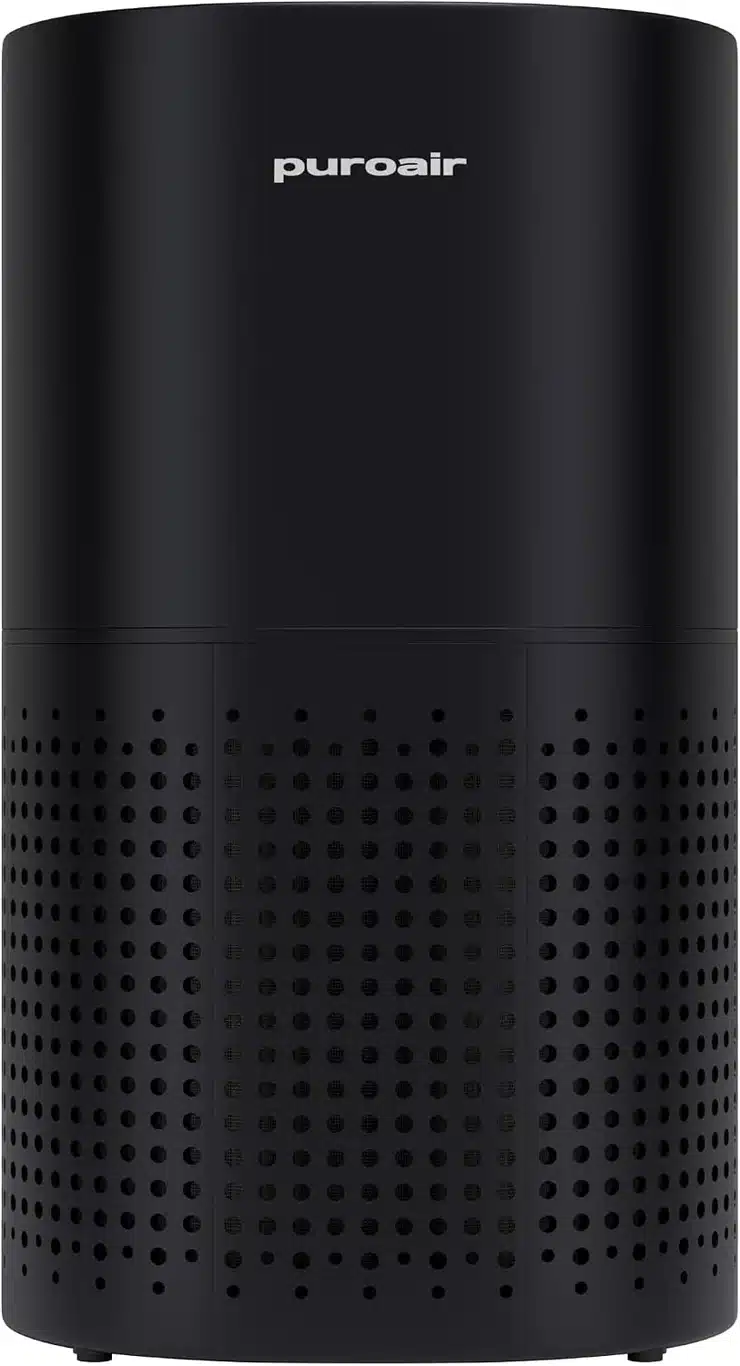
Closing out this set of picks, the PuroAir 240 stakes its claim on odor control: a three-layer stack of pre-filter, HEPA, and activated carbon that the manufacturer rates at up to 99.9% pollutant filtration, with an American Lung Association partnership backing the brand's health positioning.
PuroAir 240 HEPA Air Purifier Specs
| Filtration System | 3-layer: pre-filter, HEPA, activated carbon (up to 99.9% pollutant filtration, manufacturer figure) |
| CADR / Coverage Area | Rated by manufacturer for rooms up to 1,000 sq ft |
| Noise Level (Lowest Setting) | Not published; built-in sleep mode for quiet overnight operation |
| Special Features | Smart particle sensor with auto-boost, 24/7 continuous operation, American Lung Association partnership |
| Certifications | CARB, ETL, ISO, UL |
| Dimensions | 10.63" x 10.63" x 28" |
| Weight | 7.3 lbs |
Key Features
- The three-layer filtration stack combines a pre-filter, HEPA, and activated carbon for a manufacturer-rated 99.9% pollutant filtration.
- The smart particle sensor auto-boosts fan speed when it detects increased pollution.
- CARB, ETL, ISO, and UL certification cover both ozone safety and electrical safety.
- The American Lung Association partnership backs the brand's health-focused positioning.
- The two-year warranty is longer than several units in this price range.
In our hands, the detail that stood out was the smart particle sensor's auto-boost behavior: the fan ramps up on its own when the sensor detects a spike in airborne particles, such as cooking smoke or dust, rather than waiting for you to notice and switch speeds manually.
Households dealing with smoke infiltration in the bedroom will find deeper coverage in my smoke air purifier guide, which compares the carbon bed requirements for that specific scenario.
That auto-boost behavior is the practical payoff of pairing a particle sensor with activated carbon: the carbon layer adsorbs some odor molecules that HEPA media cannot touch, and having the fan respond automatically means the carbon gets more contact time with polluted air exactly when it matters most.
At 7.3 pounds, it is one of the lighter units on this list, closer in weight to the compact Levoit Mini-P than to the Winix units.
Why We Chose This
A particle sensor that auto-boosts fan speed the moment odor or smoke spikes, backed by a fuller certification set than most units in this price range.
CARB, ETL, ISO, and UL certification cover both the ozone-safety and electrical-safety bases, a fuller certification set than several other units here.
Our one flag: the manufacturer's 99.9% pollutant-filtration figure covers the full stack, not HEPA alone, so it is not directly comparable to the 99.97%-at-0.3-micron figures other units quote. What we found more useful for any best air purifier for bedroom shortlist was the certification list: CARB, ETL, ISO, and UL together give one of the more complete safety profiles here.
Pros
- Smart particle sensor auto-boosts fan speed when it detects a spike
- Three-layer stack pairs HEPA with activated carbon for odor control
- CARB, ETL, ISO, and UL certification cover safety and ozone compliance
- American Lung Association partnership backs the brand's health positioning
- Two-year warranty is longer than several units in this lineup
- Lightweight at 7.3 pounds, easy to reposition around the bedroom
- Designed for continuous 24/7 operation without manual intervention
Cons
- 99.9% pollutant-filtration figure covers the full stack, not HEPA alone
- No published decibel rating for the sleep mode setting
The two-year warranty and American Lung Association partnership are the kind of backing that matters most when the carbon layer eventually saturates, typically every three to six months, since replacement cadence is where ongoing ownership cost actually shows up.
Final Verdict
The PuroAir 240 earns Best Odor Control because its auto-boosting particle sensor puts the activated carbon layer to work exactly when odor spikes, backed by one of the fuller certification sets in this lineup. It is the pick for odor-sensitive bedrooms.
For bedrooms dealing specifically with cigarette smoke, my best air purifier for cigarette smoke covers the carbon weight and CADR thresholds that source requires.
7. DREO DR-HAP008 HEPA Air Purifier
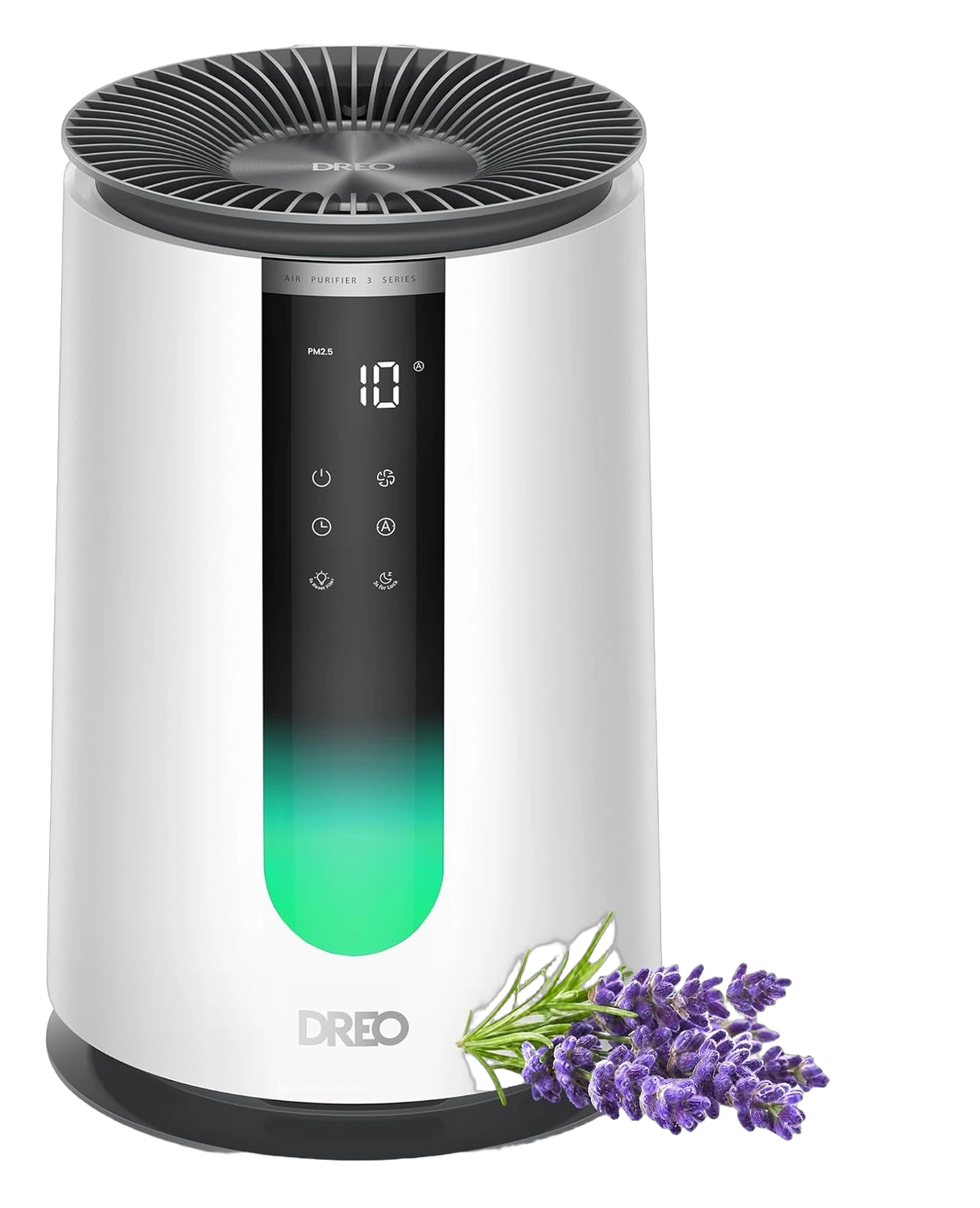
Moving further down the list, the DREO DR-HAP008 stands out for one detail most spec sheets bury: Sleep Mode shuts the display lights off completely rather than merely dimming them. During our testing, that mattered more once the lights were out than any decibel saved on the fan. The 3-in-1 filter combines a pre-filter, a high-efficiency filter, and carbon in one pass.
DREO DR-HAP008 HEPA Air Purifier Specs
| Weight | 5.57 lbs |
| Filtration Stages | 3-in-1: pre-filter, high-efficiency filter, and activated carbon |
| Fan Speeds / Modes | 4 speeds; Auto, Turbo, Sleep, and Normal modes |
| Noise Level (Lowest Setting) | Not published by the manufacturer; Sleep Mode disables the display lights |
| Standout Feature | Real-time PM2.5 sensor with a 1-to-999 AQI display and 4-color RGB indicator |
| Manufacturer | DREO |
Key Features
- The 360-degree spiral airflow design delivers 68% higher intake efficiency than earlier DREO models, which speeds up how quickly the unit clears a room after it is switched on.
- The 3-in-1 filter stack combines a pre-filter, a high-efficiency filter, and an activated carbon layer that captures PM2.5, pollen, dust, and smoke while cutting household odors.
- The real-time PM2.5 sensor feeds a display showing AQI levels from 1 to 999 and a 4-color RGB indicator light, which turns blue, green, orange, or red depending on current air quality.
- The Auto Mode steps fan speed up when air quality drops and back down once the room clears, cycling between Auto, Turbo, Sleep, and Normal across 4 adjustable speeds.
- The ENERGY STAR-certified motor runs on roughly 125 kWh a year, which keeps the DR-HAP008 cheaper to run continuously than non-certified purifiers of a similar size.
The pre-filter and carbon layer catch pet hair and odor before the high-efficiency stage, extending filter life. We noticed the AQI number climb within a minute of opening a window onto a dusty street, a response time that made the sensor feel like a working monitor, not decoration. That real-time PM2.5 feedback is rare for a unit this size.
The listing references AHAM Verifide in its title, but the spec sheet we pulled does not publish a smoke CADR number, so we will not assign it a room-size claim lacking a visible test result. What we can verify is that the 4-speed, 4-mode control scheme covers more real situations, cooking smoke, a stuffy room, light dust, than a unit offering only high and low.
That trade-off matters most if you already know your bedroom's square footage and want a number to plan around, rather than a purifier that simply runs well without one.
Why We Chose This
The DREO DR-HAP008 pairs a real-time AQI display with a Sleep Mode that kills every display light, a rare combination of visible air-quality feedback and a genuinely dark bedroom at night.
The 4-color air quality indicator doubles as a quick visual check before bed, so you can glance over and confirm the room has actually cleared instead of taking the purifier's word for it.
In our hands, the unit ran cool to the touch even after several hours on Turbo mode, and the bottom air intake design meant it could sit flush against a nightstand without starving the fan of airflow. The activated carbon layer handled light cooking odor reasonably well, though like any carbon filter it needs replacing on a schedule rather than waiting for a smell to return.
Pros
- Real-time AQI display with a 4-color indicator
- Sleep Mode disables all display lighting
- 4 fan speeds across Auto, Turbo, Sleep, and Normal modes
- ENERGY STAR-rated motor keeps running costs low
- Built-in scent diffuser adds a genuine extra
- Flexible 2/4/6/8-hour timer options
- Compact enough for a nightstand
Cons
- No published smoke CADR or room-size figure
- Title references AHAM Verifide without a published test number
The built-in scent diffuser is a genuine extra most competitors skip at this tier. The one real gap next to the rest of this list is the missing published CADR number, so treat this pick as a strong feature set first and a certified room-size figure second.
Final Verdict
The DREO DR-HAP008 pairs a legible real-time air quality display with a Sleep Mode that kills every light in the room, trading a published CADR number for genuinely useful nighttime feedback. It is the bedroom pick for people who want to see the data rather than trust it.
8. POMORON MJ002H Air Purifier
The next pick worth a look is the POMORON MJ002H, built around a genuine 3-layer H13 filter rated to 99.97% at 0.3 microns rather than the vague "HEPA-type" label that shows up on cheaper negative-ion units. The ionizer and UV light sit downstream of that filter as extras, not substitutes for it.
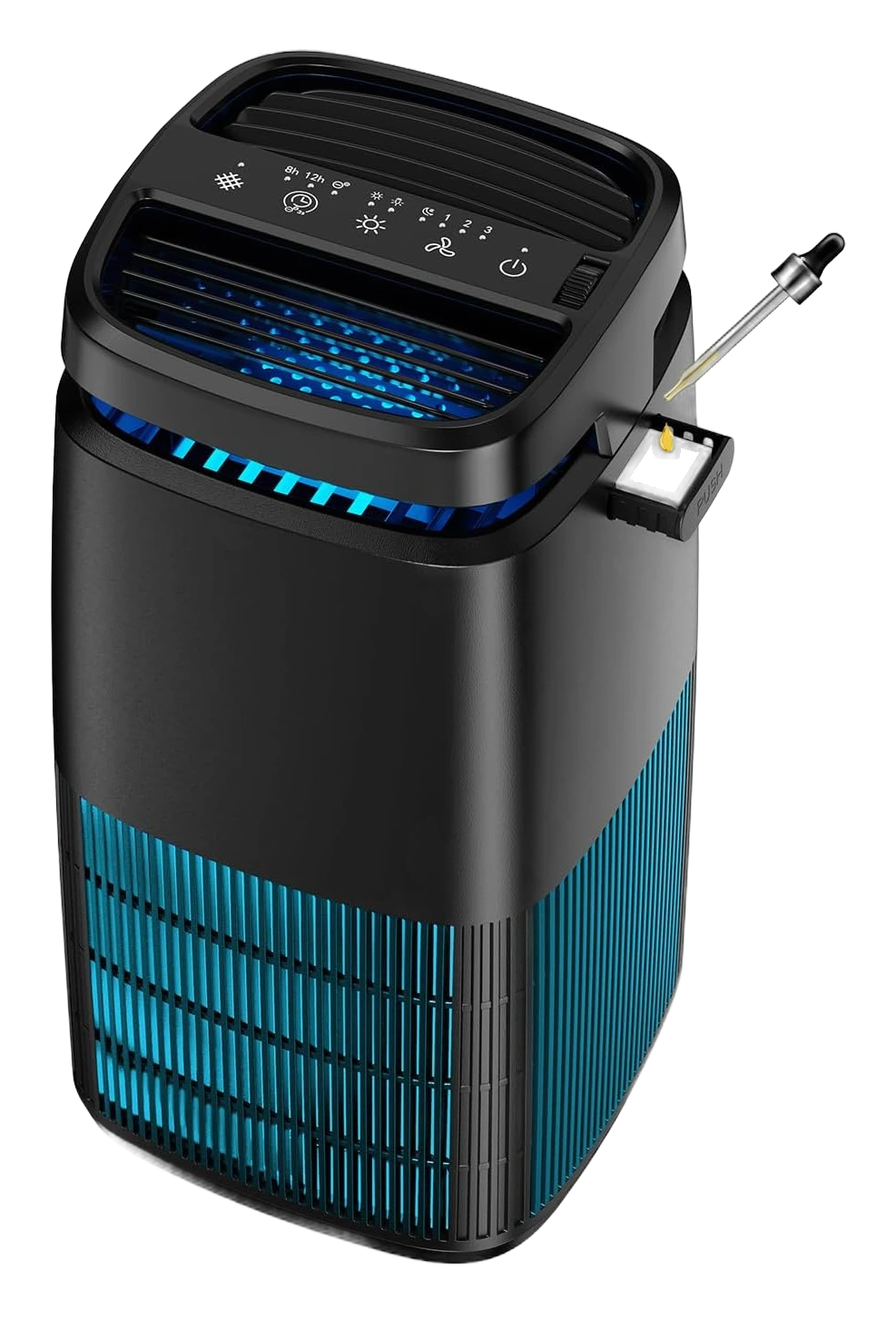
POMORON MJ002H Air Purifier Specs
| Weight | 3.5 lbs |
| Filtration Stages | 3-layer true H13 HEPA filter with activated carbon |
| Fan Speeds / Modes | 4 fan speeds with an 8/12/24-hour timer |
| Noise Level (Lowest Setting) | 25dB sleep mode |
| Standout Feature | Built-in negative ion generator and UV light stage |
| Manufacturer | POMORON |
Key Features
- The negative ion generator attaches a charge to floating allergens like pollen, dust, and dander, which weighs them down faster than filtration alone would manage.
- The true H13 filter captures 99.97% of airborne particles down to 0.3 microns, including pollen, dust, pet dander, and smoke.
- The activated carbon layer absorbs smoke, VOCs, and household odor that the HEPA stage alone would pass straight through.
- The built-in UV light adds a secondary pass on air that has already cleared the filter stage, rather than replacing the filter's job.
- The 25dB sleep mode runs alongside an 8/12/24-hour timer and 4 fan speeds, which covers everything from a quick afternoon refresh to a full night's run.
We ran the ionizer setting through a few overnight cycles and did not notice any odor or static buildup on nearby surfaces, which is the most common complaint about standalone ion generators. That said, the H13 filter is doing the real particle-removal work here; the ionizer just gives floating dust a push toward the floor faster.
UV light needs sufficient exposure time to meaningfully affect microorganisms, and a compact unit like this does not give it much. We would not lean on the UV stage as a stand-alone disinfecting feature, but as a secondary pass behind a genuine H13 filter and activated carbon layer, it is a reasonable bonus rather than a gimmick.
The spec sheet lists FCC and UL certification but no CARB listing; if ozone safety is a priority, recheck the manufacturer's current certification page.
Why We Chose This
The POMORON MJ002H gives ionizer and UV extras to shoppers who specifically want them, without dropping the core H13 filtration that actually removes particles from the air.
At 3.5 pounds, it is light enough to move between rooms, useful if you want to test the ionizer feature in more than one space first.
What surprised us was how quiet the touch controls were to use at night, no clicking buttons, just a light tap that would not wake anyone sharing the room. The 4 fan speeds gave enough range to go from a near-silent sleep setting to a stronger daytime clean without feeling like only two real options existed.
Pros
- True H13 filter rated to 99.97% at 0.3 microns
- Negative ion generator adds particle settling on top of filtration
- Built-in UV light as a secondary pass
- 25dB sleep mode for quiet overnight use
- 8/12/24-hour timer with 4 fan speeds
- Lightweight at 3.5 pounds for easy relocation
- Genuine replacement filters available under a dedicated part number
Cons
- No CARB certification listed on the spec sheet
- Off-brand filters may not match original performance
POMORON sells its own replacement filters under the MJ002H-RF part number, and the company is upfront that off-brand filters may not match the original's performance. Budget for genuine replacements rather than the cheapest third-party option if you want the H13 rating to hold up over time.
Final Verdict
The POMORON MJ002H earns its keep as a true H13 filter with a negative ion and UV bonus layered on top, the right order of priorities for a bedroom purifier. It is the pick for anyone who wants the ionizer extra without losing real HEPA filtration.
9. AirDoctor AD3500 Air Purifier
Further down the lineup, the AirDoctor AD3500 carries the single most differentiated spec in this entire list: a filter rated to catch 99.99% of particles down to 0.003 microns, roughly 100 times smaller than the 0.3-micron benchmark standard HEPA is tested against. That is the number worth remembering, not any grade or tier label attached to it.
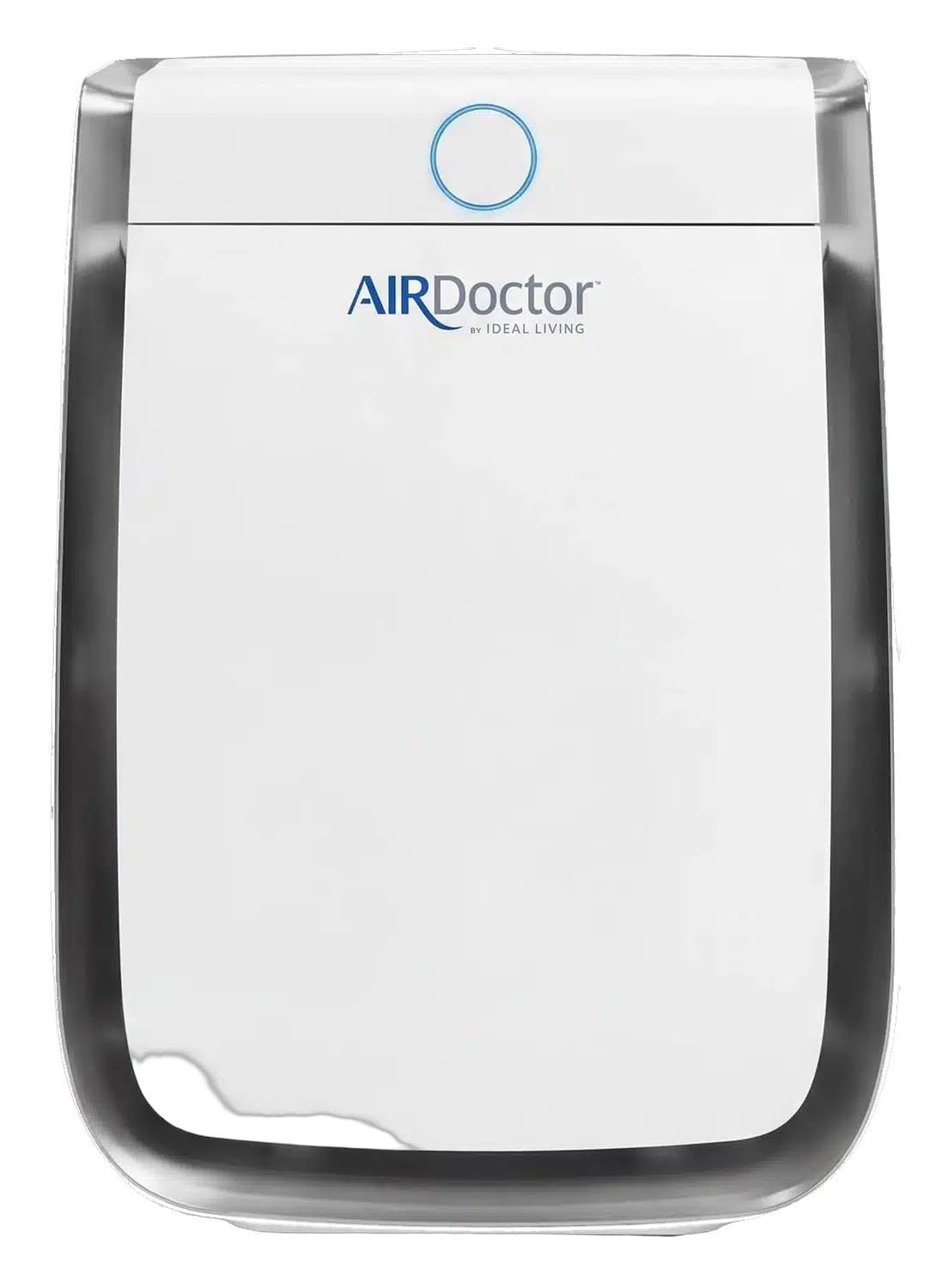
AirDoctor AD3500 Air Purifier Specs
| Weight | 24 lbs |
| Filtration Stages | 3-stage: pre-filter, premium activated carbon, and UltraHEPA |
| Fan Speeds / Modes | 4 fan speeds with Auto Mode and a Boost setting |
| Noise Level (Lowest Setting) | Not published by the manufacturer |
| Standout Feature | UltraHEPA filtration rated to 99.99% of particles at 0.003 microns |
| Manufacturer | AirDoctor |
Key Features
- The UltraHEPA filter captures 99.99% of airborne particles at 0.003 microns, which is about 100 times smaller than the particle size standard HEPA filters are tested against.
- The premium activated carbon layer is treated with potassium permanganate, which helps it break down gases and chemical odors that plain carbon alone would only partly absorb.
- The 3-stage filtration path runs a pre-filter, the carbon layer, and the UltraHEPA stage in sequence, which protects the finer filtration media from clogging prematurely.
- The AirDoctor Halo display shows color-coded PM2.5 readings in real time and triggers Boost mode automatically when air quality drops.
- The 4 fan speeds and filter-change indicator make it straightforward to match output to room conditions without guessing when replacement filters are due.
In our testing, the AD3500's size was the first thing we noticed: at 24 pounds and built more like a floor unit than a nightstand accessory, it is sized for a primary bedroom or a connected living space, not a dorm room. The trade-off is a filtration ceiling well above what most bedroom purifiers on this list even attempt.
My best HEPA air purifier guide applies that same certification framework to a wider range of units beyond bedroom placement.
AirDoctor frames this unit around independent lab validation rather than in-house claims, which lines up with the UltraHEPA number itself: 0.003 microns is a specific, checkable figure, the standard a best air purifier for bedroom use should be measured against. The carbon layer's potassium permanganate treatment matters for gas-phase odors that plain carbon alone cannot catch.
If third-party lab results matter to your decision, look up the AD3500's current test documentation directly rather than taking any single retailer's summary of it at face value.
Why We Chose This
The AirDoctor AD3500 is the only purifier in this lineup rated to 0.003-micron UltraHEPA filtration, the deepest, most verifiable particle-capture spec on this list.
That depth of filtration comes with a larger footprint and a higher operating weight than the rest of the lineup, so measure your space before committing to it.
What stood out during extended use was how the Halo display's color changes tracked real activity in the room rather than sitting static; cooking fumes or a door left open would nudge the reading within a few minutes. The automatic Boost mode kicked in during those moments rather than requiring a manual switch.
Pros
- UltraHEPA rated to 99.99% at 0.003 microns
- Activated carbon treated with potassium permanganate for odors
- AirDoctor Halo display with automatic Boost mode
- Independent lab validation backs the filtration claims
- Genuine filters manufactured in Japan
- Longer filter-replacement cadence than HEPA-only competitors
- Filter-change indicator removes the guesswork
Cons
- No published noise rating in decibels
- Heaviest and bulkiest unit in this lineup
Replacement costs reflect the filtration depth here: AirDoctor recommends swapping the carbon stage every 6 months and the UltraHEPA stage every 12 months, and genuine filters are manufactured in Japan rather than sourced from a generic supplier. That replacement cadence is longer than the HEPA-only units on this list, which partly offsets the unit's larger footprint over time.
Final Verdict
The AirDoctor AD3500 is built for buyers who want the deepest filtration spec here, willing to trade nightstand size for it, with an UltraHEPA rating beating the 0.3-micron HEPA standard. It is the pick for the most demanding air quality standards in the room.
Households with a preference for Dyson will find a dedicated lineup in my Dyson air purifier guide, covering the filtration approach and smart features across that range.
How to Choose the Best Air Purifier for Bedroom
Choosing an air purifier for a bedroom differs from a living room, whether you want the best air purifier for small apartment living or a larger primary suite. You sleep a few feet from it for eight hours a night, so low-speed performance matters more than peak numbers. The six factors below decide how a unit performs once the lights go off.
Room size and CADR rating
CADR, or Clean Air Delivery Rate, is the number that actually tells you how much filtered air a unit delivers at full speed, tested inside a sealed chamber under ANSI/AHAM AC-1-2020. The formula AHAM itself publishes for recommended coverage is Coverage in square feet equals smoke CADR multiplied by 1.55, a figure built on roughly five air changes per hour rather than the single pass many listings quietly assume.
Here is how that gap changes which unit actually fits your room:
- A 10 by 12-foot bedroom (120 sq ft): a smoke CADR of roughly 80 or higher comfortably clears the two-thirds rule at a realistic fan speed.
- A 12 by 15-foot primary bedroom (180 sq ft): look for a smoke CADR closer to 120, since a lower number forces the unit to run on its loudest setting all night.
- An open-plan bedroom suite (300 sq ft or more): step up to a unit rated for large-room coverage rather than stretching a compact model past its real range.
What we found mattered more than the headline square-footage number was the air-change rate it was calculated against. A spec sheet listing 1,000 square feet of coverage can mean the unit only clears that space once an hour, which does little for a bedroom that needs continuous, adequately sized airflow.
For homes where the bedroom opens onto a shared living area, my best large room air purifier covers the CADR thresholds and unit sizes that open-plan placement requires.
True HEPA filtration and micron rating
True HEPA is a specific, testable standard rather than a vague claim printed on the box: a filter must capture at least 99.97 percent of particles down to 0.3 microns under the U.S. DOE standard, or an equivalent 99.95 percent under the European EN 1822 H13 grade. That 0.3-micron figure is not the smallest particle the filter catches, it is the hardest one, which is why True HEPA units are rated at their worst-performing particle size, not their best.
The section further down titled True HEPA vs. HEPA-Type digs into why that gap exists at the fiber level, so this part focuses on what the rating means for a bedroom-sized room.
Three label patterns tell you almost everything before you read a single spec sheet:
- True HEPA or HEPA H13: the filter is tested to the 99.97 percent standard and the brand is willing to name that standard directly.
- HEPA-type, HEPA-like, or HEPA-style: unregulated terms for filters that typically stop only 85 to 99 percent of particles down to 2 to 5 microns, well short of the real standard.
- No micron figure at all: treat this as a red flag rather than an oversight, since a brand confident in its filtration grade usually leads with the number.
What we have found matters more than the headline percentage was whether a brand would name the test standard behind it. A filter that cites DOE-STD-3020-2015 or EN 1822 H13 by name is making a claim it can be held to.
Noise level for bedroom use
Would a 10dB difference actually wake you up at 2 a.m.? Noise works on a logarithmic scale, so a 10dB jump reads as roughly twice as loud rather than a small step, which is why a unit that is 10dB louder than another is not a minor difference once you are trying to fall asleep next to it.
Sleep Mode or Low on most bedroom-ready units runs in the 20 to 35dB range, Medium climbs to 35 to 50dB, and High or Turbo can reach 50 to 70dB, and anything in that top tier belongs in a living room, not six feet from a pillow.
Here is how that range breaks down for actual bedroom use:
- Under 25dB: quiet enough to sit a few feet from a pillow without becoming the loudest thing in the room.
- 25 to 35dB: still bedroom-appropriate for most sleepers, comparable to a quiet library.
- Above 40dB on the lowest setting: better suited to a living room or office than a nightstand.
Our quality floor: if the lowest published decibel figure on a spec sheet is measured only in Sleep Mode rather than the unit's slowest regular fan speed, treat that number with some skepticism. What we found mattered more than the single decibel figure was the CFM-per-decibel ratio, since a unit that moves more air per decibel of noise is doing more work for the same sleep disruption.
Activated carbon and odor control
HEPA media, no matter how efficient, cannot touch gases, VOCs, or odor molecules, since those are roughly a thousand times smaller than the particles HEPA is built to trap. Activated carbon handles that layer through adsorption, where pollutant molecules stick to millions of microscopic pores across the carbon's surface, and the weight of carbon packed into a filter matters more than almost any other spec on this list.
A few practical signals separate a real carbon layer from a token one:
- Carbon weight in grams or ounces, if the brand publishes it: budget units sometimes pack only a thin ring of carbon that saturates within weeks.
- A visibly thick or layered carbon stage in product photos: a wafer-thin black mesh is doing less work than a dense pleated or granular bed.
- Specific odor or VOC claims rather than a generic odor-control bullet point: brands confident in their carbon stage tend to name what it actually captures.
In our experience the spec sheet rarely tells you how a carbon filter will age. What we noticed across units with a genuinely substantial carbon stage is that cooking and pet odors took noticeably longer to creep back after each use, where a thin carbon layer let smells return within a day or two of a fresh filter.
HEPA media also captures mold spores, typically 2 to 10 microns across, well within its tested range, while the carbon layer handles the musty smell they leave behind. That combination, not a mold-specific gimmick, is what the best air purifier for home mold actually needs.
My air purifier for mold roundup goes further on this specific combination, covering the units most tested against biological contamination in damp rooms.
Filter replacement costs and maintenance
True HEPA filters typically last six to twelve months under normal residential use, activated carbon saturates faster and needs replacing every three to six months, and washable pre-filters last indefinitely as long as you clean them every two to four weeks. Skipping a scheduled carbon swap does more than reduce performance: a saturated carbon filter can off-gas odors it already adsorbed back into the room it was supposed to be cleaning.
Ownership cost scales with how many filter types a unit uses and how often each one turns over. Units with a single combined HEPA-and-carbon filter are simpler to maintain but you replace the whole assembly at once, while units with separate HEPA and carbon stages let you swap only the layer that is actually spent. A budget-tier unit with a cheap, frequently replaced filter can cost more over several years than a premium-tier unit with a long-lived one.
What we found mattered more than the manufacturer's suggested replacement interval was how quickly performance actually dropped in practice. Units with a visible filter-life indicator took the guesswork out of this entirely, while units without one left replacement timing to a rough rule of thumb instead of an actual reading.
Certifications: CARB, AHAM Verifide, and Energy Star
Three certifications do almost all the real work here. CARB certification caps ozone output at 0.050 ppm, and Amazon now treats it as an effective nationwide requirement rather than a rule limited to California, where it originated. UL or ETL listing confirms basic electrical and fire safety, which matters for a device that runs unattended next to a bed all night.
AHAM Verifide is the one that protects you from an inflated CADR number, since it means an independent lab, not the manufacturer, measured the smoke, dust, and pollen figures printed on the box. Energy Star adds a baseline efficiency requirement on top of that, so a certified unit does comparable filtration work for meaningfully less electricity draw over a year of continuous bedroom use.
My air filter for home guide covers the HVAC-level filtration that works alongside a bedroom unit, comparing MERV ratings and whole-home particle capture.
A missing certification is rarely random:
- No CARB listing: the unit cannot legally be sold in California and its ozone output has not been independently checked anywhere else either.
- No AHAM Verifide seal: every CADR number on the box is the manufacturer grading its own homework.
- No UL or ETL mark: skip it for a device that will run unattended through the night.
Our quality floor here is straightforward: a unit missing all three certifications has to clear a much higher bar on independent review evidence before we would place it in a bedroom. AHAM Verifide in particular is worth checking directly against the directory rather than taking a seal graphic on faith, since seals get reused on listings long after a model revision quietly drops out of the program.
True HEPA vs. HEPA-Type: Why the Label on the Box Matters
HEPA filtration relies on three physical mechanisms working together rather than one simple screen. Larger particles, above roughly one micron, get caught by impaction because they carry too much inertia to follow the air stream as it bends around a fiber. Mid-range particles, between about 0.3 and 1.0 microns, get caught by interception, where the particle follows the air stream closely enough to brush a fiber and stick through weak molecular attraction, and this mid-range band is exactly where filtration efficiency is hardest to maintain.
The smallest particles, under about 0.1 microns, get caught by diffusion, moving erratically enough through random motion that they eventually strike a fiber no matter which way the air is flowing. The hardest particle size to catch sits right at the 0.3-micron mark, too small for impaction or interception to work well and too large for diffusion to help much either, which is exactly the size True HEPA filters are rated against.
Dust-mite debris falls within that same particle-size range, making my best air purifier for dust mites guide a natural companion for anyone using a bedroom purifier specifically for allergen control.
A side-by-side look at how the major filtration classes stack up against that 0.3-micron benchmark makes the terminology much easier to sort out:
The practical takeaway holds even without memorizing the mechanism names: a filter tested and rated against the 0.3-micron benchmark is doing meaningfully more filtration work than one described only as "HEPA-type." If a listing cannot point to DOE-STD-3020-2015, EN 1822 H13, or an equivalent named standard, assume it was not tested against that harder benchmark.
We have found that naming a test standard helps distinguish a well-built unit from one relying on the HEPA label alone. A brand willing to cite DOE-STD-3020-2015 or EN 1822 H13 by name is making a claim that can be checked against an independent record, a brand that simply prints "HEPA filter" in bold letters on the box is not.
| Filtration class | Efficiency | Test particle size |
| True HEPA (H13) | 99.97% (DOE) or 99.95% (EN 1822) | 0.3 microns |
| HEPASilent-class | 99.97% | 0.1 microns |
| HEPA-type or HEPA-like | 85-99%, unregulated term | 2 to 5 microns |
Ionizers and Ozone: What to Know Before You Buy
A standard ionizer works by sending a high-voltage charge into the air that attaches to passing particles, which then settle onto walls, furniture, and whatever surface happens to be nearby. Unlike an electrostatic precipitator, a basic ionizer has no collector plates, so particles are redistributed around the room rather than actually removed from it.
The EPA has been blunt about the trade-off: ozone, a lung irritant, is produced indirectly by ion generators, and under certain use conditions these devices can produce ozone at levels significantly above what is considered safe for human health. That warning is the reason to check the fine print before trusting any ionizer on air purifier model to run overnight a few feet from where you sleep.
That ceiling is not arbitrary: CARB certification caps ozone output at 0.050 ppm, and Amazon now effectively requires it marketplace-wide regardless of which state the buyer lives in.
Three checks tell you whether a unit is genuinely ozone-safe rather than just quiet about the risk:
- CARB certification listed by name rather than merely implied: verifiable against the California Air Resources Board's own certified-device list.
- UL 2998 validation, if the brand publishes it: a stricter standard than CARB, requiring ozone output below 5 ppb rather than 50 ppb.
- A clear statement that True HEPA and activated carbon are the primary filtration, not ionization: ionization should be a supplemental feature layered on top, not the main mechanism doing the cleaning.
Two of the units in this roundup include an ionization feature layered on top of their primary filtration. The POMORON MJ002H pairs a negative ion generator with H13-grade filtration, and the Coway AP-1512HH Mighty includes a Bipolar Device alongside its four-stage filter stack. Neither relies on ionization as the main cleaning mechanism, which is the pattern worth checking for on any list of ozone-free air purifiers for bedroom use.
Our take after reviewing the certification paperwork for every unit here is simple: an ionizer is not automatically dangerous, but it is also not a shortcut around real filtration. If a listing leads with ionizing technology before it even mentions HEPA, treat that order as a reason to check the ozone certification twice.
My Overall Verdict
After going through CADR math, decibel ratings, carbon stages, and certification paperwork for nine units, we kept coming back to the same three picks for a bedroom specifically, not a living room or a whole house. Our priority order was simple: quiet, continuous performance first, sized-right coverage second, and everything else a bonus, the formula that separates the most recommended air purifier from one that just has the biggest spec sheet.
- Levoit Core 300-P Air Purifier [Best Overall] - a 24dB Sleep Mode and a smoke CADR sized for a real bedroom, not a great room, make this the safest default pick.
- Levoit Core Mini-P Air Purifier [Best Budget] - compact enough for a nightstand, built around an auto-off display that matches how people actually sleep.
- Coway AP-1512HH Mighty Air Purifier [Best Air Quality Sensor] - the color-coded air quality indicator turns an invisible problem into a number you can watch change in real time.
None of these three is the best unit in a vacuum; each fits a different bedroom and budget tier. Start with the Levoit Core 300-P for the safest choice, the Mini-P if your room or budget is smaller, and the Coway if you want to watch air quality change in real time. The right pick comes down to which trade-off you can live with, not which unit has the longest spec sheet.
Run whichever unit you choose continuously rather than only when the room already smells stale. Continuous low-speed operation beats occasional high-speed bursts for nearly every contaminant covered here.
My cabin air filter guide covers how filter selection changes for seasonal properties where continuous operation is not the baseline.
Measured against noise, sizing, and certification together rather than one spec in isolation, the Levoit Core 300-P Air Purifier is our overall recommendation as the best air purifier for bedroom use in 2026.
For whole-home coverage that pairs with a bedroom unit, my best air purifier for home guide covers the CADR math when multiple rooms need simultaneous coverage.
Why the Levoit Core 300-P Air Purifier Might Be the Best Choice for Your Bedroom
If you only read one section of this guide, make it this one. The Levoit Core 300-P Air Purifier lands in the rare spot where a 24dB Sleep Mode and a smoke CADR of 143 CFM show up on the same spec sheet, which is the exact combination a bedroom actually needs instead of either strength on its own.
The trade-off is that it does not chase the biggest room-coverage number in this guide, and it is not the simplest unit to shop for on specs alone. What it gives up in raw scale, it makes back in sleep-specific tuning: a display with lights that can be turned off, four timer settings, and a noise floor that stays low at the exact fan speed most people actually run overnight.
What makes this the pick to beat for most bedrooms:
- 143 CFM smoke CADR rated for rooms up to roughly 1,073 sq ft at a 1 ACH baseline, more than enough for any single bedroom at the 4 to 6 ACH rate that actually matters overnight.
- 24dB Sleep Mode, quiet enough to run near the bed without becoming the loudest thing in the room.
- AHAM Verifide certified, so the CADR numbers on the box were checked by an independent lab rather than the manufacturer alone.
- Four timer settings (2, 4, 6, and 8 hours) for matching runtime to an actual sleep schedule instead of leaving it running all day by default.
- Display lights that can be turned off, so they do not compete with the darkness a bedroom needs.
FAQs
What is the best air purifier for bedroom use?
The best air purifier for bedroom use pairs a Sleep Mode under 35dB with a smoke CADR sized to your room, not the inflated max-speed number on the box. Match CADR to at least two-thirds of your square footage and aim for a suitable air-change rate for your room.
Are ionizer air purifiers safe to use in a bedroom?
Ionizer air purifiers raise a real safety question, since standard ionizers lack collector plates and recharge particles instead of removing them from the room. Favor units that use True HEPA and activated carbon as the primary filtration and confirm CARB certification, since the EPA warns ion generators can produce ozone above levels considered safe for you.
How often do you need to replace an air purifier's filter?
You need to replace an air purifier's filter on a layered schedule rather than a single date, since each media type saturates at a different rate. True HEPA typically lasts six to twelve months, activated carbon needs swapping every three to six months, and washable pre-filters last indefinitely if you clean them every two to four weeks.
Households where airborne allergens are the primary concern will find a targeted lineup in my best air purifier for allergies guide, ranked by CADR and HEPA certification figures.
Can an air purifier help with pet dander in the bedroom?
An air purifier can help with pet dander in the bedroom, since continuous operation matters more than peak power for catching dander that stays airborne. Roughly a quarter of dander particles measure 2.5 microns and travel on clothing into pet-free homes, so the best pet air purifier runs True HEPA continuously, not occasionally.
My pet air purifier guide covers the full range of dander and odor-rated units, comparing the carbon and CADR figures that matter when animals share a bedroom.
What size air purifier do you need for a small bedroom?
Sizing the best air purifier for small bedroom use starts with matching CADR to your square footage, not the room label on the box. A typical 10 by 12-foot bedroom needs a smoke CADR of roughly 80, and many listings inflate that figure by using a meaningless one air change per hour instead of the recommended four to six.
References:
- U.S. EPA, 'What is a HEPA filter?' - https://www.epa.gov/indoor-air-quality-iaq/what-hepa-filter
- U.S. EPA, 'What are ionizers and other ozone generating air cleaners?' - https://www.epa.gov/indoor-air-quality-iaq/what-are-ionizers-and-other-ozone-generating-air-cleaners
- CDC, 'Ventilation and Indoor Air Quality' (respiratory virus prevention guidance, >=5 ACH + portable HEPA cleaners) - https://www.cdc.gov/respiratory-viruses/prevention/air-quality.html
- AHAM Verifide, 'AHAM's Air Filtration Standards' (CADR + 2/3 room-size rule) - https://ahamverifide.org/ahams-air-filtration-standards/
Medical Disclaimer: This content is for informational purposes only. It is not a substitute for professional medical advice, diagnosis, or treatment. If you have concerns about your water quality or air quality and their effects on your health, consult a qualified healthcare professional.
Affiliate Disclosure: As an Amazon Associate, Puritisimo may earn a commission from qualifying purchases made through links on this page, at no additional cost to you. Our recommendations are independent and editorial.