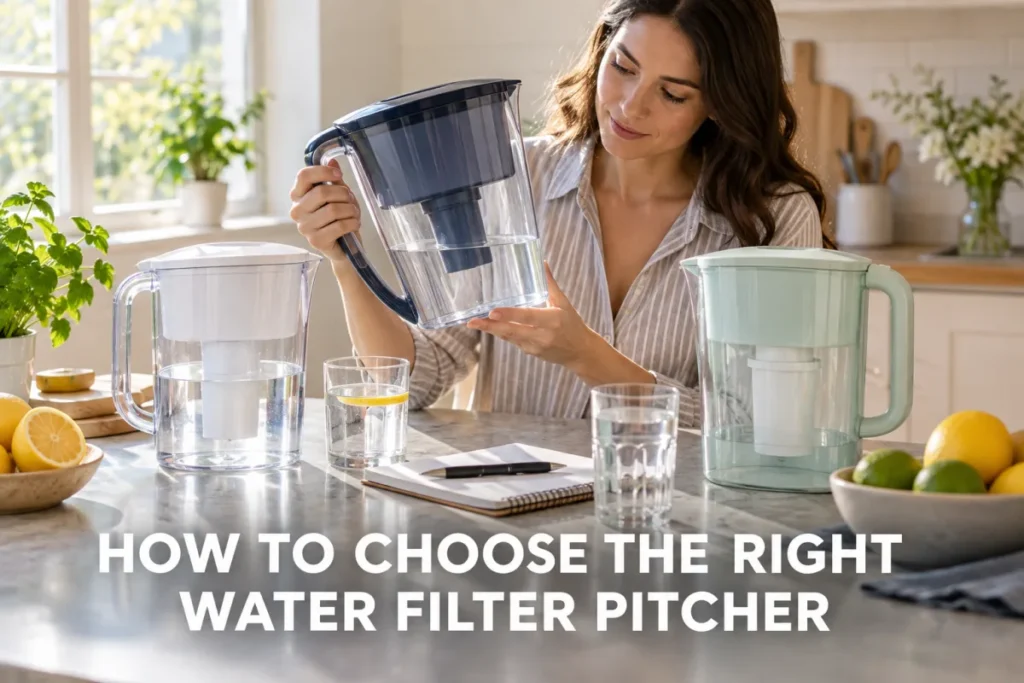
The right water filter pitcher is not one specific product. It is whichever pitcher holds NSF/ANSI 53 certification (an independent standard that checks for health-related contaminant removal). That pitcher also has to match what is in your water. Most store-shelf pitchers only meet NSF/ANSI 42. That standard improves taste and odor but says nothing about safety. The right choice depends on your water report, household size, and cost per gallon over a year.
By the end, you will know which certification matters most. You will see how activated carbon differs from reverse osmosis and alkaline pitchers. You will also learn how to size capacity and filter life to your household, so you do not pay more per gallon than you need to.
Key Takeaways
- A pitcher’s certification, NSF/ANSI 53 rather than 42, shows it actually removes harmful contaminants.
- Activated carbon removes chlorine, taste, and odor. On its own it does not remove dissolved metals or total dissolved solids.
- Certification scope, not price or brand name, shows which pitcher actually removes the most contaminants.
- Most pitcher filters last about 40 gallons or two months, so replacement cost matters as much as sticker price.
What Is the Best Water Filter Pitcher for Your Home?


A water filter pitcher is a portable container with a built-in filter. Water passes through it by gravity before it reaches the reservoir. What makes one the best for a household comes down to four things: certification scope, contaminant cut, reservoir size, and cost per gallon.
Certification is the standard that sets pitchers apart. It comes from outside labs, not from a brand’s own ads. NSF/ANSI 42 certifies chlorine taste and odor only. NSF/ANSI 53 certification covers health effects, including lead and certain PFAS (per- and polyfluoroalkyl substances, a group of persistent industrial chemicals). Only the second standard backs a real health-related removal claim.
The distinction rarely appears on packaging. A pitcher labeled NSF certified with no standard number could mean only NSF/ANSI 42. That standard changes nothing about what dissolves in your glass. Capacity and cost per gallon matter too, but certification comes first. A large reservoir with a weak filter still leaves pollutants behind. A small one with strong certification just means refilling it more often.
Consumer Reports uses the same criteria this guide uses: certification, pollutant cut, and cost per filter. It does not name one universal winner. Its lab testing is one more data point to check alongside NSF/ANSI certification. It does not replace checking what a pitcher is certified to remove.
How Activated Carbon Filtration Works in a Pitcher
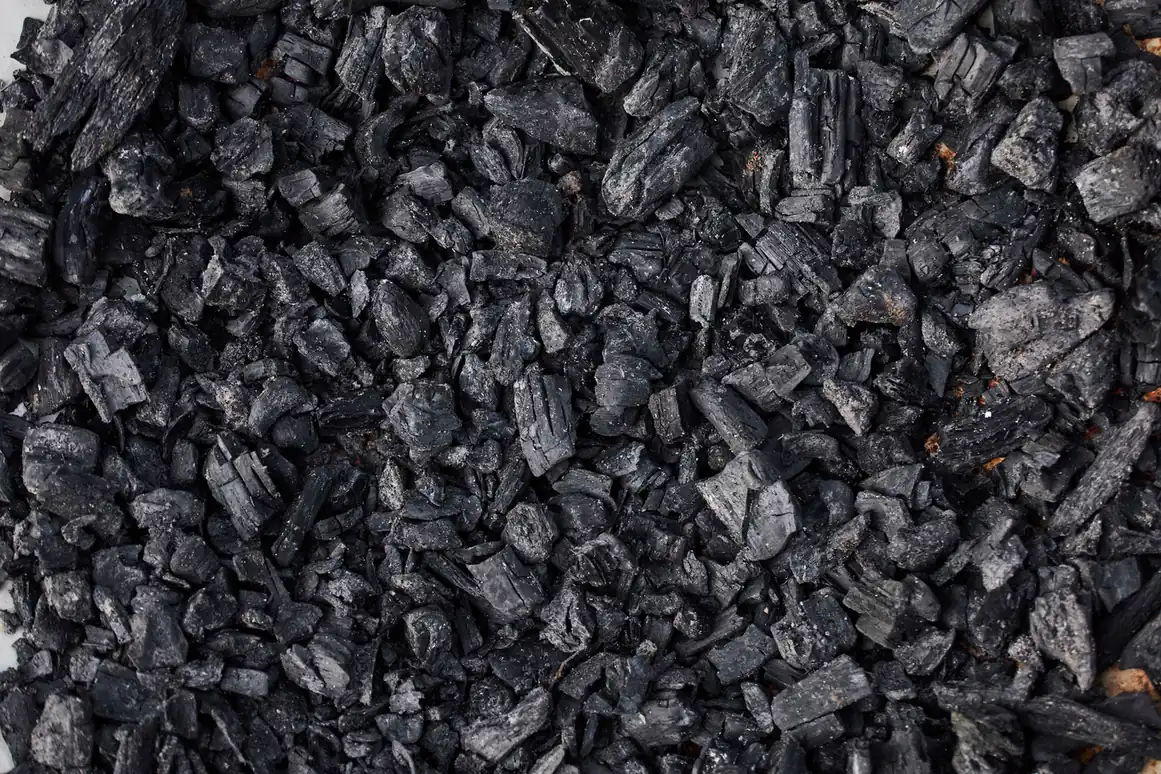
Almost every water filter pitcher on the market runs water through the same base material: activated carbon. That carbon is treated with heat and oxygen, so its surface fills with millions of tiny pores. The porous carbon does not strain out particles like a mesh screen. Instead it works through adsorption, binding contaminant molecules to its surface as water flows past. One gram of activated carbon can expose more than 500 square meters of pore surface to the water passing through it.
That adsorption process is what carbon fixes well: chlorine taste, odor, and the chemical byproducts city treatment leaves behind. NSF International certifies this exact function under NSF/ANSI 42. That standard covers taste, odor, and chlorine, not health-based contaminants. A carbon-only design is tested to this level only. That is worth checking if you own a Brita water pitcher, to see exactly what it filters.
Carbon filtration has clear limits. It does not remove dissolved metals like lead or arsenic. On its own it does nothing to lower total dissolved solids (TDS), the combined measure of minerals and salts dissolved in water. That changes only if the filter blends in more media, such as ion-exchange resin. That gap is exactly why certification scope, not the word carbon on the box, is the detail worth checking next.
A whole-house sediment-and-carbon cartridge narrows that certification gap at the entry point for every tap in the home; my PUREPLUS sediment filter review covers an NSF 42 certified 5-micron option in that format.
Here is the detail most shoppers miss: NSF/ANSI 42 certification by itself gives no proven health protection. It only confirms that chlorine taste and odor improved during testing. It does not confirm that lead, PFAS, or bacteria were addressed at all. That is exactly why the certification level covered next matters more than the pitcher’s price tag.
Which Water Filter Pitcher Removes the Most Contaminants
Contaminant removal is not about brand names. It comes down to which standards a pitcher is actually certified against. A filter stamped with NSF/ANSI 53 has been tested on its own for specific health-related contaminants, such as lead and cysts. NSF/ANSI 401 extends that testing to newer contaminants. That list includes certain drugs and pesticides that ordinary carbon filtration was never built to catch.
PFAS (per- and polyfluoroalkyl substances, a group of manufactured chemicals linked to long-term health risks) is the clearest example. NSF/ANSI 53 certification for PFAS means a pitcher must cut seven named PFAS compounds below 20 parts per trillion. The EPA tells shoppers to check for that exact certification. Do not trust a maker’s contaminant-count claim on the box instead.
Outside testing groups add another data point on top of certification. Consumer Reports, for example, runs its own lab tests across pitcher brands. It treats that as one input alongside certification, not a swap for it. Put the two checks together. The best water filter pitcher for pollutant removal comes down to certification scope first and outside testing second.
Certification scope is what changes most between pitcher types.
| Certification Level | Contaminants Verified | Best Suited For |
| NSF/ANSI 42 only | Chlorine taste and odor | Municipal water with no known contaminant concerns |
| NSF/ANSI 42 + 53 | Taste, odor, plus lead and cysts | Households with older plumbing or a private well |
| NSF/ANSI 42 + 53 + 401 | Taste, odor, lead, cysts, plus PFAS and other emerging contaminants | Areas with documented PFAS or pharmaceutical contamination |
Types of Water Filter Pitchers: Carbon, Alkaline, and RO-Hybrid
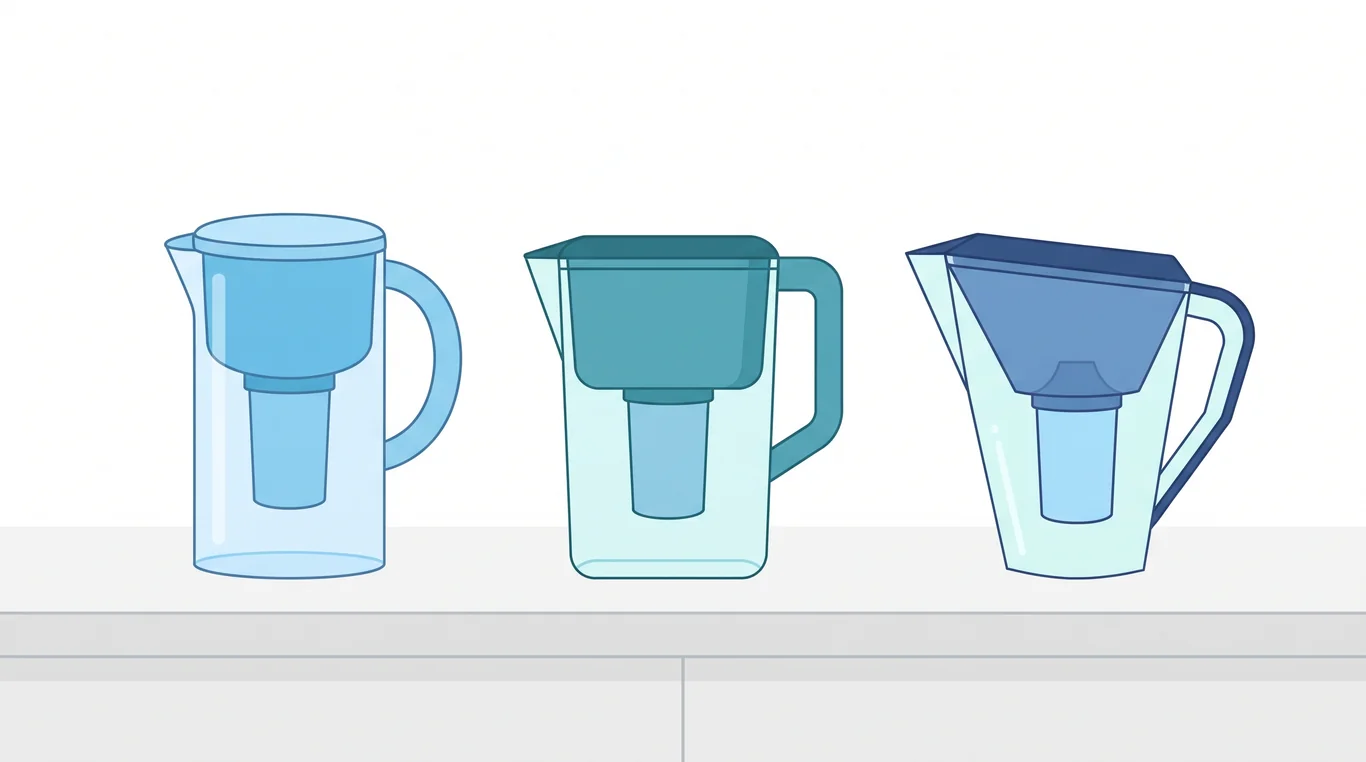
Every pitcher builds on the carbon base from the last section. Makers add other parts to change what the filter does past chlorine and taste. Three types cover most of what is sold today: standard carbon, alkaline (or remineralizing) pitchers, and reverse-osmosis-hybrid pitchers built around deionization.
A full under-sink RO system with a dedicated alkaline remineralization stage covers the pH recovery that pitcher formats handle through added minerals rather than membrane filtration; my iSpring RCC7AK comparison covers the NSF/ANSI 58 certified 6-stage option with that stage built in.
Here is what changes between the three:
- Standard carbon: removes chlorine taste and odor and, when certified to NSF/ANSI 53, lead and other regulated contaminants. This is the base setup used in most pitchers sold today.
- Alkaline or remineralizing: water passes through carbon first. Then it passes through a mineral cartridge that raises pH and adds back calcium and magnesium. This changes taste and mineral content. It does not add a contaminant-removal claim.
- Reverse-osmosis-hybrid: pairs carbon with a deionization stage. That stage strips out both contaminants and dissolved minerals. That is why models like ZeroWater use up their filter after roughly 25 to 40 gallons. A carbon-only cartridge typically lasts 100-plus gallons.
True reverse osmosis (RO, a process where a membrane blocks nearly all dissolved solids) is rare in pitcher form. NSF/ANSI 58 governs reverse-osmosis systems.
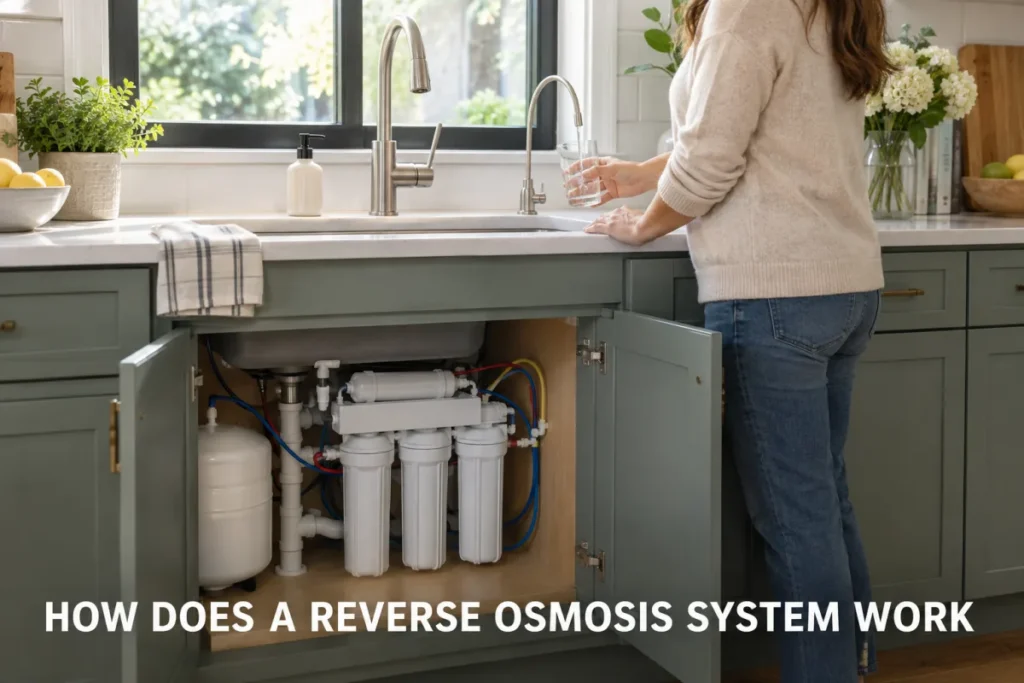
Households ready to step up to a full under-sink RO system can check my iSpring RCC7 hands-on review for a detailed look at what NSF/ANSI 58 certification means in practice. It calls for a minimum 75 percent cut in total dissolved solids, a bar that few countertop-sized cartridges are built to meet. For no-plumbing filtered drinking water without a pitcher, a countertop water filter handles chlorine and lead removal at a lower per-gallon cost. That is why most pitchers marketed as reverse osmosis actually use the deionization-hybrid design above, not true membrane-based RO.
What to Look for Before You Buy: Capacity, Cost, and Fit
Reservoir capacity should match how your household actually drinks and cooks, not just fit the fridge shelf. If you live alone, a six-cup pitcher might be enough. A family of four typically needs a 10-cup or larger reservoir to avoid refilling several times a day just to keep up with cooking and drinking water.
Filter life is where a great value water filter pitcher stands apart from one that only looks cheap on the shelf. A cartridge rated for 40 gallons and replaced every two months costs more per year than a 100-gallon cartridge that lasts four months. That is true even if the sticker price looked lower at checkout. Working out the cost per gallon, not the shelf price, is what to look for in a water filter pitcher before you check out. Regularly cleaning the reservoir between filter changes also keeps flow rate and taste consistent.
Certification should outrank price every time, especially if you have kids at home. The CDC recommends filters certified to NSF/ANSI Standard 53 for lead removal. A great value water filter pitcher for home use should meet that standard first. Only then should you look at capacity or design.
Faucet-mounted clip-on filters carry those same certifications without taking up fridge or counter space; my PUR Plus water filter review covers how NSF and WQA certification looks on one of the most popular clip-on faucet models.
Physical fit matters too. It is easy to overlook next to the spec sheet. A pitcher that earns top capacity marks may not fit your fridge shelf. That sends more than one otherwise well-reviewed pitcher back to the store within a typical 30-day return window.
How We Research
We check every claim against primary sources. Federal agencies like the EPA and CDC come first. Certification bodies like NSF and AHAM come next. We verify each standard number against the issuing body. We review this guide on a set schedule.
Why Trust This Guide
Puritisimo covers only water and air quality. Our guidance is editorial and independent. We cite every health figure so you can check it. We never present a promotional claim as fact.
Choosing the Pitcher That Fits Your Water, Not Just Your Budget
No single pitcher earns the title of best for every household. The water coming out of one tap is never quite the same as the water from another tap. A family on a city supply with no history of lead or PFAS may do just fine with a basic carbon pitcher certified only to NSF/ANSI 42. My Waterdrop PT-07B Review covers one of the most popular options at that NSF 42 certification tier in full detail.
A household on a private well, or in a city with known contamination, needs the broader coverage of NSF/ANSI 53 or 401. Price or pitcher color should not enter the decision before that. Capacity and cost per gallon narrow the shortlist further, but certification decides which pitchers belong on it. If a pitcher does not fit your household’s volume or budget, our guide to the best water filter covers other formats worth a look. Once those checks line up, working out what the best water filter pitcher is for your household stops being a guess.
Frequently Asked Questions
What is the best water filter pitcher?
The best water filter pitcher for most households is one certified to NSF/ANSI 53, not just the more common NSF/ANSI 42 taste-and-odor standard. It should be sized to your household’s daily water use and checked against the actual cost per gallon of new filters. Certification scope matters more than brand name or price once those three factors are counted.
What water filter pitcher removes the most contaminants?
Contaminant removal tracks certification scope, not brand claims. A pitcher certified to NSF/ANSI 53 and 401 together has been checked on its own against a wider range of pollutants, including PFAS. That is a wider range than one certified only to the base NSF/ANSI 42 taste-and-odor standard. The EPA also points to this certification when naming PFAS-capable filters.
Is there a better water pitcher than Brita?
The comparison to Brita comes down to certification, not brand name. Brita’s base line carries NSF/ANSI 42 certification for taste and odor. Several rival pitchers add NSF/ANSI 53 or 401 certification instead. That verifies a wider set of health-related contaminants. The base Brita line has not been tested against those.
Is ZeroWater better than Brita?
ZeroWater and Brita use different methods. Neither one simply beats the other. ZeroWater adds a deionization stage that strips total dissolved solids (TDS) along with pollutants. That is why its filters typically last only 25 to 40 gallons before they need to be swapped. Brita’s carbon-only design leaves more dissolved minerals in place and lasts closer to 100 gallons per cartridge, built around the same NSF/ANSI 42 standard.
What is the right water filter pitcher according to Consumer Reports?
Consumer Reports uses the same criteria this guide uses: certification, pollutant cut, and cost per filter. It does not name one universal winner. Its lab testing is one more data point to check alongsideNSF/ANSI certification. It does not replace checking what a pitcher is certified to remove.
References
- EPA. Identifying Drinking Water Filters Certified to Reduce PFAS. Accessed 2026.
- NSF International. Standards for Water Treatment Systems. Consumer Resources. Accessed 2026.
- CDC. Lead Prevention: Drinking Water. Accessed 2026.
Medical Disclaimer: This content is for informational purposes only. It is not a substitute for professional medical advice, diagnosis, or treatment. If you have concerns about your water quality or air quality and their effects on your health, consult a qualified healthcare professional.