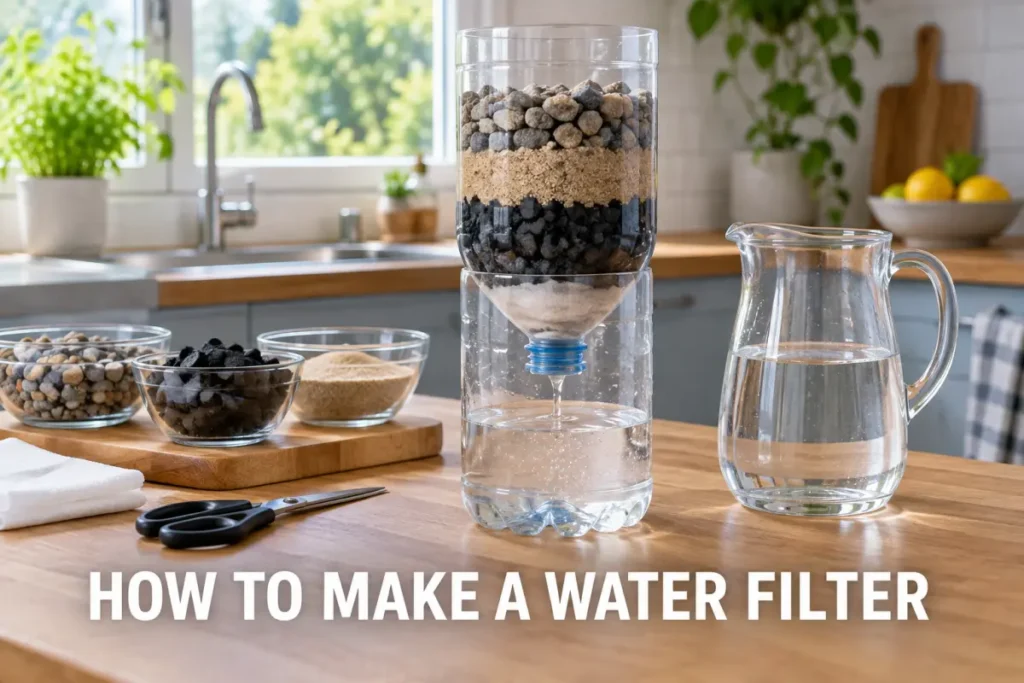
A homemade water filter is built by layering coarse-to-fine materials, cloth, charcoal, sand, and gravel, inside a bottle. Gravity pulls water through and traps particles along the way. This simple design has worked for years and takes about fifteen minutes to assemble with items most homes already have on hand. Making a water filter at home comes down to getting that layer order right.

This guide walks through the classic bottle method, plus outdoor and ceramic variations. It shows why the material order matters more than the materials themselves. It also covers the one step each version still needs before the water is safe to drink.
Key Takeaways
- A bottle filter layers cloth, charcoal, sand, and gravel in a specific order for water to pass through cleanly.
- Charcoal traps odors and some chemicals through adsorption, but it does not remove bacteria or viruses.
- Silver-coated ceramic filters remove more bacteria than plain clay, but they still cannot catch viruses.
- Boil or chemically disinfect homemade-filtered water before drinking to kill any remaining bacteria, viruses, or parasites.
How to Make a Water Filter at Home (Step by Step)
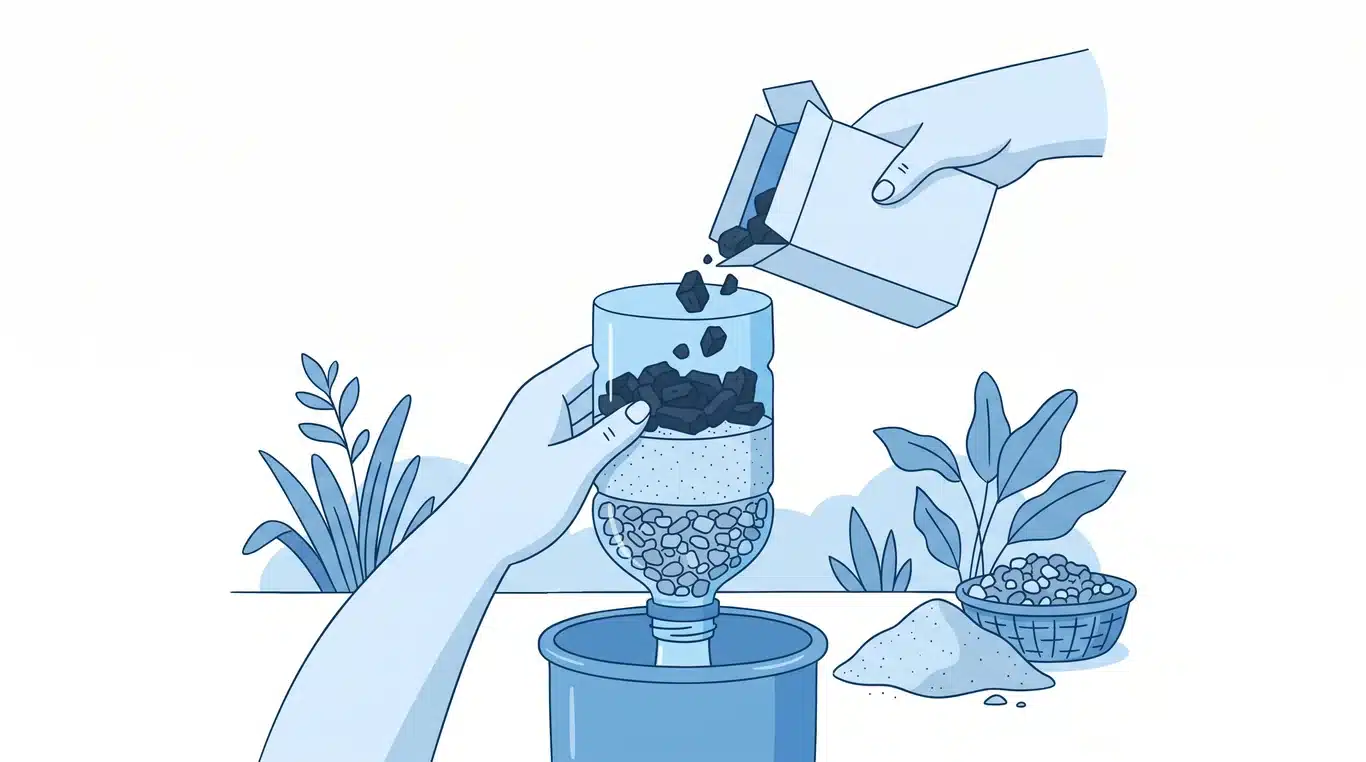
Gravity pulls water down through layers of material stacked from coarse to fine. Each layer strains out particles too large to pass through its gaps.
- Cut the bottom off a plastic bottle and set it aside.
- Turn the top half upside down so the cap points downward, forming a funnel.
- Push cloth or cotton into the neck to hold the layers and catch the largest debris.
- Add a layer of activated charcoal directly on top of the cloth.
- Add a layer of sand above the charcoal.
- Add a layer of gravel on top of the sand to finish the stack.
- Pour water in slowly, and discard the first cloudy batch before getting the rest.
Activated charcoal works through adsorption (a process where compounds stick to the surface of the material instead of passing through it). That is why it targets odors and certain chemicals instead of straining them out like sand and gravel do.
Finer materials sit near the neck and coarser ones sit on top for a reason. Water passes through the tightest layer last before it exits the bottle. This is the same coarse-to-fine staging used in sediment pre-filters on commercial water systems.
Boil filtered water at a rolling boil for at least one minute before drinking it from an unfamiliar source.
What Each Filter Material Actually Removes
Each layer in a homemade water filter earns its place by doing one job. Sand and gravel work by straining, trapping particles too big to pass between the grains. Charcoal is different. It relies on adsorption to pull contaminants from the water instead of blocking them by size.
That difference is why a carbon water filter layer improves taste and odor more than a sand-only setup ever could. Knowing how charcoal filters water helps explain the whole stack’s logic.
Here is what each material adds to the stack:
- Sand: Filters out fine sediment and cloudiness by physically blocking particles larger than its grain size.
- Gravel: Pre-filters the largest debris, like leaves and grit, and keeps the finer layers above it from washing down and clogging the outlet.
- Activated charcoal: Adsorbs some pesticides, chlorine byproducts, and odor-causing compounds, which is why a charcoal layer clearly improves taste.
- Cloth or cotton: Acts as the final physical barrier, catching loose particles the layers above let through before the water exits the container.
None of these materials disinfect water, no matter how many layers you stack. The CDC (Centers for Disease Control and Prevention) recommends a filter rated at 1 micron or smaller. Another option is reverse osmosis (RO, a fine-membrane filtration method).
That standard is what it takes to remove parasites like Cryptosporidium and Giardia (waterborne parasites that cause intestinal illness). A loosely packed sand-and-charcoal layer does not meet that standard. Treat a homemade filter as a clarity fix, not a safety guarantee.
Making a Water Filter in the Wild or While Camping
Building a portable water filter in the wild follows the same coarse-to-fine logic as the bottle version. It just uses materials found on the ground instead of bought at a store. A sock, a hollowed-out log, or a cone of birch bark can replace the plastic bottle as the outer shell. It just needs to hold layers of media and let water drain from one end.
Pack the same order: a plug of grass or moss at the drainage point, then sand, then crushed charcoal from a dead campfire. Finish with a coarser layer of gravel or small stones on top. Charred wood works almost like store-bought activated charcoal because burning strips away surface dirt and opens tiny pores that trap odor and some chemicals. It is far less consistent than the store-bought version, though.
Moss and dense grass double as a mechanical pre-filter, catching twigs, insects, and larger sediment before water reaches the sand layer. That keeps the finer layers from clogging within the first few uses.
A wilderness filter built this way is less reliable than the bottle version. There is no way to control grain size or layer thickness closely. Treat it strictly as a way to clear out visible dirt and debris before boiling or otherwise disinfecting the water. That step comes later in this guide.
How to Make a Water Filter With Ceramic Clay
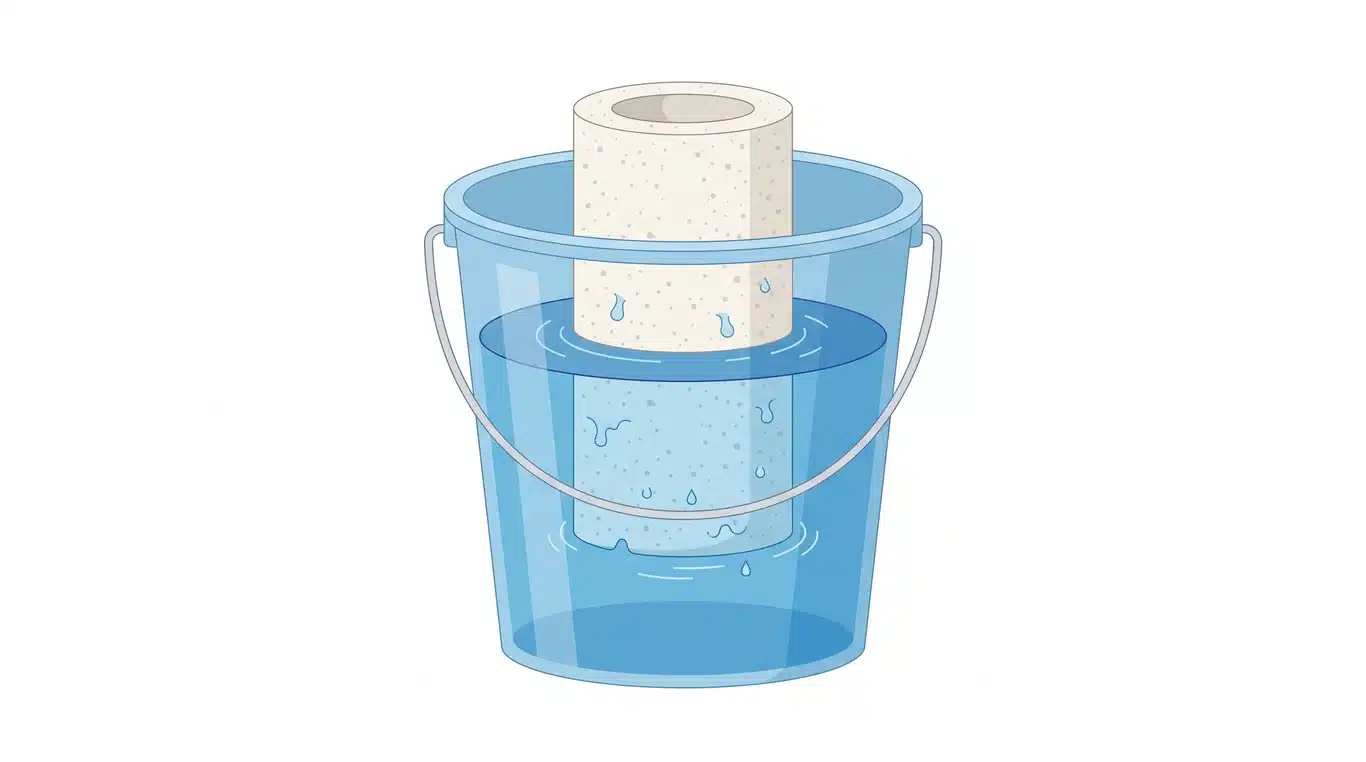
Fired clay is the most durable material in this guide for building a water filter. It works on a different principle than a loose layer stack. Mixing clay with sawdust or rice husks, then firing the mixture in a kiln, burns away the organic material. What is left behind is a maze of tiny gaps just wide enough to strain out sediment and many bacteria.
The clay-to-sawdust ratio controls how fine those gaps end up. More sawdust burns out more material and creates a coarser, faster-draining filter. Less sawdust produces a denser wall that filters more thoroughly but drains slower.
Some builders coat the fired shell with colloidal silver, which acts as a mild antimicrobial rather than a filter medium itself. In one published pore-size study, a silver-impregnated ceramic element improved E. coli (a common test bacteria) removal from 2.55 log to 4.91 log compared with plain fired clay.
Even with silver, a ceramic filter cannot catch viruses, since viruses are small enough to pass through pores that stop bacteria and parasites. A ceramic build still needs to be paired with boiling or chemical disinfection for water from an uncertain source.
Is a Homemade Water Filter Safe to Drink?
A homemade water filter is not a substitute for disinfection, and it is no replacement for the best water filter built for everyday use. It clears out sediment, cloudiness, and some odor. None of the builds in this guide fully remove the bacteria, viruses, or parasites that make water unsafe to drink.
The stakes are real. The CDC estimates 7.15 million waterborne illnesses occur in the United States each year. The WHO (World Health Organization) reports that roughly 1.7 billion people worldwide rely on a drinking water source contaminated with feces.
Whichever build you use, the CDC recommends boiling the filtered water at a rolling boil for at least one minute. Above roughly 6,500 feet elevation, boil it for three minutes instead. That single extra step kills the bacteria, viruses, and parasites that filtering by itself leaves behind. Building a filter for water purification starts with the same four layers. Stack cloth, charcoal, sand, and gravel as shown above. Then boil or disinfect what drains out. That two-step process completes purification, not the filter alone.
Here is how the four builds in this guide compare on what they can and cannot remove:
The CDC recommends a pore size of 1 micron or smaller to catch parasites like Cryptosporidium, a benchmark a sand-and-charcoal build does not meet.
| Method | Removes Sediment | Reduces Taste and Odor | Removes Bacteria | Removes Viruses |
| Bottle filter (sand and charcoal) | Yes | Yes | No | No |
| Wilderness filter (sock, moss, and charcoal) | Yes | Partial | No | No |
| Ceramic filter (plain clay) | Yes | Partial | Partial | No |
| Ceramic filter (silver-coated) | Yes | Partial | Partial | No |
How We Research
We check every claim against primary sources. Federal agencies like the EPA and CDC come first. Certification bodies like NSF and AHAM come next. We verify each standard number against the issuing body. We review this guide on a set schedule.
Why Trust This Guide
Puritisimo covers only water and air quality. Our guidance is editorial and independent. We cite every health figure so you can check it. We never present a promotional claim as fact.
Getting Safe Water From a DIY Filter
Knowing how to build a filter from a bottle, a sock, or a block of fired clay is a useful skill. It matters for an emergency, a camping trip, or a school project. Each method in this guide works the same way. Layer materials from coarse to fine so gravity pulls water through and traps particles along the way.
None of them make questionable water safe to drink on their own. Bacteria, viruses, and parasites are small enough to slip through even a well-built stack. Pair whichever build you choose with boiling or another disinfection step. See how a water filter works for more on the mechanics behind each layer. That is why pairing what you now know about making a water filter with a disinfection step matters most when it counts.
Frequently Asked Questions
How to make a water filter at home?
Making a water filter at home means layering coarse-to-fine materials, like cloth, sand, gravel, and charcoal, inside a container. Gravity pulls water through and traps debris along the way. Cut the top off a bottle, invert it as a funnel, and stack the materials before pouring water through slowly.
How effective is a homemade water filter?
A homemade filter clears sediment, cloudiness, and some odor, but it does not fully remove bacteria, viruses, or parasites. The CDC recommends a pore size of 1 micron or smaller to catch parasites like Cryptosporidium, a benchmark a sand-and-charcoal build does not meet.
How can I naturally purify water at home?
Filtering and purifying are different steps. A homemade filter clears particles, while purifying kills or inactivates pathogens through boiling, chlorine tablets, or ultraviolet light. Boil filtered water at a rolling boil for at least one minute before drinking it from an unfamiliar source.
What is the cheapest way to filter water at home?
The cheapest option is the two-liter bottle method using materials most homes already have. Grab a cloth scrap, sand, gravel, and charcoal from a cooled fire or charcoal briquettes. Cut the bottle, layer the materials coarse to fine, and pour water through slowly for a clearer, better-tasting result.
How to filter water naturally without a filter?
Natural substitutes work the same way a store-bought filter does. Cloth, grass, moss, and charred wood from a fire stand in for cotton, gravel, and activated charcoal. These materials still only strain out particles, so pair them with boiling before drinking the water.
References
- CDC. A Guide to Water Filters for Cryptosporidium and Giardia Parasites. 2023.
- CDC. Waterborne Disease and Outbreak Surveillance Reporting. MMWR Surveillance Summaries. 2024.
- WHO. Drinking Water. Fact Sheet. 2023.
- ResearchGate. Pore Size Distribution and Bacterial Log-Reduction in Silver-Impregnated Ceramic Water Filters. 2016.
Medical Disclaimer: This content is for informational purposes only. It is not a substitute for professional medical advice, diagnosis, or treatment. If you have concerns about your water quality or air quality and their effects on your health, consult a qualified healthcare professional.