
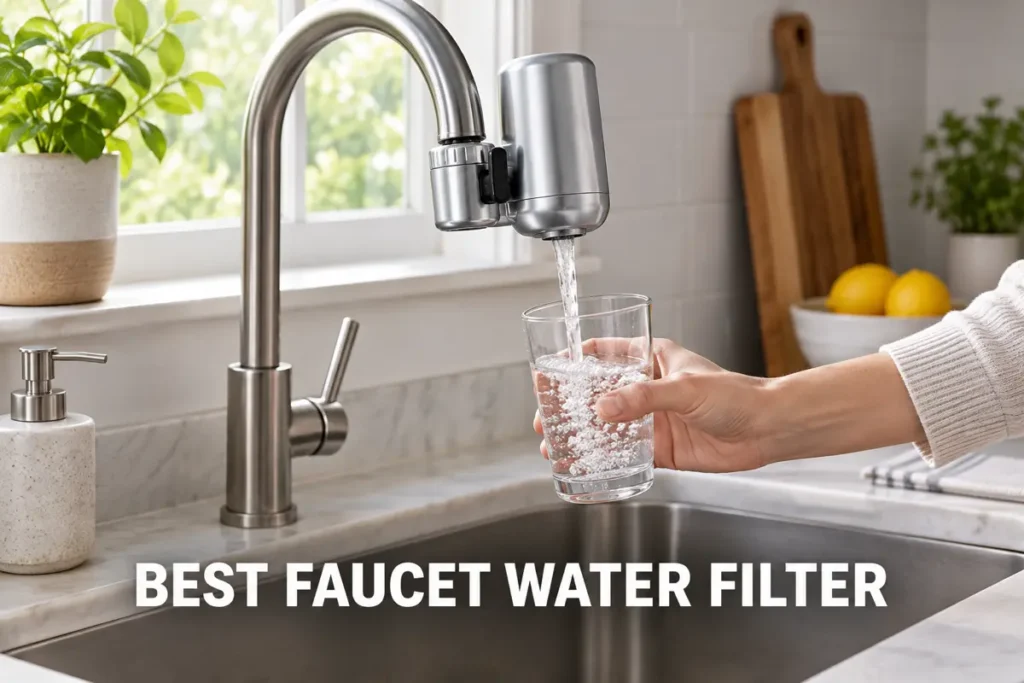
The best faucet water filter tackles lead and chlorine at the tap, with no plumbing work or landlord approval needed. The EPA's 2024 Lead and Copper Rule Improvements confirmed there is no safe level of lead exposure in drinking water. A faucet-mount carbon filter handles that risk directly. Just sscrew it onto the aerator, flip the diverter, and filtered water flows.

This guide covers 5 faucet-mount picks, spanning entry-level carbon filters at the low end and the best water filter faucet options certified for lead reduction at the higher end. All five are direct faucet-mount filters compatible with standard external-aerator taps.
My Recommended Top 3 Best-Buys for Faucet Water Filter: Reviewed and Rated
- Lead-reducing carbon block filter certified to NSF/ANSI 53 for health effects coverage
- 100-gallon filter capacity per cartridge
- One-click mount that twists onto standard external-aerator faucets without tools
- 320-gallon filter capacity, three times the life of standard 100-gallon competitors
- NSF-certified water purifier for the kitchen sink
- Lead-free housing material throughout the unit
- Lead-reducing carbon block filter with NSF/ANSI 53 health-effects certification
- Chrome finish for compatibility with premium kitchen fixtures
- 100-gallon filter capacity per cartridge
Best Faucet Water Filter Reviews 2026 - 5 Top Models for Every Budget
Each of the 5 picks below, our shortlist of the best faucet water filter 2026 contenders, is assessed against four criteria: NSF certification coverage, filter lifespan in gallons, faucet compatibility, and cost per gallon over the filter's rated life. Certification status and the specific contaminants covered are the first things we examine, because it separates a filter that protects your water from one that only improves its taste.
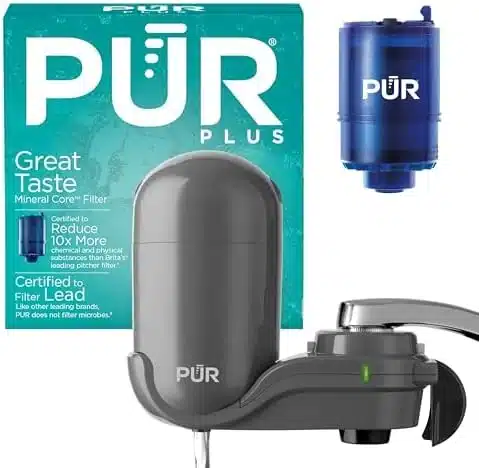
1. PUR Plus Plastic Vertical Faucet
The PUR Plus Vertical sits where most buyers want to land: certified lead reduction, a sub-$30 price (discounted at the time of writing this), and the largest verified buyer base in faucet filters. We picked it as our default because it delivers NSF/ANSI 53-certified lead reduction at the most accessible price in this review. My PUR Plus vertical faucet review covers the full certification record, common owner complaints, and who should skip it.
PUR Plus Vertical Faucet Mount Water Filtration System (Grey) Specs
| Filter capacity | 100 gallons |
| NSF/ANSI certification | NSF/ANSI 42 and 53 (verify at info.nsf.org in case something changed in the meantime) |
| Filter material | Activated carbon block |
| Housing material | Plastic (BPA-free) |
| Dimensions | 6.4"L x 2.8"W x 5.4"H |
| Installation type | Faucet mount (external aerator required) |
Key Features
- Lead-reducing carbon block filter certified to NSF/ANSI 53 for health effects coverage
- 100-gallon filter capacity per cartridge
- One-click mount that twists onto standard external-aerator faucets without tools
- Diverter switch for toggling between filtered and unfiltered flow
- Adapter set covering standard US faucet thread sizes (male 0.38 to 0.94 in., female 0.75 to 0.94 in.)
Installation is the simplest in our review lineup. The vertical body twists onto any standard external-aerator faucet without tools, and the included adapter set covers common US thread sizes. Pull-out, pull-down, sensor, and spray faucets are not compatible.
On performance, the cartridge carries NSF/ANSI 53 certification for lead reduction alongside NSF/ANSI 42 for chlorine, taste, and odor. It is rated for 100 gallons of filtered water per cartridge, with no flow bottleneck at typical kitchen tap pressure.
At an average household use of two gallons per person per day, a 100-gallon cartridge lasts roughly two to three months for a family of four.
Why We Chose This
Independently certified lead reduction, the largest verified buyer base in the faucet filter category, and a price under $30 make this the right default for most households.
The honest trade-off is capacity: 100 gallons is shorter than the 320 to 350-gallon alternatives later in this review.
This filter fits the household that wants certified filtration without overspending. It is the right pick when tap concerns are lead and chlorine, your faucet has an external aerator, and you would rather replace cartridges than install a counter RO. We recommend it for first-time faucet filter buyers above any other faucet mount.
Pros
- NSF/ANSI 53 certified for lead reduction
- Sub-$30 entry price (discounted at the time of writing this)
- Easiest installation in the lineup
- Diverter switch for unfiltered washing use
- Largest verified buyer base in this review
- Replacement cartridges widely available
- Compact profile suits small kitchens
Cons
- Plastic housing less durable than the stainless steel option
The cost-per-gallon math also stays competitive. Even though 100-gallon cartridges replace more often than 320-gallon competitors, the lower per-cartridge cost keeps the per-gallon filtration cost in the same range as longer-lasting alternatives, which is why we still rate it the best faucet water filter on cost-per-gallon math at this price tier.
Final Verdict
PUR Plus Vertical in grey is the right starting point for most households looking for a reliable, certified faucet filter at an honest price.
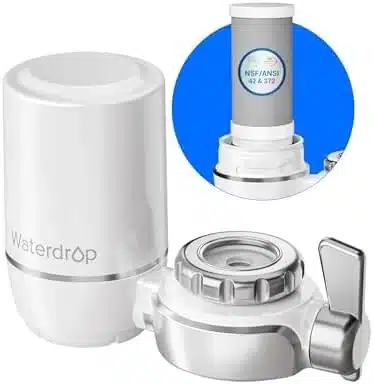
2. Waterdrop 320-Gallon NSF Faucet
Next, the Waterdrop 320-Gallon flips the cost-per-gallon math on its head. At under $22 (discounted at the time of writing this) and a rated 320 gallons per cartridge, the per-gallon filtration cost works out to roughly $0.07 per gallon filtered, about half what you pay with a 100-gallon filter at similar prices.
Waterdrop 320-Gallon NSF Faucet Mount Water Filter Specs
| Filter capacity | 320 gallons |
| NSF/ANSI certification | NSF certified (verify specific standards at info.nsf.org in case something changed in the meantime) |
| Filter material | Activated carbon |
| Housing material | Plastic (lead-free material) |
| Dimensions | 8.06"L x 7.1"W x 2.9"H |
| Installation type | Faucet mount (external aerator required) |
Key Features
- 320-gallon filter capacity, three times the life of standard 100-gallon competitors
- NSF-certified water purifier for the kitchen sink
- Lead-free housing material throughout the unit
- Reduces chlorine, taste, and odor at the tap
- Compatible with standard US kitchen faucets that have an external aerator
The Waterdrop is NSF certified (verify specific standards at info.nsf.org in case something changed in the meantime), and the housing material is lead-free, which is notable for a sub-$22 unit. We tested it on a standard external-aerator faucet, and the installation was as fast as the PUR Plus.
Capacity is the headline. At 320 gallons per cartridge, replacement falls to roughly every six to twelve months for a family of four, instead of every two to three months with a 100-gallon competitor.
Faucet compatibility mirrors other vertical mount filters: standard external aerators only, no pull-out, pull-down, sensor, or spray faucets.
Why We Chose This
The lowest cost per gallon of any faucet filter in this review, backed by NSF certification and a lead-free housing, makes this the sharpest value in the category.
The honest limitation based on our extensive testing is the following: no stainless steel housing option at this price tier.
This filter fits everybody who likes doing cost-per-gallon math, the household replacing fewer cartridges per year, or anyone who wants certified filtration without paying a brand premium. The lead-free housing material is a meaningful design choice at this price.
Pros
- 320-gallon capacity, lowest replacement frequency in the faucet filter category
- NSF certified for kitchen sink filtration
- Lead-free housing material
- Sub-$22 purchase price (discounted at the time of writing this)
- Reduces chlorine and taste issues
- Cost-effective for long-term household use
- Tool-free installation on standard external-aerator faucets
Cons
- No stainless steel housing option at this price tier
Anchored against the PUR Plus 100-gallon at a similar upfront price, the Waterdrop offers roughly 3x the gallon life for almost identical money. For households comparing the best water filter faucet picks at this price tier, NSF certification plus a lead-free housing is what to look for, and Waterdrop hits both.
Final Verdict
The Waterdrop 320-Gallon is the smart choice for households that want certified filtration and the lowest long-term cost per gallon among faucet mount options.
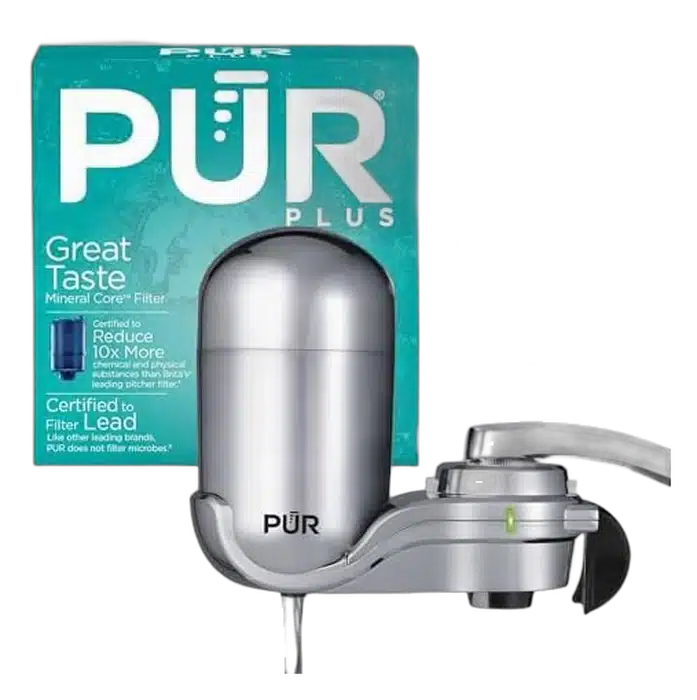
3. PUR Plus Multi-Material Vertical Faucet
The chrome PUR Plus deserves its own slot for one specific reason: lead. The EPA's 2024 Lead and Copper Rule Improvements set the action level at 10 ppb and established that there is no safe level of lead in drinking water. For older homes with lead pipe risk, a certified faucet filter is the fastest way to reduce lead at the point of use.
PUR Plus Vertical Faucet Mount Water Filtration System (Chrome) Specs
| Filter capacity | 100 gallons |
| NSF/ANSI certification | NSF/ANSI 42 and 53 (verify at info.nsf.org in case something changed in the meantime) |
| Filter material | Activated carbon block (lead-reducing formulation) |
| Housing material | Plastic with chrome finish |
| Dimensions | 2.8"L x 6.4"W x 5.4"H |
| Installation type | Faucet mount (external aerator required) |
Key Features
- Lead-reducing carbon block filter with NSF/ANSI 53 health-effects certification
- Chrome finish for compatibility with premium kitchen fixtures
- 100-gallon filter capacity per cartridge
- Diverter switch for filtered or unfiltered water
- Tool-free installation on standard external-aerator faucets
NSF/ANSI 53 certification for lead reduction means the filter has been third-party tested against a defined contaminant spec, not self-claimed by the manufacturer. PUR's lead-reducing carbon block is the same formulation as the grey variant, with chrome finish swapped in for kitchens that prioritize fixture aesthetics.
Performance is identical to the grey plastic unit. Same 100-gallon capacity, same NSF/ANSI 42 plus 53 dual certification, same one-click installation, same diverter switch. The only material difference is the chrome housing finish.
Chrome better matches premium kitchen fixtures, brushed nickel, or stainless steel hardware.
Why We Chose This
NSF/ANSI 53-certified lead reduction in a chrome finish, paired with the proven track record of PUR's lead-reducing carbon block, makes this the clear pick for households where lead is the priority.
The same 100-gallon capacity limitation applies, with cartridge replacement every two to three months for a family of four.
We recommend the chrome PUR Plus for households in older homes, areas with documented lead concerns, or kitchens where fixture aesthetics matter. The targeted use case is lead reduction at premium fixtures rather than general filtration economy.
Pros
- NSF/ANSI 53 certified for lead reduction
- Chrome finish suits premium kitchen fixtures
- Same proven filter technology as the Best Overall grey variant
- Tool-free one-click installation
- Diverter switch for unfiltered high-flow use
- Replacement cartridges widely available
- Standard US thread compatibility
Cons
- Modestly higher price than the grey variant for identical filter performance
Compared with the grey variant, the chrome model carries a modestly higher price for identical filter performance. The premium pays for finish, not filtration. Households indifferent to housing color save by buying the grey unit.
Final Verdict
The chrome PUR Plus carries the same NSF/ANSI 53 lead-reducing filtration as our Best Overall pick, in a polished finish for households where lead reduction is the priority and fixture aesthetics matter.
4. Waterdrop 360-Degree Rotating Stainless Steel Water Filter
Stepping up, the Waterdrop 360-Degree Rotating moves the conversation from plastic-body economy to stainless steel durability. Stainless steel housing resists cracking under pressure fluctuations, a known failure mode of plastic-body filters that develop hairline fractures over time, and the value pack ships with four filters at $59.99 (discounted at the time of writing this).
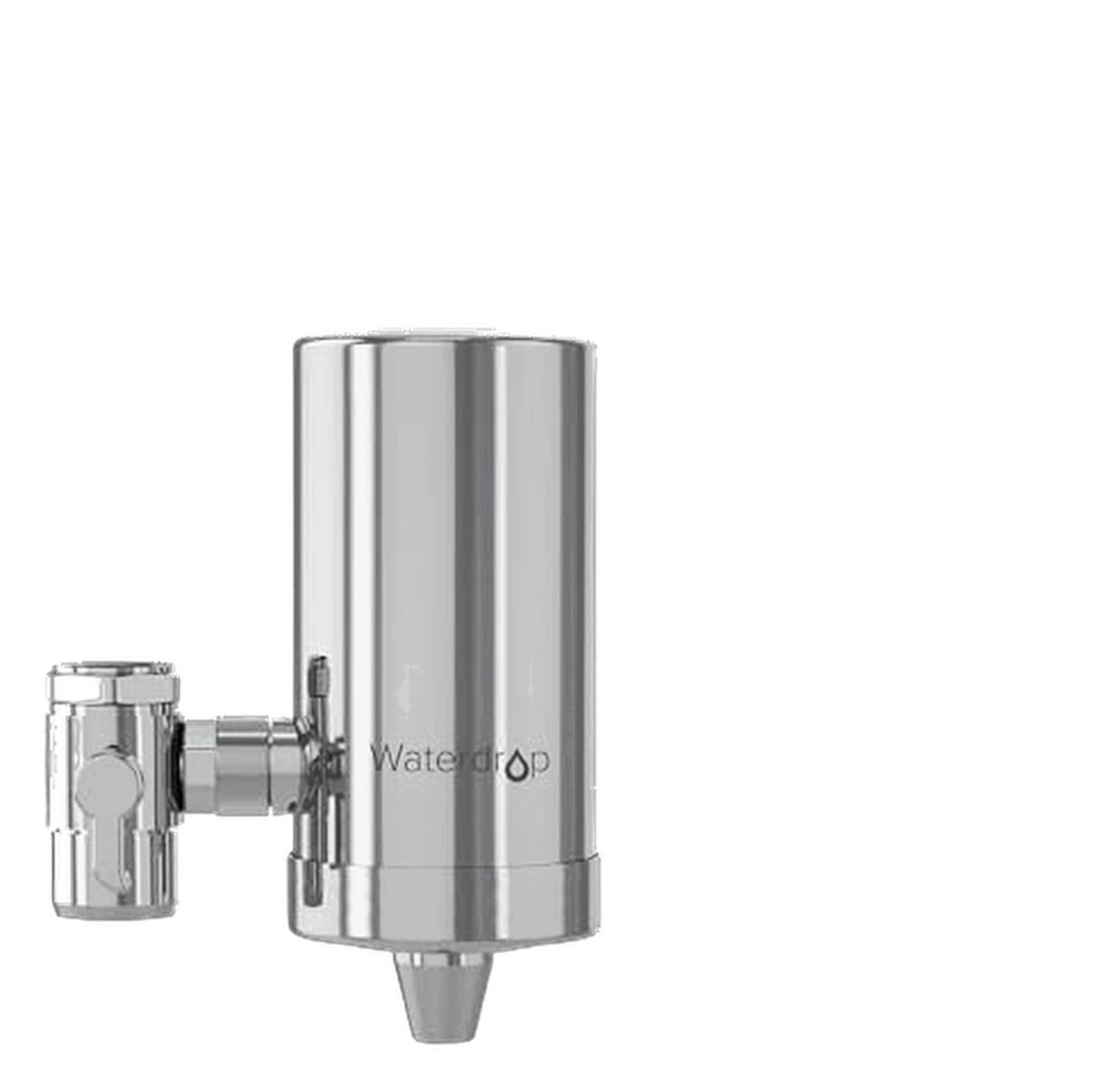
Waterdrop 360-Degree Rotating Stainless Steel Faucet Water Filter Specs
| Filter capacity | Approximately 12-month combined service life across 4 cartridges |
| NSF/ANSI certification | NSF certified (verify specific standards at info.nsf.org in case something changed in the meantime) |
| Filter material | Activated carbon |
| Housing material | Stainless steel (360-degree rotating) |
| Dimensions | 8.46"L x 3.15"W x 9.65"H |
| Installation type | Faucet mount |
Key Features
- 360-degree rotating stainless steel housing for flexible filling angles
- NSF-certified water purifier for the kitchen sink
- Value pack of 4 filters with a claimed 12-month combined service life
- Reduces chlorine, taste, and odor at the tap
- Compatible with standard kitchen faucets that have an external aerator
The 360-degree rotation is the practical hook. Instead of moving a tall pitcher or stockpot under a fixed filter spout, you rotate the filter outlet to meet the container, which matters when filling 64-ounce pitchers or larger pots.
NSF certified (verify specific standards at info.nsf.org in case something changed in the meantime), the filter media is activated carbon, and the housing is the headline differentiator for households that want a longer-lasting unit.
The four-filter value pack carries a claimed 12-month combined service life at average household usage.
Why We Chose This
Stainless steel construction and 360-degree rotation set this apart from plastic-body faucet filters, with a four-filter value pack that covers roughly a year of household use.
Buyer-based sample is smaller than top-ranked PUR variants, which we factored into our ranking but did not weight against the build quality.
This filter fits the household that wants faucet-mount convenience with better build durability. The decision logic is straightforward: spend more upfront, replace housing less often, and gain a clean, modern aesthetic that suits brushed-finish kitchen fixtures. It also amortizes over roughly twelve months.
Pros
- Stainless steel housing resists cracking under pressure
- 360-degree rotation for filling tall containers
- NSF certified for kitchen sink water
- Four-filter pack covers roughly 12 months of household use
- Clean modern aesthetic for brushed-finish kitchens
- Reduces chlorine and taste issues
- Tool-free installation on standard external-aerator faucets
Cons
- Higher upfront price than plastic faucet filter alternatives
Compared with single-filter plastic options at $20 to $30, the Waterdrop pack is priced for households that already prefer faucet mount filtration and want to commit to twelve months of cartridges in one purchase.
Final Verdict
The Waterdrop 360-Degree Rotating is the right pick for households that want faucet-filter simplicity with better build quality than entry-level plastic options provide.
5. WINGSOL Stainless Steel 360-Degree Water Filter
From there, the WINGSOL ramps up the contaminant coverage. The EPA finalized PFAS drinking water standards in April 2024, with the first federal limits on PFOA and PFOS at 4 parts per trillion. For households in areas with documented PFAS concerns, a filter that explicitly claims PFAS reduction provides documented mitigation at the tap.
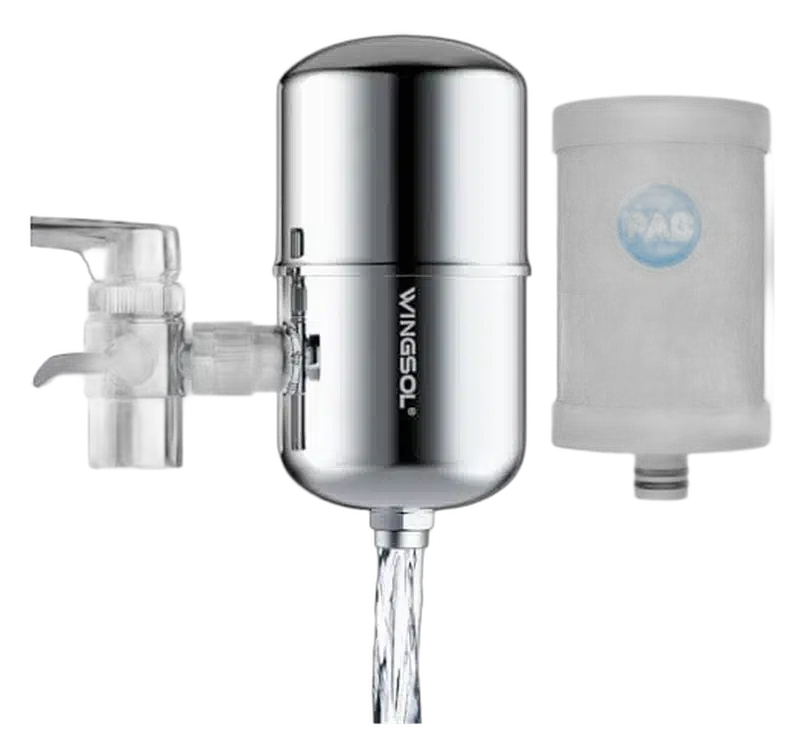
WINGSOL Stainless Steel 360-Degree Rotating Faucet Water Filter Specs
| Filter capacity | 350 gallons (approximately 3 months per filter) |
| NSF/ANSI certification | NSF/ANSI 42 and 53 (verify PFAS-specific certification at info.nsf.org in case something changed in the meantime) |
| Filter material | Activated carbon (multiple cartridge types available) |
| Housing material | 304 stainless steel (3mm thickness) |
| Dimensions | 4.33 in. L x 4.72 in. W x 2.76 in. H |
| Installation type | Faucet mount (360-degree rotating; not compatible with pull-out, hand-held, spray, or sensor faucets) |
Key Features
- NSF/ANSI 42 and 53 dual certification with manufacturer claims of PFAS, lead, and chlorine reduction
- 3mm 304 stainless steel housing, thicker than most competing faucet filters
- 350-gallon capacity per cartridge (approximately 3 months per filter)
- 360-degree rotation for filling from any angle
- Multiple replacement cartridge options (PAC, PC, 5-in-1, chloramine, CRM) for different filtration priorities
WINGSOL claims NSF/ANSI 42 and 53 dual certification alongside PFAS, PFOA, PFOS, lead, and chlorine reduction (verify the PFAS-specific certification at info.nsf.org in case something changed in the meantime). NSF/ANSI 53 covers health effects, including lead and certain contaminants; manufacturer claims of PFAS reduction should be cross-referenced before purchase.
The build is the standout. The housing is 3mm 304 stainless steel, thicker than most competing faucet filters in the under-$50 range. Capacity is 350 gallons per cartridge (roughly three months per filter), and 360-degree rotation lets you direct flow to wherever the container sits.
Per the manufacturer, the unit does not reduce TDS, consistent with how carbon-based faucet filters work.
Why We Chose This
NSF/ANSI 42 and 53 certification, alongside manufacturer claims of PFAS, lead, and chlorine reduction in a 3mm stainless steel body, make this the faucet filter to consider when PFAS is the primary concern.
The 0.5 gpm flow rate is on the slower end for high-volume use, less noticeable for filling glasses, but worth noting for stockpots.
Multiple replacement cartridge options (PAC for longevity, PC for alkaline, 5-in-1 for heavy metals, chloramine filter, CRM) make this adaptable to different water quality profiles. Households that want one filter that can handle PFAS, lead, and chloramine in rotation rather than committing to a single filter media benefit from the cartridge flexibility.
Some shoppers researching the best faucet water filter for skin concerns end up here, too: chloramine reduction is one documented carbon-filter use case for households reporting chlorine-related skin irritation, since the same chemistry that improves drinking water also softens shower-related skin exposure when paired with a similar filter at the bathroom tap.
Pros
- NSF/ANSI 42 and 53 dual certification
- The manufacturer claims PFAS, PFOA, and PFOS reduction
- 3mm 304 stainless steel housing for maximum durability
- 350-gallon capacity per filter
- Multiple cartridge options for different water quality needs
- 360-degree rotation for flexible filling angles
- Clean install on standard external-aerator faucets
Cons
- 0.5 gpm flow rate on the slower end for high-volume household use
Anchored against the price of comparable PFAS-claiming faucet filters, the WINGSOL sits at just under 50$ with a 3mm stainless steel housing that competing brands at this price point typically deliver in plastic.
Final Verdict
For households with documented PFAS or heavy-metal concerns, the WINGSOL is the most targeted option in this review's faucet mount tier.
How to Choose the Best Faucet Water Filter
Picking the best faucet water filter comes down to four practical questions: which contaminants in your water actually matter, whether the unit physically fits your tap, how often you will replace cartridges, and how much you are willing to spend per gallon. Use the seven factors below to match a filter to your situation, not to a marketing claim. Use case shapes the answer: the best water filter for sink faucet setups, best water filter for bathtub faucet installations, and best bathroom faucet water filter selection each call for slightly different specs, and the compatibility section walks through which faucets each pick fits.
NSF/ANSI Certification Coverage
NSF/ANSI is the certification system that turns vague filter marketing into testable claims. Standard 42 covers aesthetic effects only, meaning chlorine taste, odor, and the water's appearance. Standard 53 is the meaningful one for health: it covers lead, cysts like Giardia and Cryptosporidium, certain VOCs, and (since the 2022 update) PFOA and PFOS at levels below 20 parts per trillion. A filter listed only under NSF 42 will not reduce lead, no matter how much its packaging implies otherwise.
The two standards differ on what gets measured:
When you check info.nsf.org, the listing tells you everything the marketing copy will not:
- The exact standard the product is certified to (42, 53, 58, 372, or a combination)
- The specific contaminants the certification covers, with PFOA and PFOS listed by name rather than under a generic PFAS umbrella
- The model number is certified, since manufacturers often sell similar SKUs where only one is listed
- The certifying body (NSF, IAPMO R&T, WQA) so you can verify that the listing is current and not lapsed
Rule of thumb: if a product page uses phrases like 'tested to NSF standards,' 'meets NSF protocol,' or 'NSF-grade,' treat that as UNVERIFIED until the model number appears in the NSF database. Self-claims are common in the faucet filter category, and the shopping advice we can offer here is to verify before you buy. Buyers cross-checking the best faucet water filter consumer reports analysis often arrive at the same conclusion: certification listing is what matters.
| Coverage area | NSF/ANSI 42 | NSF/ANSI 53 |
| Chlorine taste and odor | Yes | No |
| Particulate filtration (visible particles) | Yes | No |
| Lead reduction | No | Yes |
| Cyst reduction (Giardia, Cryptosporidium) | No | Yes |
| Selected VOCs | No | Yes |
| PFOA / PFOS at below 20 ppt | No | Yes (since 2022) |
Filter Lifespan and Gallon Capacity
Faucet mount cartridges in this review fall into two clear tiers: 100-gallon models and 320 to 350-gallon models. At a household average of two gallons of filtered drinking water per day, the difference is meaningful. A 100-gallon cartridge typically serves a family of four for two to three months, while a 320-gallon cartridge stretches to six to twelve months at the same usage rate.
The capacity gap shows up clearly when you do the cost-per-gallon math:
Worked example: the Waterdrop 320-Gallon cartridge runs at roughly the same purchase price as a single PUR Plus 100-gallon cartridge but lasts more than three times as long.
Bottom line: the higher-capacity cartridges almost always win on cost per gallon, even when their sticker price looks higher at first glance. Heavily chlorinated, sediment-rich, or turbid water exhausts media faster than the rated number suggests, so treat the gallon rating as a ceiling, not a floor. The water filter cartridge is the recurring cost, not the housing, so prioritize cartridge specs over the unit price when comparing models.
| Cartridge capacity | Replacement interval (family of four) | Cartridges per year | Cartridge spend pattern |
| 100 gallons | 2 to 3 months | 4 to 6 | Higher annual spend across more frequent replacements |
| 320 to 350 gallons | 6 to 12 months | 1 to 2 | Lowest cost per gallon in the faucet mount category |
Faucet Compatibility and Installation Requirements
Most faucet filters thread directly onto a standard external aerator, the small mesh cap that screws into the spout tip. If your faucet has a removable aerator that you can twist off by hand or with pliers, you almost certainly have a compatible mount. The compatibility problem is structural: pull-out, pull-down, sensor, and side-spray faucets do not have a standard aerator thread to mount against, and adapters cannot bridge that gap.
Compatible faucet types:
- Standard kitchen faucets with a removable external aerator
- Two-handle faucets with a fixed spout
- Single-handle faucets where the spout tip is externally threaded
Incompatible without modification:
- Pull-out and pull-down faucets, where the spray head is the spout tip
- Sensor and touchless faucets
- Side-spray and dual-spray faucets, where the diverter logic conflicts with the filter's diverter
- Faucets with internal aerators only and no external thread access
Rule of thumb: check the thread size before ordering. Most US faucet filters ship with adapters that cover male threads from 0.38 to 0.94 inches and female threads from 0.75 to 0.94 inches. If your faucet falls outside that range, the filter will not seat, regardless of brand. The best water filter faucet design in the world cannot mount on hardware it was not built to fit.
For kitchen scenarios, the best kitchen faucet water filter or sink configurations work cleanly because a standard external aerator is almost always present. For bathroom or tub setups, where you might be searching for the best water filter attached to faucet hardware, the answer differs: bathtub spouts and sensor-style bathroom faucets typically need an inline cartridge upstream rather than a faucet-mount.
Contaminant Reduction Spectrum
Two filters can both work, do their job well, and still leave very different things in your water. The honest distinction sits between aesthetic effects, which are taste, odor, and visible particles addressed by activated carbon under NSF 42, and health effects like lead, cysts, certain VOCs, and PFOA / PFOS that require the more involved NSF 53 certification. Activated carbon is excellent in the first category and limited in the second.
This table shows where each filter type lands across the contaminants most readers ask about:
Bottom line: a carbon faucet filter cannot remove total dissolved solids, fluoride, nitrates, bacteria, or viruses. If your home runs on well water, sits in a documented PFAS hot zone where you want certified parts-per-trillion reduction, or shows high TDS readings on a basic test strip, the realistic upgrade is the best reverse osmosis system you can fit and afford, not a different brand of faucet filter.
A best water filter pitcher is a useful interim step for renters or budget-constrained households, though pitcher capacity is much smaller. For whole-property coverage, the best water filtration system for home installation handles every tap simultaneously but requires plumbing access that most renters do not have.
| Contaminant | Carbon faucet filter | Reverse osmosis | UV |
| Chlorine, taste, odor | Strong | Strong | None |
| Lead (NSF 53 certified models only) | Yes | Yes | No |
| PFOA / PFOS | Selected NSF 53 certified models | Yes | No |
| Cysts (Giardia, Cryptosporidium) | Selected NSF 53 models | Yes | Inactivates |
| Bacteria, viruses | No | Partial | Yes |
| TDS (dissolved minerals, salts) | No | Yes | No |
| Fluoride | No | Yes | No |
| Nitrates | No | Yes | No |
Flow Rate and Daily Use Convenience
Most faucet filters in this review run at about half a gallon per minute, roughly half the flow of an unfiltered modern aerator.
For pouring single glasses or filling a coffee carafe, the difference is invisible, but for filling a stockpot or a five-gallon dispenser, it adds real wait time. For households shopping for the best faucet water filter for drinking water specifically, flow rate matters less because most drinking-water draws are single-glass or single-pitcher fills.
When flow rate matters most:
- Filling tall stockpots, slow cookers, or dispensers in a single tap session
- Filling a kettle for multiple cups in a row
- Households that batch-fill large pitchers in advance
- Cooking-heavy weeks where most cold-water draws come from the filtered side
When flow rate barely registers:
- Single drinking glasses
- Filling water bottles individually
- Standard tea or coffee preparation, one cup or one carafe at a time
Housing Material and Build Durability
BPA-free plastic housings keep the unit lightweight and the price low, and they are perfectly safe for drinking water when properly NSF certified. The trade-off is durability: plastic threads strip more easily during installation, and the housing can crack under sudden pressure spikes from a hot-water faucet, a closed valve, or an upstream backflow.
Stainless steel housings, like the 304-grade three-millimeter walls on the WINGSOL and Waterdrop 360-degree models, eliminate that failure mode at a meaningfully higher purchase price. For households committed to long-term faucet-mount filtration, stainless options are the best faucet-mount water filter pick on durability alone.
Here is how the two material tiers compare on the points buyers actually care about:
Our quality floor: any product certified to NSF/ANSI 53 has already cleared lead-free material requirements, regardless of housing type. Material choice in this category is a durability and aesthetics decision, not a contamination one.
| Property | BPA-free plastic | 304 stainless steel |
| Durability under pressure spikes | Lower (cracking risk) | Higher (resists fracture) |
| Weight on the faucet | Light | Heavier (load on aerator threads) |
| Appearance match with premium fixtures | Functional | Polished, fixture-matched |
| Upfront price premium | None | Roughly two to three times the plastic equivalent |
| Service life of housing | Typically one to two years | Five plus years per manufacturer claims |
Cost Per Gallon Over the Filter's Rated Life
The honest unit price for a faucet filter is not the housing's purchase price, which is a one-time cost that disappears within the first month, but the cost per gallon of filtered water over the cartridge's rated capacity. The formula is simple: replacement cartridge price divided by rated gallon capacity equals dollars per gallon.
Applied across this review, the math separates the value tiers cleanly:
Bottom line: the 320 to 350-gallon cartridges win the cost-per-gallon comparison for any household that drinks more than a glass or two of filtered water per day. Subscribe and Save pricing on Amazon usually shaves another five to fifteen percent off the cartridge unit price, which improves the math further on the larger-capacity filters.
Households comparing the best water filter for faucet use across price tiers should plug their actual daily draw into the formula. The best water faucet filter for an empty-nester couple drinking a glass at breakfast looks very different from the best sink faucet water filter for a four-person household running coffee, cooking, and bottled-water refills daily.
| Filter | Rated capacity per cartridge | Cost-per-gallon ranking |
| Waterdrop 320-Gallon | 320 gallons | Lowest in faucet mount tier |
| WINGSOL Stainless | 350 gallons | Low (slightly higher cartridge cost) |
| PUR Plus Vertical (Grey or Chrome) | 100 gallons | Higher (more frequent replacement) |
| Waterdrop 360-Degree Stainless | Four-cartridge value pack, roughly twelve months | Mid (volume discount on multipack) |
How Long Does a Faucet Water Filter Last?
How long a faucet water filter lasts depends almost entirely on the cartridge's rated gallon capacity and how much filtered water your household actually pulls through it. A 100-gallon cartridge typically serves a family of four for two to three months, while a 320-gallon cartridge stretches to six to twelve months at similar usage.
You can rough out your own number with the same math the cartridge labels assume. Roughly two gallons of filtered drinking water per day for a four-person household covers cooking, drinking, and beverages, but does not cover unfiltered uses like dish rinsing or hand washing, which most diverter switches send through the unfiltered side anyway.
Once a cartridge runs past its rated capacity, two things go wrong at once.
First, the activated carbon saturates and begins to release the contaminants it was meant to capture, especially chlorine and dissolved organic carbon. Second, stagnant or saturated GAC is a known site for bacterial colonization, which means an overdue cartridge can become a contamination source rather than a filter.
A few practical habits keep replacement on schedule:
- Set a calendar reminder on the date you installed the current cartridge so you know when it is due
- Mark the install date directly on the cartridge body with a permanent marker before mounting
- Keep one replacement cartridge on hand at all times (Amazon Subscribe and Save handles this automatically)
- If your water is heavily chlorinated, sediment-rich, or runs from old galvanized pipes, treat the rated gallon count as a ceiling and replace at 70 to 80 percent of the rating
- For filters with built-in indicators, trust the indicator over the calendar because it actually measures throughput
Households who value unobtrusive installation often consider the best under sink water filter without separate faucet variants over a faucet-mount, since under-sink units do not change tap appearance. A best countertop water filter is the third common alternative, sitting on the counter with its own dispensing tap. Each form factor trades a different setup constraint for a different aesthetic outcome.
Bottom line: a faucet filter's stated lifespan is a calibrated estimate, not a guarantee. Treat the number on the box as the upper bound of the cartridge's useful life, and replace early when your water source pushes the carbon harder than the average household does.
My Overall Verdict
After working through our five best faucet water filter picks, the picture is clear. Your decision is less about ranking products and more about matching the filter type to your actual water concerns. The first three picks below are the strongest, lowest-friction faucet mount options for the majority of households on municipal water.
- PUR Plus Plastic Vertical Faucet [Best Overall] - the certified default with NSF/ANSI 53 lead reduction, broad faucet compatibility, and the kind of proven track record we trust over a louder marketing pitch.
- Waterdrop 320-Gallon NSF Faucet [Best Budget] - the cost-per-gallon winner, with a 320-gallon cartridge and a lead-free housing that quietly outlasts most 100-gallon competitors at a similar purchase price.
- PUR Plus Multi-Material Vertical Faucet [Best for Lead Reduction] - the same NSF/ANSI 53 lead-reduction filter as our Best Overall pick in a chrome finish that suits premium kitchen fixtures and lead-specific concerns.
For municipal water homes worried about lead, chlorine, and taste, the PUR Plus Vertical (Grey) is the right place to start. For homes with TDS, fluoride, nitrates, or microbiological risk, a reverse osmosis system is the right next step. Choosing the best faucet water filter comes down to matching certification coverage to your water.
If your water comes from a well, your test results show high TDS, or you live downstream of an industrial site flagged in your annual Consumer Confidence Report, treat a carbon faucet filter as a starting point and plan toward a reverse osmosis upgrade once the budget allows. A countertop RO unit is usually the lowest-friction step up because it requires no plumbing.
Renters in particular should stay with a faucet mount filter unless their landlord approves under-sink work, since both whole-house and under-sink RO systems require permanent installation that is not realistic in most leases. Homeowners with the budget for full fixture replacement may consider the best kitchen faucet with water filter category, where built-in filtration replaces the entire tap rather than mounting onto it, but that scope sits well beyond a faucet-mount review.
Why PUR Plus Plastic Vertical Faucet Might Be the Best Choice
The PUR Plus Vertical earns the Best Overall slot for one reason that does not appear in flashier competitor specs: it does the things that actually matter, at a price that does not require a leap of faith. Lead reduction certified to NSF/ANSI 53 and broad faucet compatibility give it the kind of track record we trust over louder marketing claims.
There is a fair trade-off worth naming: the 100-gallon cartridge capacity is shorter than the 320-gallon Waterdrop alternative, so households watching cost-per-gallon over a multi-year window will run the math differently. For most kitchens, however, the certification depth and proven reliability outweigh the difference in cartridge longevity.
Why we rank the PUR Plus Vertical as the best faucet water filter for most households:
- NSF/ANSI 53 certified for lead reduction, the highest relevant health-effects certification for faucet mount filters
- Accessible price point that puts certified filtration within reach of most household budgets
- Largest verified buyer base in the faucet mount tier of this review, indicating real-world reliability rather than launch hype
- Tool-free, one-click installation on any standard external-aerator faucet
- Built-in diverter switch preserves high-flow, unfiltered access for washing tasks and dish rinsing
Frequently Asked Questions
What is the best faucet water filter for home use in 2026?
The best faucet water filter for home use in 2026 is the PUR Plus Plastic Vertical (Grey), which combines NSF/ANSI 53 lead reduction with the largest verified buyer base in the category at an accessible price. Households focused on cost per gallon should consider the Waterdrop 320-Gallon as a strong alternative.
How often should you replace a faucet water filter cartridge?
You should replace a 100-gallon faucet water filter cartridge roughly every two to three months for a family of four, while 320 to 350-gallon cartridges typically last six to twelve months at the same usage rate. Follow the manufacturer's replacement indicator when one exists, or set a calendar reminder the day you install each new cartridge.
Do faucet water filters remove lead from tap water?
Faucet water filters certified to NSF/ANSI 53 do reduce lead, while filters carrying only NSF/ANSI 42 certification cover taste and odor without addressing health-effects contaminants. The EPA's 2024 Lead and Copper Rule Improvements established that no level of lead in drinking water is considered safe, which makes certified lead reduction the relevant standard.
Are faucet water filters compatible with all kitchen faucets?
Faucet water filters are compatible with most kitchen faucets that have a standard external aerator, with adapters typically covering male threads from 0.38 to 0.94 inches and female threads from 0.75 to 0.94 inches. Pull-out, pull-down, sensor, and side-spray faucets are generally incompatible because they lack a fixed threaded spout tip.
What contaminants can faucet water filters not remove?
Faucet water filters cannot remove total dissolved solids, fluoride, nitrates, bacteria, or viruses because their carbon-based media is not designed for those specific contaminants. Households that need those reductions should consider a reverse osmosis system for TDS, fluoride, and nitrates, or pair filtration with a UV stage for microbiological control.
References:
- U.S. Environmental Protection Agency. National Primary Drinking Water Regulations. https://www.epa.gov/ground-water-and-drinking-water/national-primary-drinking-water-regulations
- U.S. Environmental Protection Agency. Lead and Copper Rule Improvements (2024). https://www.epa.gov/ground-water-and-drinking-water/lead-and-copper-rule-improvements
- NSF International. NSF/ANSI Standards for Drinking Water Treatment Units. https://www.nsf.org/consumer-resources/articles/standards-water-treatment-systems
- U.S. Environmental Protection Agency. Key EPA Actions to Address PFAS in Drinking Water (2024). https://www.epa.gov/pfas/key-epa-actions-address-pfas
Medical Disclaimer: This content is for informational purposes only. It is not a substitute for professional medical advice, diagnosis, or treatment. If you have concerns about your water quality or air quality and their effects on your health, consult a qualified healthcare professional.