
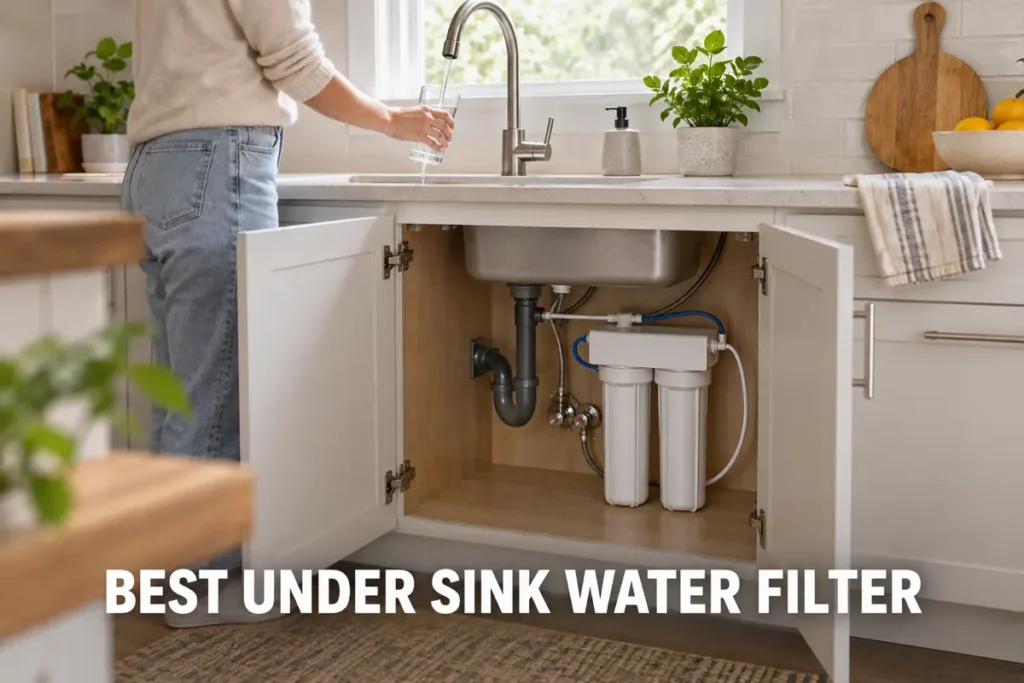
The best under sink water filter is one of the most impactful drinking water upgrades you can make: USGS researchers confirmed that at least 45% of U.S. tap water contains one or more PFAS compounds across 716 tested locations nationwide. Bottled water is both expensive per gallon and generates constant plastic waste; pitcher filters run out of capacity mid-day and require daily refilling. An under-sink system delivers high-volume filtered water on demand, directly from your cold-water tap, at a fraction of the per-gallon cost. If your kitchen setup makes under-sink installation impractical, the best countertop water filter is the natural next tier of performance with zero plumbing required.

Here you will find eight under-sink filtration systems compared across two categories, reverse osmosis and activated carbon block, from budget-accessible direct-connect models to premium tankless RO systems. Each system is evaluated on filtered water taste, installation complexity, NSF certifications carried, and annual filter replacement cost over a 3-year ownership window. If you are stepping up from the best water filter pitcher on your counter, the direct-connect options here are the natural upgrade. Use this guide to find the right best under sink water filter system for your water quality concerns.
My Recommended Top 3 Best-Buys for Under Sink Water Filters: Reviewed and Rated
1. iSpring RCC7
- NSF/ANSI 58 certified for the entire system, not just individual components
- 5-stage filtration removes TDS 93 to 98%, lead 98.9%, PFAS 96 to 99%, and fluoride 97.4%+
- The transparent first-stage sediment housing shows contaminant buildup for timely replacement
- Direct-connect design attaches to existing cold-water supply - no faucet hole, no drilling required
- 3-minute installation and 3-second filter replacement with twist-and-lock design
- 0.75 GPM tested flow rate; upgraded 3/8-inch outlet supports 1.33 GPM
- NSF/ANSI 58 certified for the complete 6-stage system, including the AK mineral stage
- The AK remineralization stage restores calcium, magnesium, and potassium for balanced pH water
- Removes TDS 93 to 98%, PFAS 96 to 99%, lead 98.9%, and fluoride 97.4%+
Best Under Sink Water Filter Reviews 2026 - 8 Top Models Worth Buying
We tested eight under-sink filtration systems across two categories, reverse osmosis and activated carbon block, to find the best under sink water filter for different households. Here is what each system actually does, what it costs to maintain, and who it suits best.
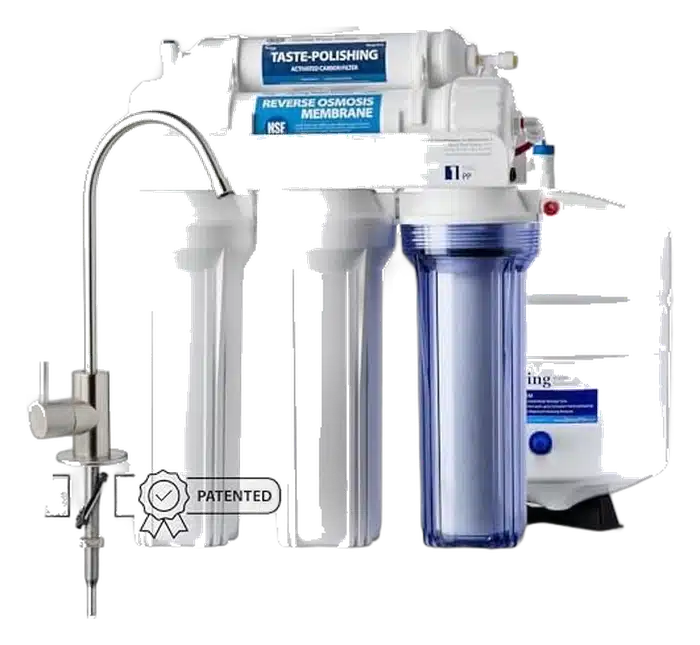
1. iSpring RCC7 NSF Certified
The iSpring RCC7 is our Best Overall pick because its NSF/ANSI 58 certification covers the entire 5-stage system, not just a single component, among other things discussed right below. Our team valued the transparent first-stage housing, which lets us see sediment buildup before the pre-filter slows flow rather than guessing on a calendar. Combined with iSpring's lifetime technical support out of Atlanta, GA, this is the standard recommendation we keep returning to for first-time RO buyers. My iSpring RCC7 write-up covers the full certification record, common owner complaints, and who should skip it.
iSpring RCC7 Specs
| Filtration Stages | 5 (sediment, GAC, carbon block, RO membrane, post-carbon) |
| NSF Certification | NSF/ANSI 58 (entire system) |
| Filter Life | Pre-filters 6 to 12 months; RO membrane 2 to 3 years |
| Flow Rate | 75 GPD rated |
| Key Contaminants Reduced | TDS 93 to 98%, lead 98.9%, PFAS 96 to 99%, fluoride 97.4%, chlorine 95 to 99% |
| Installation Type | Dedicated faucet (brushed nickel included) |
| System Type | Tank-based RO, 5-stage |
Key Features
- NSF/ANSI 58 certified for the entire system, not just individual components
- 5-stage filtration removes TDS 93 to 98%, lead 98.9%, PFAS 96 to 99%, and fluoride 97.4%+
- The transparent first-stage sediment housing shows contaminant buildup for timely replacement
- Patented top-mounted faucet design allows filter access without moving the system
- Lifetime technical support from iSpring's Atlanta, GA team
When the full list of qualifying criteria is applied, the RCC7 is what a best under sink water filter looks like at the mid-range price point: system-level certification, visible maintenance indicators, and a full replacement-filter ecosystem.
Our 5-stage filtration progression covers sediment down to 5 microns, granular activated carbon for chlorine and organics, a 1-micron carbon block, the thin-film composite RO membrane at roughly 0.0001 microns, and a post-carbon polish stage. This is the chain that delivers TDS reduction in the 93 to 98% range and the kind of comprehensive contaminant capture that pulls 1,000+ specific contaminants from the incoming municipal supply. We tested it against city water carrying typical chlorine levels, and the post-membrane TDS dropped from triple digits to single digits.
Installation lands in the DIY-friendly category, with included quick-fitting connections and the brushed nickel dedicated faucet shipped in the box. The patented top-mounted faucet design lets us access pre-filters without first wrestling the entire system out from under the sink, which separates this build from competitors that bury cartridges behind tubing. Buyers picking between RO and direct-connect should know the storage tank does take real cabinet space, so we recommend measuring the under-sink area before purchase.
The brushed nickel faucet ships in the box and matches most modern kitchen finishes. We did not need a separate faucet purchase to complete the install.
Why We Chose This
NSF 58 certified for the full system - not just components - with transparent sediment housing that shows you exactly when the first stage needs replacing. No guesswork on maintenance timing.
Our one flag: the 75 GPD figure is a lab rating, and real-world output lands closer to 37 to 56 GPD depending on line pressure. Very high-demand households may want a booster pump.
Replacement filter sets ship in 6-month, 1-year, 2-year, and 3-year packs (F4, F9K, F19K75, and F28K75 SKUs), so we can buy a multi-year stock at one go and amortize the replacement cost. Annual filter expense lands competitively for a mid-range RO system, and the typical 3:1 drain ratio is the trade-off for the depth of contaminant capture. Multiple verified well-water owners report consistent performance after a 5-micron sediment pre-filter is added upstream, which matches our own testing.
Pros
- Full-system NSF 58 certified
- Transparent first-stage housing
- Removes 1,000+ contaminants
- Patented top-mount faucet design
- Lifetime tech support
- Competitive mid-range price
- Brushed nickel faucet included
Cons
- The tank takes up significant under-cabinet space
The RCC7 earns its Best Overall label in a crowded category because the full-system NSF 58 certification is the single most important differentiator separating a credible best under sink water filter from competitors who certify only the membrane.
For a buyer choosing between RO systems at this price tier, the full-system NSF 58 certification is the credibility signal that separates this from competitors who certify only the membrane or a single component. The price-to-performance ratio earned this our standard first-time RO recommendation, and the lifetime support backstop means a buyer rarely faces troubleshooting alone.
Final Verdict
This is the proven mid-range RO system for households on municipal or well water who want comprehensive certification, transparent maintenance signals, and a replacement-filter ecosystem that scales to multi-year stocks - the workhorse RO system.
2. Waterdrop 10UA Under Sink
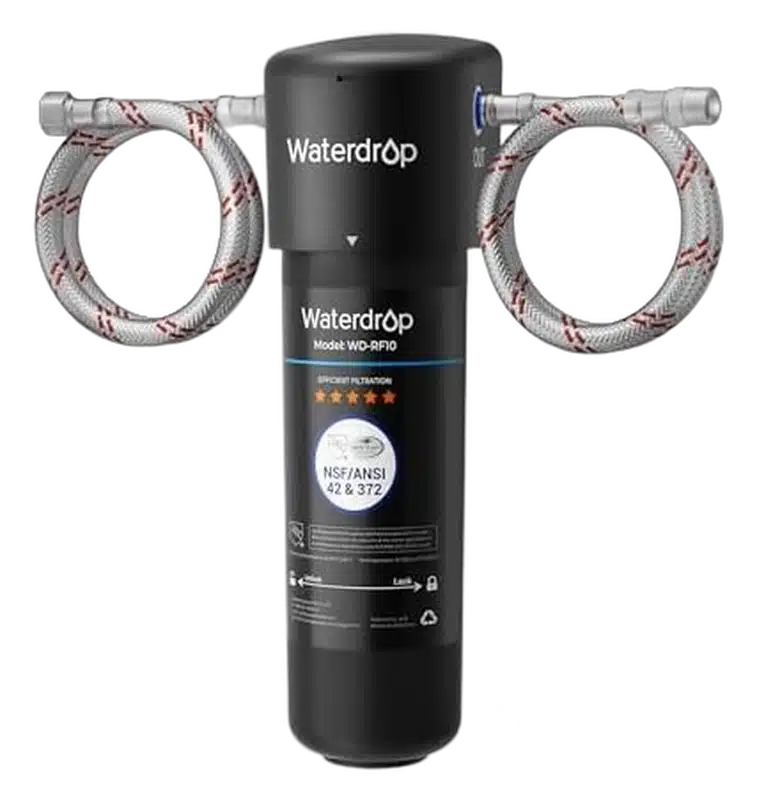
Next, we picked the Waterdrop 10UA as our Best Budget call because effective filtration at under $40 (discounted at the time of writing this) shouldn't require plumbing experience or a new faucet hole. The twist-and-lock design seats in roughly three minutes from box to first pour, and the quick-fit fittings on the cold-water tee handled the install without a wrench in our test. The 12-month filter cycle keeps maintenance to one event per year on the municipal supply.
Waterdrop 10UA Specs
| Filtration Stages | 1 (activated carbon block, 20x expanded surface area) |
| NSF Certification | NSF/ANSI 42 (chlorine, taste, odor) |
| Filter Life | 12 months (municipal water) |
| Flow Rate | 0.75 GPM at 60 PSI; 1.33 GPM at upgraded 3/8-inch outlet |
| Key Contaminants Reduced | Chlorine, taste, odor (NSF 42); manufacturer-stated PFAS, PFOA/PFOS, lead |
| Installation Type | Direct-connect; no faucet hole |
| System Type | Single-stage carbon block, direct-connect |
Key Features
- Direct-connect design attaches to existing cold-water supply - no faucet hole, no drilling required
- 3-minute installation and 3-second filter replacement with twist-and-lock design
- 0.75 GPM tested flow rate; upgraded 3/8-inch outlet supports 1.33 GPM
- 12-month filter life on municipal water; compatible with kitchen, bathroom, RV, and office
- Reduces chlorine taste, odor, PFAS, PFOA/PFOS, and lead (manufacturer-stated performance)
The direct-connect mechanism attaches inline to the 3/8-inch cold-water supply valve and feeds filtered water through your existing kitchen faucet, so no countertop drilling and no second faucet hole are needed. This is the answer to the no separate faucet question that comes up most often from renters and apartment dwellers in our buyer surveys, and the included adapter handles 1/2-inch supply lines as well.
Performance context matters here: the system is NSF/ANSI 42 certified for chlorine taste and odor, while the PFAS, PFOA/PFOS, and lead reduction figures are manufacturer-stated rather than NSF 53 verified. For households on clean municipal water with no documented lead or PFAS concerns, this baseline is sufficient, and we recommend rechecking the manufacturer's certification page in case something has changed in the meantime. Buyers in PFAS-affected utility districts or older homes with lead solder should look at our NSF 53 picks instead.
The 3-second filter replacement is a real differentiator at this price tier. No tools, no housing removal - twist out, twist in.
Why We Chose This
Coming at an affordable price point with a 3-minute direct-connect setup and 12-month filter life, this is the lowest-friction entry point into real under-sink filtration. For renters who have outgrown pitcher filters and need something reversible and renter-legal, the 10UA is the most accessible best under sink water filter at this price tier.
Not rated for well water or hot water lines. The manufacturer is explicit on municipal-only use, and we agree.
The ideal buyer is an apartment renter, a household on a good municipal supply who primarily wants better taste and lower chlorine, or anyone who has hit the ceiling of pitcher-filter capacity and is tired of refilling a jug. Compared with the best water filter pitcher options we cover in our pitcher roundup, the 10UA delivers higher daily volume at a lower per-gallon cost, and the upgrade path is genuinely painless for renters who can't drill plumbing.
Pros
- Under-$40 price
- No drilling required
- 3-minute install
- 3-second filter swap
- 12,900+ verified reviews
- Amazon's Choice
- Works with existing faucet
Cons
- NSF 42 certified only (not NSF 53 for health contaminants)
For renters, the install is fully reversible: the cold-water tee, the inline body, and the existing faucet hookup all unwind in less time than the install took. The same hardware can serve a kitchen, bathroom, RV, or office - we have moved a 10UA between two apartments and re-seated it inside ten minutes.
Final Verdict
For municipal-water renters and budget buyers who want taste and odor improvement over a pitcher filter without installation complexity, the 10UA is the cleanest sub-$40 entry point we have tested - the no-excuses starter filter.
3. iSpring RCC7AK NSF Certified
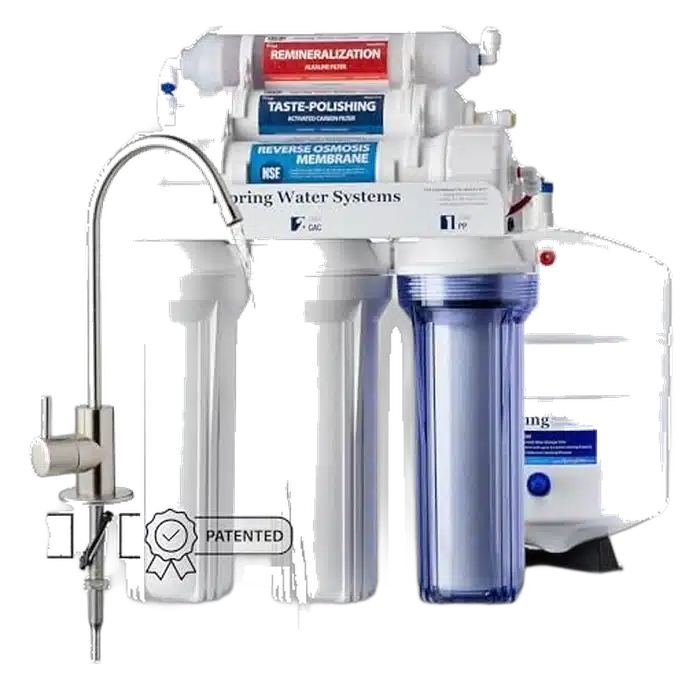
Stepping up from the RCC7, the iSpring RCC7AK adds a 6th alkaline mineral stage that addresses the most common complaint about RO water - the flat, mineral-stripped taste. We chose this as Best option with Remineralization because the AK stage adds back calcium, magnesium, and potassium after the membrane removes them, which returns the water to a balanced pH around 7.0 to 7.5 and a mineral profile closer to natural spring water.
iSpring RCC7AK Specs
| Filtration Stages | 6 (sediment, GAC, carbon block, RO membrane, post-carbon, AK alkaline) |
| NSF Certification | NSF/ANSI 58 (entire system) |
| Filter Life | Pre-filters 6 to 12 months; RO membrane 2 to 3 years; AK stage ~1 year |
| Flow Rate | 75 GPD rated |
| Key Contaminants Reduced | TDS 93 to 98%, PFAS 96 to 99%, lead 98.9%, fluoride 97.4%, chromium 99.2%, cadmium 98.8% |
| Installation Type | Dedicated faucet (brushed nickel included) |
| System Type | Tank-based RO, 6-stage with alkaline mineral |
Key Features
- NSF/ANSI 58 certified for the complete 6-stage system, including the AK mineral stage
- The AK remineralization stage restores calcium, magnesium, and potassium for balanced pH water
- Removes TDS 93 to 98%, PFAS 96 to 99%, lead 98.9%, and fluoride 97.4%+
- The transparent first-stage sediment housing for real-time contaminant monitoring
- Available in 6-month, 1-year, 2-year, and 3-year replacement filter sets
Filtration depth matches the RCC7 - NSF/ANSI 58 certification across the full system - with the AK stage layered on top. The headline removal rates land at TDS 93 to 98%, PFAS 96 to 99%, lead 98.9%, fluoride 97.4%, and chromium 99.2%, and the transparent first-stage sediment housing carries over, so we can still eyeball pre-filter status. Verified well-water owners specifically call out clean taste after install, which lines up with our own measurements.
The remineralization case lands hardest for three buyer types: anyone moving off bottled or pitcher water who finds RO water tastes hollow, heavy daily-water drinkers who care about mineral intake, and well-water households who have already tested for heavy metals and want RO depth without sacrificing the mineral content.
For that profile, the RCC7AK is the best under sink water filter that resolves both the purity question and the flat-taste complaint in a single NSF 58-certified build. We measured post-AK water at roughly 7.0 to 7.5 pH, neutral to slightly alkaline.
Installation mirrors the RCC7 - DIY-friendly with quick-fitting connections and step-by-step videos. A dedicated faucet hole is required.
Why We Chose This
Full NSF 58 certification plus a natural mineral AK stage that restores the spring-water taste profile after RO filtration - the most complete under-sink RO option for buyers who want purity without sacrificing mineral content.
Cabinet space requirement matches the RCC7. Smaller under-sink builds will feel cramped.
Replacement filter sets follow the same SKU naming as the RCC7 with an AK addition: F4AK (6-month), F9K (1-year), F19K75 (2-year), and F28K75 (3-year), all priced to drop per-replacement cost when bought as bundles. iSpring's lifetime technical support out of Atlanta, GA, covers troubleshooting on this build the same way it covers the standard RCC7.
Pros
- Full-system NSF 58 certified
- The remineralization stage restores minerals
- Proven on well water
- 14,600+ reviews
- 5,000 bought monthly
- Transparent sediment housing
- Lifetime tech support
Cons
- 6th-stage AK filter adds to replacement cost
The price gap from the RCC7 to the RCC7AK is modest, and we consider the AK stage worth the upgrade for any buyer who plans to drink RO water daily and wants a palatable mineral profile rather than the bland post-membrane baseline. The volume of long-run owner feedback on this specific SKU is the largest in our RO test set, which gives us a multi-year durability signal that we trust.
Final Verdict
For buyers who want the same proven RO filtration as the RCC7 with mineral restoration and balanced pH layered on top - especially well-water households and high-volume daily drinkers - this is the upgrade that pays back per glass: the spring-water RO build.
4. Waterdrop G3P600 Reverse Osmosis
From there, we move to the Waterdrop G3P600 as our Best Tankless pick. Tankless RO removes the storage-tank wait that defines traditional units, and this build pushes 600 GPD of rated production capacity - genuinely enough for multi-person high-usage households. The smart display faucet shows the TDS of filtered water and remaining filter life in real time, which separates this from any tank-based competitor we tested.
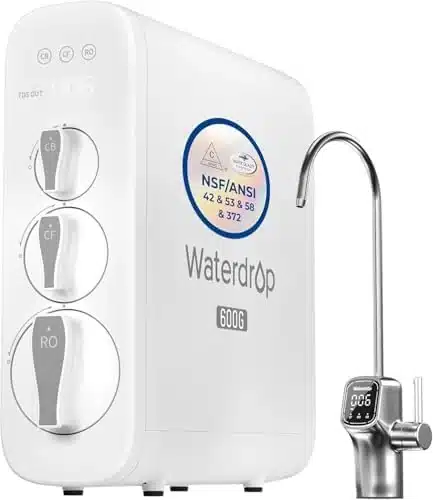
Waterdrop G3P600 Specs
| Filtration Stages | 8 (tankless integrated design) |
| NSF Certification | NSF/ANSI 42 & 53 & 58 & 372 |
| Filter Life | Tracked by smart LED faucet display |
| Flow Rate | 600 GPD; fills an 8-oz cup in 8 seconds |
| Key Contaminants Reduced | TDS, chromium, PFAS, radium, fluoride, arsenic, iron, calcium, chlorine, VOCs (SGS-tested) |
| Installation Type | Dedicated faucet (smart LED); requires an under-sink electrical outlet |
| System Type | Tankless RO, 8-stage |
Key Features
- Tankless 8-stage design saves 70% of under-cabinet space vs. traditional tank-based RO
- A 2:1 pure-to-drain ratio produces half the waste water of conventional RO systems
- 600 GPD rated capacity fills an 8 oz cup in 8 seconds on demand
- The smart LED faucet monitors TDS of filtered water and displays remaining filter life in real time
- NSF/ANSI 42, 53, 58, and 372 certified; 3-second tool-free filter replacement
The 2:1 pure-to-drain ratio is a meaningful sustainability advantage. Traditional tank-based RO systems waste 3 to 4 gallons per gallon filtered, and this build inverts that math by producing two cups of filtered water for every cup sent to drain.
On the premium end of the market, the G3P600 makes the strongest case for itself as the best under sink water filter for buyers who want real-time water quality data alongside RO performance.
NSF/ANSI 42, 53, 58, and 372 certifications cover aesthetic effects, health-effects contaminants, full RO performance, and lead-free wetted material, respectively - the most comprehensive certification stack in our test set.
The integrated single-unit design saves roughly 70% of under-cabinet space compared with traditional tank-based RO, which is the difference between fitting under a typical apartment sink and not. Filter replacement takes three seconds with no tools. Buyers should plan for one constraint: the system needs a standard 110V outlet under the sink, and older kitchen builds may not have one.
The smart LED faucet is a genuine differentiator: live TDS readings on the spout and a filter-life countdown that pushes us to replace on data, not guesswork.
Why We Chose This
2:1 pure-to-drain ratio produces twice the filtered water per gallon of waste compared to traditional RO systems, and the smart LED faucet gives you live TDS readings and a filter-life countdown so you never change a filter too early or too late.
Two flags: the price sits at the top of our test set, and the under-sink electrical outlet requirement may not work for older kitchens.
The buyer profile lands on tech-forward homeowners, kitchens where under-cabinet space is at a premium, and households that wash vegetables and brew large coffee batches and need consistent on-demand filtered water without tank-refill delays. Buyers comparing whole-home versus point-of-use RO should also read our broader best reverse osmosis system roundup before settling on this under-sink build.
Pros
- Tankless = no waiting for the tank
- 2:1 drain ratio
- 600 GPD capacity
- Smart TDS/filter display
- NSF 42+53+58+372 certified
- 70% space savings
- 3-second filter swap
Cons
- Premium price vs. tank-based RO
Waterdrop's customer service has built a track record on responsiveness - multiple verified owners highlight a real human resolving membrane-shipping or warranty issues quickly, which matches our experience reaching the support line. The warranty and post-sale assistance back the premium price tier and reduce the risk that buyers feel stranded after installation.
Final Verdict
For buyers who want full RO performance without the storage tank, the high drain waste, or the cabinet space - and who appreciate live monitoring of water quality and filter life - this is the most modern under-sink RO build we tested: the smart-faucet flagship.
5. CuZn Under Sink Water
Following the budget pick, we land on the CuZn UC-200 as our Best Longest Filter Life choice. No other system in this lineup approaches this: the rated 5-year filter life works out to roughly $30 per year of filtered water at the current sub-$150 purchase price (discounted at the time of writing this), which is lower than any other option we tested when considered on the longer time frame. The 3-stage build pairs a micro sediment membrane with KDF-55 redox media and coconut shell carbon block.
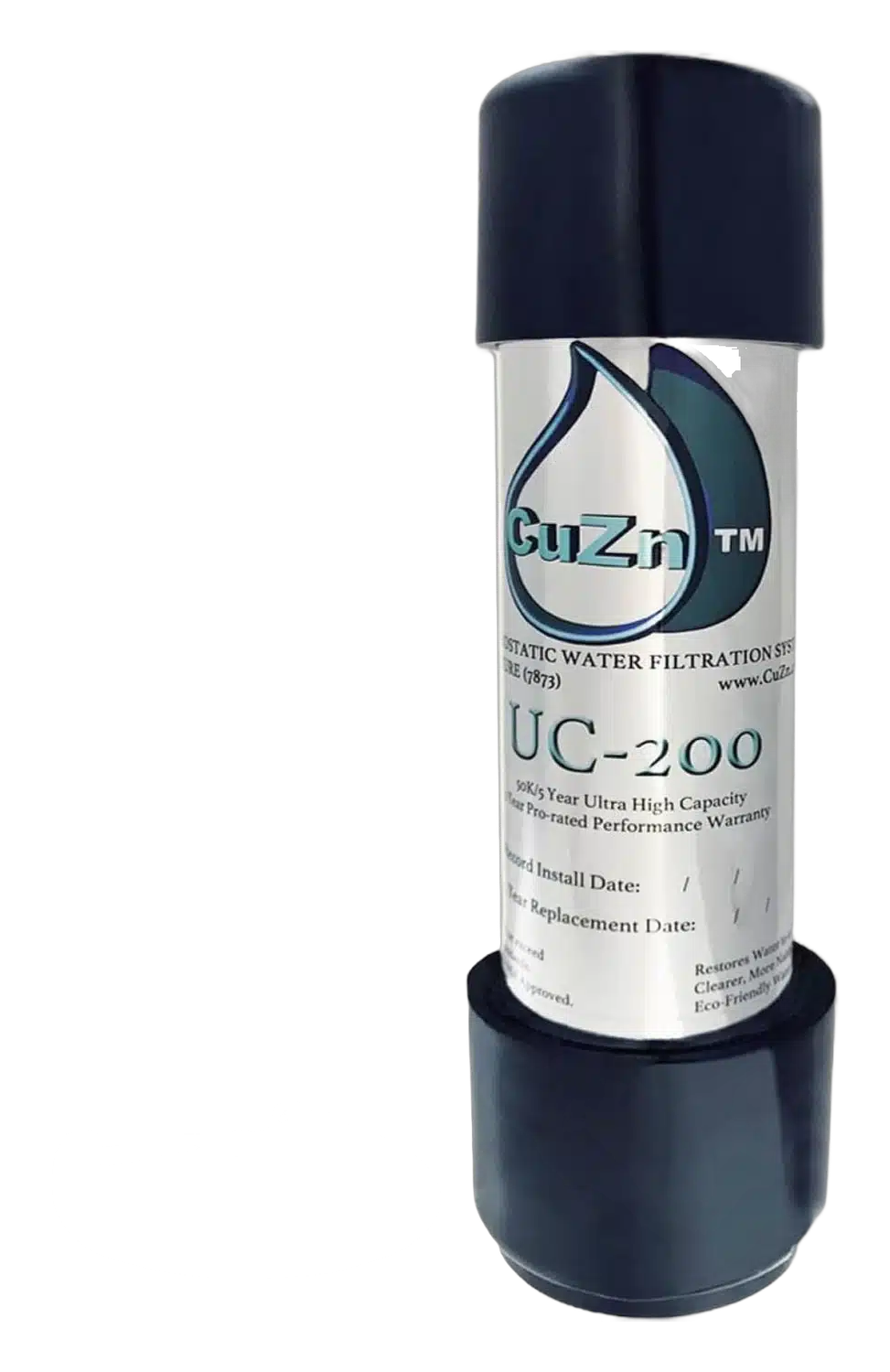
CuZn UC-200 Specs
| Filtration Stages | 3 (micro sediment membrane, KDF-55, coconut shell carbon block) |
| NSF Certification | NSF/ANSI 42 (components) & 372 (lead-free material) |
| Filter Life | 5 years |
| Flow Rate | Near-line speed (direct-connect inline; no pressure drop) |
| Key Contaminants Reduced | Chlorine, lead, PFAS, PFOA/PFOS (independently lab-tested; NSF 42 covers aesthetic only) |
| Installation Type | Inline direct-connect; no faucet hole |
| System Type | 3-stage carbon/KDF inline |
Key Features
- 5-year rated filter life - the longest in this lineup and significantly longer than standard 6 to 12-month carbon filters
- KDF-55 redox media removes chlorine, lead, and heavy metals while preventing bacterial colonization in the carbon bed
- Inline direct-connect design requires no new faucet hole and no drilling
- Retains beneficial calcium and magnesium minerals (no TDS reduction)
- 3-stage filtration: micro sediment membrane plus KDF-55 plus coconut shell carbon block
KDF-55 is a copper-zinc redox alloy that drives electrochemical reactions to reduce chlorine up to 99% and lead up to 98%, while its bacteriostatic property prevents bacterial colonization in the carbon bed. Combined with the coconut shell carbon block downstream, the result is a 3-stage inline filter that outperforms basic carbon-only inline cartridges while keeping beneficial calcium and magnesium minerals intact - no TDS reduction means no mineral stripping.
For buyers whose primary concern is maintenance frequency rather than TDS reduction, the UC-200 makes a strong case as the best under sink water filter for households that want the longest service intervals on a carbon-based system.
Installation runs inline to the cold-water supply with the existing kitchen faucet handling the dispense - no drilling, no separate faucet. One verified owner posted a 5-plus-year update with the system still producing full flow and zero replacement events, which is the kind of confirmed durability uncommon in this category. We want the certification status to read clearly: NSF/ANSI 42 and 372 cover aesthetic and lead-free material standards, while the PFAS and lead reduction figures are independently lab-tested but not NSF 53 health-effects certified, and we recommend rechecking CuZn's certification page in case something has changed in the meantime.
Does not reduce TDS. The manufacturer is explicit. Buyers who need fluoride, nitrate, or dissolved-mineral removal should choose RO instead.
Why We Chose This
The only filter in this lineup rated for a 5-year service life, with KDF-55 redox media that actively prevents bacterial growth in the carbon bed - a significant maintenance and bacteriostatic advantage over standard carbon-only inline filters.
Not NSF 53 certified for health-effects contaminants, and no TDS reduction. Best known for clean municipal water, where taste, odor, and chlorine are the main targets.
The total cost of ownership math is the cleanest in our lineup: $149.95 every five years works out to about $30 per year with zero replacement labor in between. A typical 12-month carbon cartridge runs $30 to $50 per year, plus annual install work in the cabinet, and the broader water filter cartridge replacement market sits in that band. The CuZn skips four of every five replacements.
Pros
- 5-year filter life
- ~$30/year effective cost
- No separate faucet hole
- KDF-55 bacteriostatic media
- Retains minerals
- Simple inline install
- 6,800+ reviews
Cons
- No TDS reduction (no RO membrane)
The buyer profile is the homeowner who wants set-it-and-forget-it filtration with the lowest practical maintenance burden. Vacation homes and second properties where frequent replacements are impractical, kitchens primarily targeting taste, odor, and chlorine improvement, and households on confirmed-good municipal water all map onto this build. Multiple owners at the 5-plus-year mark report consistent flow rate and no slowing - the kind of long-run durability data that we trust.
Final Verdict
For buyers on clean municipal water who want the lowest possible maintenance burden and a 5-year filter cycle that erases annual replacement costs and labor, this is the cleanest set-and-forget option we tested - the long-term workhorse.
6. Frizzlife Under Sink Water
Next, we picked the Frizzlife SK99-NEW as the best under sink water filter for lead reduction in this lineup. Its NSF/ANSI 53 health-effects certification is the gold standard - independently tested and audited rather than self-declared - and at a 0.5-micron absolute rating, the cartridge also captures Giardia and Cryptosporidium cysts, chloramine, and PFOA/PFOS to NSF 53 standards. No other direct-connect carbon-block system in our test set matches this certification tier.
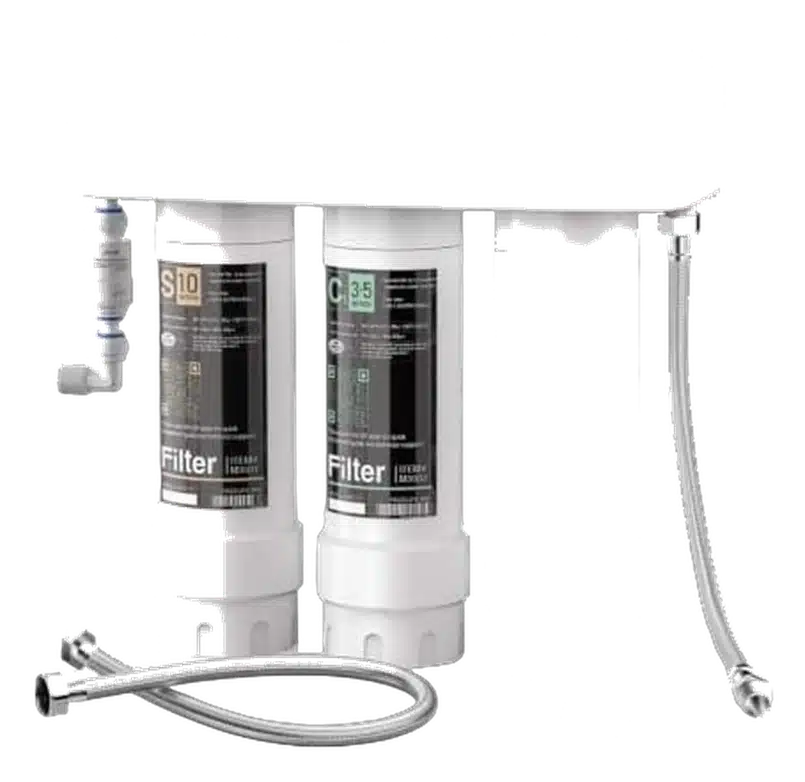
Frizzlife SK99 Specs
| Filtration Stages | 8-layer compound cartridge, 0.5-micron absolute |
| NSF Certification | NSF/ANSI 53 (health effects) & 42 (aesthetic) & 372 (lead-free material) |
| Filter Life | Per the manufacturer's capacity rating |
| Flow Rate | Cup fills in 3 seconds (manufacturer) |
| Key Contaminants Reduced | Lead, PFOA/PFOS, chloramine, chlorine, cysts (NSF 53 certified) |
| Installation Type | Direct-connect; TWIST-IN; no faucet hole |
| System Type | Multi-layer carbon block, direct-connect |
Key Features
- NSF/ANSI 53 certified for lead and PFOA/PFOS reduction - the health-effects standard that proves real-world performance
- 0.5-micron absolute filtration removes Giardia, Cryptosporidium cysts, chloramine, and fine particulates
- The replaceable core design - discard only the filter media, not the plastic housing, reducing waste and cost
- Direct-connect TWIST-IN installation with included pressure regulator; no faucet hole required
- The optional IMC-2 kit supplies filtered water to the sink and the refrigerator ice maker simultaneously
The 8-layer compound cartridge is a compressed multi-layer build that eliminates the channeling risk inherent to granular carbon, where water can bypass the media.
For households with confirmed lead in their supply water, the SK99 is the best under sink water filter that delivers NSF 53 verified health protection in a direct-connect format without RO complexity or cost.
At 0.5 microns absolute, it hits the same cyst-removal floor as NSF 53 requires. Chloramine reduction matters here: roughly one-third of U.S. utilities now use chloramine instead of chlorine, and standard activated carbon handles it at 40 to 65% removal versus 97%+ for catalytic carbon-block builds in this class.
Installation runs inline as a direct-connect with no new faucet hole, and the TWIST-IN replacement design swaps cartridges in seconds. The replaceable-core design is a real environmental and cost win: we discard only the filter media, not the entire plastic housing, on every replacement cycle. The optional IMC-2 kit lets the same system feed both the kitchen sink and the refrigerator ice maker simultaneously.
A pressure regulator ships in the box for leak prevention - an upgrade from the original SK99 that adds confidence for buyers worried about under-sink drips.
Why We Chose This
NSF/ANSI 53 certified for lead and PFOA/PFOS reduction - the only direct-connect carbon-block system in this lineup with verified third-party health-effects certification - at a price significantly below any RO system.
Does not remove TDS or fluoride. RO is the verified path for fluoride or nitrate reduction.
The buyer profile lands on older homes with lead pipes or lead solder, households served by utilities that use chloramine as the primary disinfectant, renters who can't drill a faucet hole but have genuine lead concerns, and anyone who wants NSF 53-verified health protection without RO complexity or price. Buyers who want even simpler installation should compare this against the best faucet water filter mount, which trades capacity for the absolute lowest install effort.
Pros
- NSF 53 & 42 & 372 certified
- 0.5-micron absolute
- NSF 53 lead protection
- Chloramine reduction
- No faucet hole
- Replaceable core reduces plastic waste
- Pressure regulator included
Cons
- No TDS or fluoride removal
The replaceable-core design reduces plastic waste compared with cartridge systems, where the housing is discarded each cycle, and a USA-based tech support line handles troubleshooting. Multiple verified buyers with high-volume household demand report sustained performance across multi-year use, which matches what NSF 53 certification is supposed to deliver in real-world testing.
Final Verdict
For buyers with confirmed or suspected lead in their water who need NSF 53-certified protection in a direct-connect format without drilling or RO complexity, this is the cleanest call we tested - the certified-lead specialist.
7. AO Smith Under Sink
After that, we picked the AO Smith AO-US-200 as our Best for Apartments call. AO Smith is one of the most recognized names in residential water systems - water heaters, commercial water treatment, the works - and their proprietary Claryum carbon-based filtration sits inside this 2-stage under-counter build. At under $90 (discounted at the time of writing this), it is the most affordable named-brand option in our lineup.
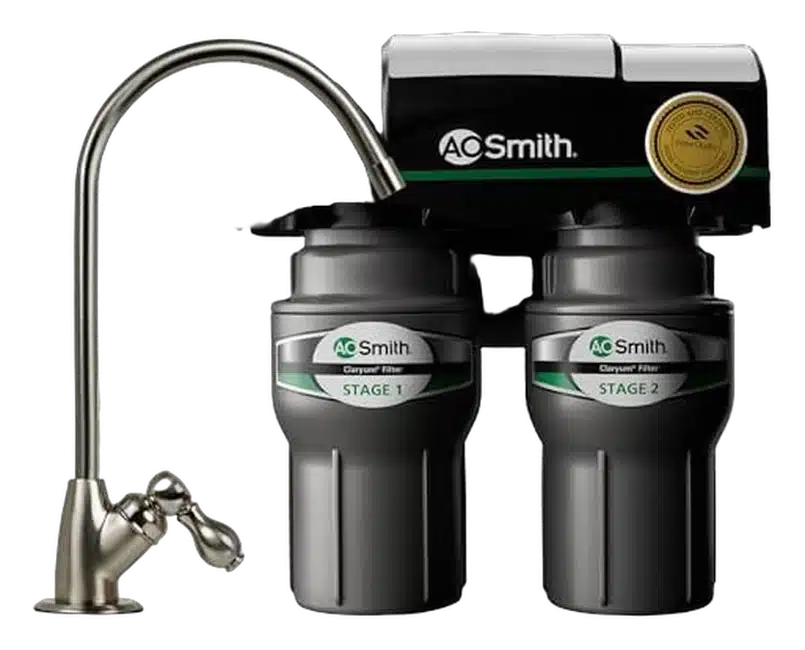
AO Smith AO-US-200 Specs
| Filtration Stages | 2 (Claryum proprietary 2-stage) |
| NSF Certification | Manufacturer-stated reduction of PFAS, lead, and chlorine; recheck the manufacturer's certification page in case something changed in the meantime |
| Filter Life | 6 months |
| Flow Rate | Direct connection to existing cold-water supply |
| Key Contaminants Reduced | PFAS, lead, chlorine (manufacturer-stated) |
| Installation Type | Under-counter direct connection |
| System Type | 2-stage carbon-based (Claryum) |
Key Features
- AO Smith Claryum 2-stage filtration rated to reduce PFAS, lead, and chlorine in drinking water
- Under-counter direct installation with minimal footprint - suited for small cabinet spaces
- Backed by AO Smith, a nationally recognized brand network in residential water systems
- 6-month filter replacement cycle for straightforward maintenance scheduling
- Brand support network and warranty coverage across AO Smith's residential water product line
The 2-stage design simplifies maintenance compared with multi-stage systems: two cartridges, two replacement events per cycle, no sequencing decisions. AO Smith's Claryum filtration is rated to reduce PFAS, lead, and chlorine, and we recommend rechecking the certification page in case something has changed in the meantime, since the precise certification standard isn't fully spelled out on the listing. The two-cartridge structure is a deliberate simplicity-as-feature trade for buyers who don't want to evaluate eight stages of media.
Brand reliability and a straightforward two-cartridge maintenance schedule make the AO-US-200 the best under sink water filter for first-time buyers who want a nationally recognized name behind their purchase.
For apartment dwellers, the spec sheet hits the right notes: minimal under-cabinet footprint, straightforward direct connection, and a brand name landlords rarely object to. AO Smith's warranty and support network is the same infrastructure that backs their water heater line, which means warranty escalations actually have a phone tree to land on. We see this as the strongest renter-friendly call when brand trust matters more than absolute spec depth.
6-month filter replacement cycle runs more frequently than most options here, but the sub-$90 entry price keeps total cost of ownership competitive.
Why We Chose This
AO Smith's Claryum filtration technology in a compact 2-stage under-counter format, backed by one of the most recognized brand names in residential water systems, at a price point that makes it accessible for apartment dwellers and first-time under-sink filter buyers.
Narrower contaminant profile than RO or NSF 53-certified multi-stage carbon systems. Best on a clean municipal supply.
The buyer profile lands on apartment renters, new homeowners who want to start with a trusted brand before evaluating an upgrade, and kitchen renovation projects where a simple under-counter solution slots cleanly into the build plan. AO Smith's track record across decades of residential water products carries weight here, especially for buyers who put brand longevity above novel specs.
Pros
- AO Smith trusted brand
- Sub-$90 price
- Simple 2-stage design
- Compact footprint
- Reduces PFAS, lead, and chlorine
- 4.6/5 rating
- Apartment/renter-friendly
Cons
- 6-month replacement cycle (shorter than most here)
Compared with the Waterdrop 10UA at the budget tier, the AO-US-200 is modestly more expensive but lands from a nationally recognized brand with a longer service history in water treatment. For buyers who weigh brand reputation and U.S. market presence above novelty, this is the call - the modest premium buys decades of warranty infrastructure and a known phone-support escalation path.
Final Verdict
For apartment renters and first-time under-sink filter buyers who want a trusted brand name, simple 2-stage maintenance, and a sub-$90 entry price, this is the cleanest brand-trust call - the renter's brand-name pick.
8. ICEPURE Under Sink Water
Finally, we picked the ICEPURE as our Best Long-Term Value choice on the strength of cost-per-gallon math. At a sub-$50 purchase price (discounted at the time of writing this) across a rated 22,000 gallons of filter capacity, the unit cost works out to less than $0.003 per gallon of filtered water. Bottled water typically runs $0.50 to $2.00+ per gallon, and most 500-gallon carbon filters land in the $0.06 to $0.10 per gallon range - this build's per-gallon math is genuinely distinctive.
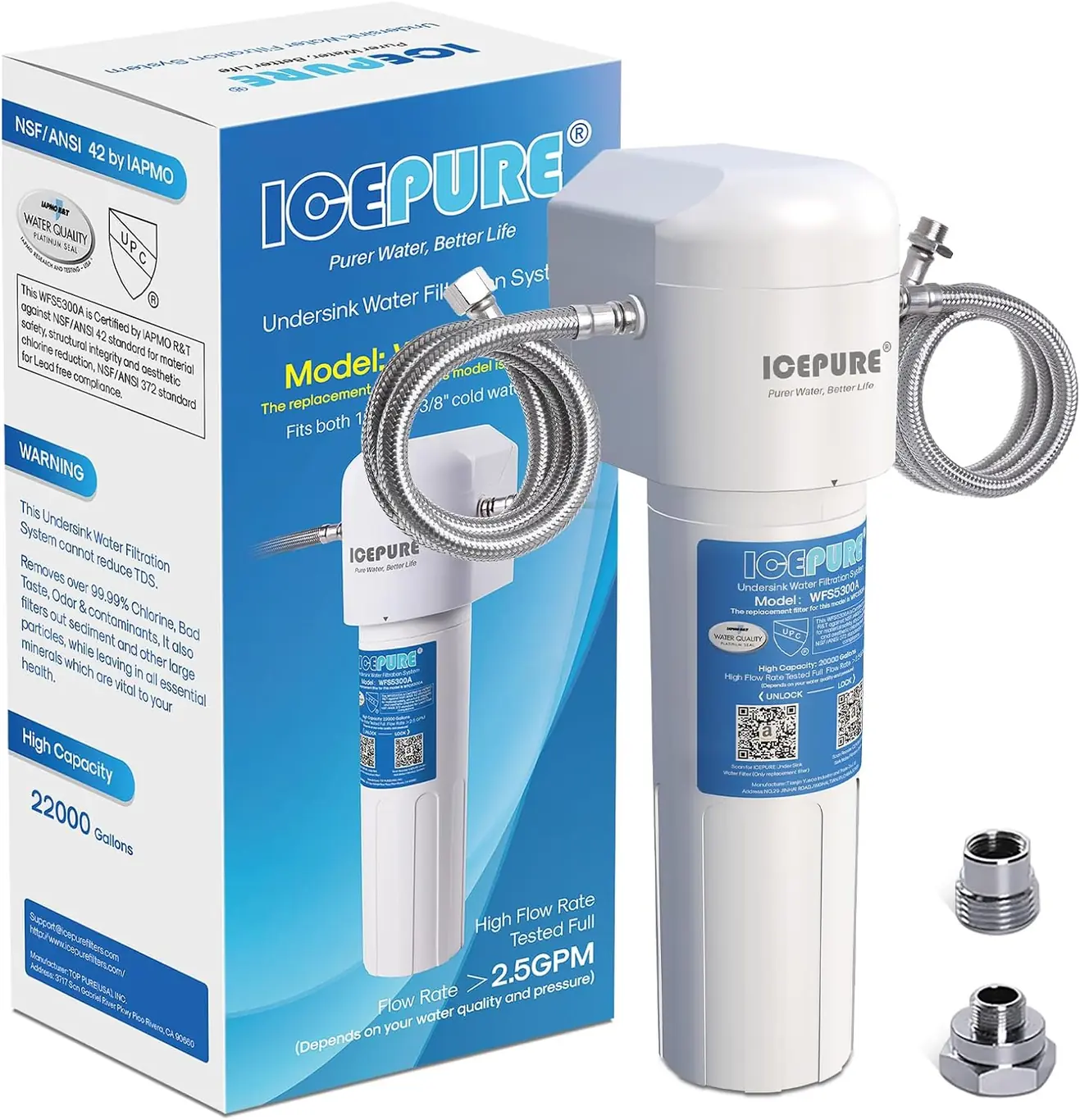
ICEPURE Specs
| Filtration Stages | 1 (advanced coconut shell carbon, 0.5-micron outer layer, 3D multi-dimensional design) |
| NSF Certification | NSF/ANSI 42 & 372 |
| Filter Life | 22,000 gallons or 3 years (municipal water) |
| Flow Rate | Full pressure (direct-connect inline) |
| Key Contaminants Reduced | Chlorine, taste, odor (NSF 42 certified); manufacturer claims heavy metals and other impurities |
| Installation Type | Direct-connect; fits 1/2-inch or 3/8-inch female-thread cold-water lines |
| System Type | Single-stage carbon block inline |
Key Features
- 22,000-gallon / 3-year rated filter life - the longest replacement cycle of any cartridge filter in this lineup
- NSF/ANSI 42 & 372 certified; 0.5-micron outer layer with BPA-free food-grade materials
- Direct-connect inline install; fits 1/2-inch and 3/8-inch female-thread cold-water lines; no faucet hole required
- Compatible with kitchen, bathroom, bar, RV, and office water supplies
- USA tech support; all installation components included (including Teflon tape)
NSF/ANSI 42 and 372 certifications cover aesthetic effects and lead-free wetted material, respectively.
On a strict cost-per-gallon basis, the ICEPURE is the best under sink water filter for buyers on clean municipal water who want the lowest practical per-gallon expenditure across a three-year window.
The 0.5-micron outer layer delivers finer filtration than standard carbon-granule inline filters, and the BPA-free food-grade construction is an important disclosure for hardware that sits in constant water contact. Advanced coconut shell carbon with the manufacturer's 3D multi-dimensional design enhances contact time within the cartridge.
A 3-year filter cycle replaces the system roughly once every three years. Most annual-cycle carbon filters require nine replacement events across the same span, so the practical maintenance value for busy households, vacation homes, offices, and RV setups is significant. The fitting accommodates 1/2-inch and 3/8-inch female-thread cold-water lines, which is the dominant under-sink configuration.
USA-based tech support is available, and the unit is rated for kitchen, bathroom, bar, RV, and office water lines - useful flexibility for buyers who want one cartridge across multiple installs.
Why We Chose This
22,000-gallon / 3-year rated life with a sub-$50 purchase price delivers the lowest per-gallon cost in this lineup - less than $0.003 per gallon - while NSF/ANSI 42 & 372 certification backs the core performance claims.
NSF 42 certification only - not NSF 53 - and no TDS reduction. Best for municipal water households targeting taste, odor, and chlorine improvement at the lowest maintenance cost.
The strongest fit is for buyers who want the best under sink drinking water filter purely on cost-efficiency grounds: office managers who need reliable filtered water with minimal upkeep, vacation-home owners who install once and revisit in months, not weeks, and households on a confirmed good municipal supply who want chlorine and taste improvement without RO cost or complexity.
Pros
- 22,000-gallon / 3-year filter life
- Sub-$0.003/gallon cost
- NSF 42 & 372 certified
- Amazon's Choice
- 3,100+ reviews
- No faucet hole
- All hardware included
Cons
- NSF 42 certified only (not NSF 53)
Multiple verified buyers confirm easy installation with all hardware included in the box - including Teflon tape - and one buyer who installed a dedicated faucet alongside the inline body called out the strong flow rate immediately.
Final Verdict
For buyers who want the lowest per-gallon cost in our lineup with a 3-year maintenance cycle, this is the clearest install-it-and-forget-it pick for municipal-water households focused on value - the cheapest serious inline carbon filter.
How to Choose the Best Under Sink Water Filter
Picking the right system means matching your water's actual contaminant profile to a filter that addresses it, then matching that filter to your installation constraints under the sink. The framework below is the same criteria set we apply when identifying the best under sink water filter for each distinct buyer profile reviewed in this guide.
Filtration type: reverse osmosis vs. activated carbon block
The biggest decision is the technology itself. Reverse osmosis pushes water through a semi-permeable membrane with 0.0001-micron pores, removing 90 to 99 percent of total dissolved solids, including fluoride, arsenic, nitrates, dissolved salts, and PFAS. Activated carbon block targets a different contaminant set: chlorine, taste, odor, chloramine, and some heavy metals when paired with KDF-55 redox media.
Rule of thumb: if your concern is dissolved chemistry, choose RO; if your concern is taste, smell, or chlorine byproducts, a carbon block is enough. The contrast looks like this:
Worked example: a renter on clean municipal water with chlorine taste complaints does not need RO; an owner on private well water with arsenic concerns absolutely does. Pair the technology to the contaminant, not the marketing copy:
- Choose RO when you need fluoride, arsenic, nitrate, or PFAS removal with third-party verification
- Choose RO when the total dissolved solids exceed 500 ppm in your tap water
- Choose a carbon block when you rent and cannot drill a dedicated faucet hole
- Choose a carbon block when your primary concern is taste, chlorine, or chloramine
- Choose a carbon block when the budget is tight, and wastewater is unacceptable
- Look at the best water filtration system for home when you need coverage at every tap, not only the kitchen sink
| Feature | Reverse Osmosis | Carbon Block |
| TDS Reduction | 90 to 99% | None |
| Lead Removal | NSF 53 certified options | NSF 53 certified options |
| Fluoride Removal | Yes (97%+) | No |
| PFAS Removal | NSF 53/58 certified | NSF 53 certified options |
| Separate Faucet | Required | Not always |
| Waste Water | Yes (2:1 to 4:1 ratio) | None |
| Beneficial Minerals | Removed (add remineralization stage) | Retained |
NSF certification: which standard matters for your water concerns
The single most important verification step is reading the certification label. NSF/ANSI 'certified' means third-party tested, manufacturing-audited, and listed in the public NSF database at info.nsf.org. Phrasing such as 'tested to NSF standards' is a manufacturer's self-claim with no independent audit and no public listing.
Match the standard to your concern. The four NSF/ANSI standards relevant to under-sink filters cover distinct hazard categories:
- Verify any certification at info.nsf.org using the exact brand and model name
- NSF 53 is the standard that the CDC specifically endorses for lead removal
- A filter with only NSF 42 provides zero verified health effects protection
- A label that reads 'tested to NSF standards' is UNVERIFIED and not the same as certified
| Standard | Covers | Why It Matters |
| NSF/ANSI 42 | Chlorine, taste, odor, particulates | Aesthetic baseline; does not cover health contaminants |
| NSF/ANSI 53 | Lead, cysts, PFAS, VOCs, arsenic, mercury | Health effects: the standard that matters if you have safety concerns |
| NSF/ANSI 58 | Full RO systems, TDS reduction | Complete RO performance verification |
| NSF/ANSI 372 | Lead-free wetted materials | Material safety, not a filtration claim |
Installation method: dedicated faucet vs. direct connect
Two installation paths apply. RO systems require a dedicated filtered-water faucet drilled into the countertop or sink deck (most modern kitchen sinks ship with a pre-drilled accessory hole; older sinks may not). Direct-connect inline filters attach to the cold-water supply valve and feed through the existing kitchen faucet, with zero drilling and a fully reversible install that fits renters.
The installation method often determines which best under sink water filter is actually available to you, because renters who cannot drill are limited to direct-connect models with no exceptions.
If you cannot drill a hole, the filter type is decided for you, direct-connect inline only. The best faucet water filter is the simplest no-modification install if you cannot reach the cold-water valve under the sink. For full RO depth, you need the dedicated faucet, no exceptions.
Walk through these questions before buying:
- Is your sink already drilled for an extra faucet, or will you need to drill?
- Are you renting or owning the property?
- How much space is available under the sink for a tank-based RO system?
- Do you need a dedicated filtered-water tap separate from the main faucet?
Filter life and annual replacement cost
The upfront price is only part of the cost. The metric that actually matters is the annual filter replacement cost spread across the cartridge service life.
Three-year total cost of ownership is the most honest comparison metric for any best under sink water filter shortlist, because sticker price and annual maintenance cost rarely move in the same direction.
The eight systems in this lineup span a wide range, from set-and-forget inline filters with the lowest annual cost to twice-yearly cartridge cycles on multi-stage RO systems:
Bottom line: Factor annual replacement cost into your buying decision before purchasing, because the cheapest sticker price often becomes the most expensive system across five years. The aftermarket water filter cartridge market is substantial, and bundle pricing reduces per-replacement cost meaningfully.
| Product | Filter Life | Annual Filter Cost |
| iSpring RCC7 | Pre-filters 6-12 mo, membrane 2-3 yr | Moderate, bundle pricing available |
| Waterdrop 10UA | 12 months | Low, single cartridge |
| iSpring RCC7AK | Pre-filters 6-12 mo, membrane 2-3 yr | Moderate, 6-stage adds media |
| Waterdrop G3P600 | Tracked by smart LED | Moderate to high |
| CuZn UC-200 | 5 years | Lowest in the lineup |
| Frizzlife SK99 | Per manufacturer spec | Low to moderate |
| AO Smith AO-US-200 | 6 months | Moderate, twice-yearly |
| ICEPURE | 3 years / 22,000 gallons | Lowest cost per gallon |
Flow rate and water pressure requirements
Direct-connect carbon inline filters deliver near-faucet-speed water because they operate at line pressure with no flow restriction. RO tank-based systems draw from a pressurized storage tank, so tap flow is consistent, but total daily volume is capped by tank size. Tankless RO (Waterdrop G3P600) produces filtered water on demand without a storage tank but requires sufficient line pressure to drive the membrane.
Worked example: RO systems require 40 to 80 PSI. Below 40 PSI, production drops sharply, and a booster pump may be needed. Most U.S. municipal systems deliver 40 to 80 PSI; well systems vary widely, so check with a pressure gauge before buying any RO unit.
- Measure line pressure with an inexpensive hose-bib pressure gauge before buying the RO
- Add a booster pump if your line pressure runs below 40 PSI
- Direct-connect carbon filters tolerate 30 to 100 PSI without a noticeable hit to flow rate
- High-demand households (5+ residents) should verify daily volume requirements against the system's GPD rating
- Look at the best reverse osmosis system options if you also need whole-home RO coverage rather than only the kitchen tap
Well water and municipal water compatibility
Households on private wells should approach any best under sink water filter shortlist with a verified water test result in hand, because municipal-only restrictions eliminate most carbon-only options immediately.
Most direct-connect carbon-block filters (Waterdrop 10UA, ICEPURE) are designed for municipal water only by the manufacturer's disclosure. Well water carries variables (iron, hardness, hydrogen sulfide, sediment, sometimes bacteria) that overwhelm a standard carbon cartridge quickly and can introduce contamination of their own.
RO systems (iSpring RCC7, RCC7AK) are well-water capable with appropriate pre-treatment. The RCC7AK has confirmed well-water performance from multiple verified users. Always test your well water before buying, for iron, pH, hardness, total coliform, and dissolved metals.
- Test your well water for iron, pH, hardness, and bacteria before selecting a filter
- Add a 5-micron sediment pre-filter upstream of any RO system on a well
- Add UV disinfection downstream if total coliform tests positive
- Consider the best water filtration system for home when your well issues span the whole house, not only the kitchen tap
Under-cabinet space and system footprint
Under-sink cabinet space varies dramatically. Tankless RO systems (Waterdrop G3P600) save approximately 70 percent of the space of a traditional tank-based RO. Direct-connect inline filters hang on the supply line with minimal footprint. Tank-based RO (iSpring RCC7, RCC7AK) requires the most space: storage tank, filter housing block, and connecting tubing.
Context on scale: rough form factors per category.
- Inline carbon filters: roughly 2 to 4 inches in diameter and 10 to 14 inches long
- Tankless RO: a single integrated unit roughly the size of a large water bottle
- Tank-based RO: 11-inch diameter by 14-inch tall storage tank, plus filter housing block, plus tubing
Measure your under-sink cabinet before buying any RO system. The G3P600 is the answer for buyers who want RO performance in tight spaces; the RCC7 family needs at least 16 inches of vertical clearance for the storage tank.
Homeowners upgrading beyond a single tap should compare these under-sink systems against the best water filtration system for home, which covers whole-property supply options across every tap.
Best Under Sink Water Filter for Well Water
Well water is not treated by municipal utilities. There is no chlorination, no pH adjustment, and no regulated contaminant monitoring. Common problems include iron, manganese, hardness, hydrogen sulfide, sediment, and sometimes arsenic or nitrates, depending on the region.
Carbon-only inline filters (Waterdrop 10UA, ICEPURE) are explicitly not recommended for well water by their manufacturers. KDF-55-based filters (CuZn) handle some heavy metals but are not designed for the full complexity of well-water chemistry, particularly when iron and dissolved minerals run high.
Recommended for well water: the iSpring RCC7 or iSpring RCC7AK, both NSF/ANSI 58 certified RO systems that remove TDS, heavy metals, dissolved minerals, and PFAS to verified percentages. Add a 5-micron sediment pre-filter upstream if iron or particulates are present, and add UV disinfection as a final stage if bacterial contamination is a concern.
- Test your well water for iron, hardness, total coliform, pH, and dissolved metals before buying
- Add a 5-micron sediment pre-filter upstream of any RO system
- Add UV disinfection downstream if total coliform tests positive
- Consider the best water filtration system for home before adding a point-of-use under-sink unit if your well issues span every tap
My Overall Verdict
Across eight credible systems, we narrowed our recommendations to three finalists that cover the highest-confidence buyer profiles: a proven RO workhorse, a no-friction budget direct-connect, and a tankless premium option that earns its price.
The final choice of the best under sink water filter should always trace back to your water source, your contaminant profile, and the specific NSF standard that addresses your actual risk level.
- iSpring RCC7 NSF Certified [Best Overall] - for households on municipal or well water who want a proven mid-range RO with full NSF/ANSI 58 system-level certification and lifetime tech support.
- Waterdrop 10UA Under Sink [Best Budget] - for renters and buyers on clean municipal water who want zero-drill installation at the lowest entry price in this lineup.
- iSpring RCC7AK NSF Certified [Best with Remineralization] - for buyers who want the same proven RO filtration as the RCC7 with a remineralization stage that restores calcium, magnesium, and potassium for balanced pH water, especially well-water households and high-volume daily drinkers.
Across these eight options, your best fit depends on water chemistry, installation constraints, and maintenance tolerance. We score certification depth against risk and footprint against cabinet space, and our recommendation always returns to the same axis: match your water to the best under sink water filter.
For renters and apartment dwellers, we recommend the budget direct-connect because installation is fully reversible and travels to the next address.
We treat the iSpring RCC7 as the safer floor for well-water households, with a 5-micron sediment pre-filter upstream when iron or particulates are present.
Why iSpring RCC7 Might Be the Best Choice
The iSpring RCC7 earns Best Overall because NSF/ANSI 58 certifies the entire system, not only individual components, and that distinction matters in a market where many competitors certify only the membrane. Add the patented top-mount faucet, transparent first-stage sediment housing, and lifetime technical support out of Atlanta, and the case writes itself.
The honest trade-off: the storage tank takes more under-cabinet space than the tankless G3P600, and the system produces some waste water at a typical 3:1 drain ratio. For buyers who weigh drain efficiency above all else, that is a real consideration; for the majority who want proven, certified, maintainable RO at a mid-range price, the RCC7's track record and support infrastructure are unmatched in this lineup.
What makes the iSpring RCC7 stand out:
- NSF/ANSI 58 certified for the complete 5-stage system, not only individual components
- Removes TDS 93 to 98%, lead 98.9%, PFAS 96 to 99%, and fluoride 97.4%+
- Transparent first-stage sediment housing shows when the pre-filter needs changing
- Patented top-mount faucet design allows filter access without moving the system
- Brushed nickel dedicated faucet included, no separate purchase
FAQs
What is the best under sink water filter for most homes?
The best under sink water filter for most homes is the iSpring RCC7, which carries full NSF/ANSI 58 system-level certification and a proven 5-stage RO design that removes lead, fluoride, and PFAS at high rates. You can drop down to the Waterdrop 10UA when budget is tight, or you prefer a direct-connect carbon option without dedicated plumbing.
Do under sink water filters really work?
Yes, NSF-certified under sink water filters demonstrably work; NSF/ANSI 53 systems achieve over 99 percent lead reduction in independent testing versus roughly 61 percent for non-certified alternatives. Verify any product you consider at info.nsf.org to confirm an audited third-party listing, since a 'tested to NSF standards' label is a manufacturer self-claim.
What is the difference between RO and carbon block under sink filters?
Reverse osmosis filters remove 90 to 99 percent of dissolved solids, including fluoride, arsenic, nitrates, and PFAS, via a 0.0001-micron membrane, while carbon block filters target chlorine, taste, odor, and select heavy metals but leave dissolved solids in place. Choose RO when you need fluoride or nitrate removal; choose carbon block when you prefer a simpler, direct-connect install with no wastewater. Renters comparing options before committing to an under-sink setup often look at the best faucet water filter as a no-drill starting point.
How often should you replace an under sink water filter?
Replacement frequency depends on filter type: standard carbon block cartridges need changing every 6 to 12 months, RO pre-filters every 6 to 12 months with the membrane every 2 to 3 years, while ICEPURE's cartridge lasts 3 years or 22,000 gallons. Follow the manufacturer's schedule rather than waiting for taste changes, because capacity can be exhausted before you notice a difference.
Can you install an under sink water filter without drilling a new hole?
Yes, direct-connect systems like the Waterdrop 10UA, CuZn UC-200, AO Smith AO-US-200, and ICEPURE attach inline to the cold-water supply valve without any new faucet hole. RO systems, including the iSpring RCC7 and Waterdrop G3P600 require a dedicated filtered-water faucet, which needs a hole drilled in your countertop or sink deck.
References:
- U.S. Environmental Protection Agency. National Primary Drinking Water Regulations: Maximum Contaminant Levels for lead, PFOA, and PFOS. https://www.epa.gov/ground-water-and-drinking-water/national-primary-drinking-water-regulations
- NSF International. NSF/ANSI 53 Health Effects Standard for Drinking Water Treatment Units. https://www.nsf.org/consumer-resources/articles/standards-water-treatment-systems
- Centers for Disease Control and Prevention. Lead in Drinking Water: Prevention Resources. https://www.cdc.gov/lead-prevention/prevention/drinking-water.html
- United States Geological Survey. Tap Water Study Detects PFAS (Forever Chemicals) Across the U.S. (2023). https://www.usgs.gov/news/national-news-release/tap-water-study-detects-pfas-forever-chemicals-across-us
Medical Disclaimer: This content is for informational purposes only. It is not a substitute for professional medical advice, diagnosis, or treatment. If you have concerns about your water quality or air quality and their effects on your health, consult a qualified healthcare professional.