
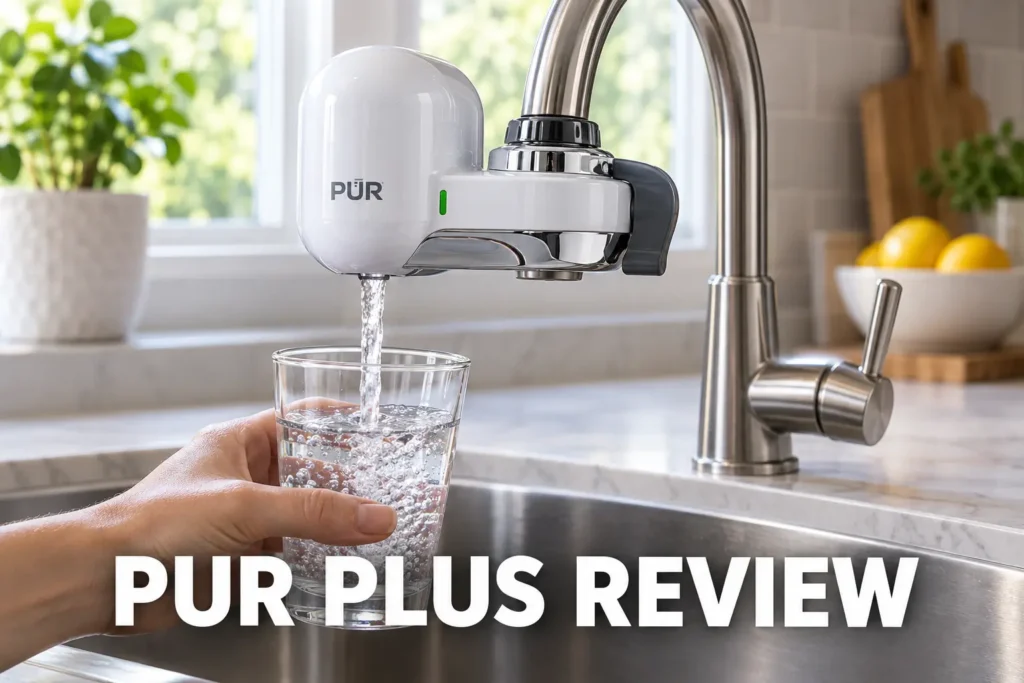
This PUR Plus review comes down to one question: does your faucet point straight down? If it does, this vertical filter earns its keep with WQA-certified lead reduction and NSF certification against 70 chemical and physical substances, and I would install it in my own kitchen without hesitation. If your faucet angles away from vertical or carries a pull-out sprayer, skip ahead to the horizontal version instead.

What follows covers everything I dug into on this pur plus water filter: the 3-month or 100-gallon filter cycle PUR rates it at, the certification record, the owner complaints that never make it into the marketing copy, and the households I would point toward the pitcher or horizontal alternatives instead. Among those pitcher alternatives, my Waterdrop PT-07B pitcher review covers one of the more compact countertop options at the NSF 42 tier.
Quick Verdict
PUR rates the filter at 3 months or 100 gallons, backed by WQA certification for lead reduction and NSF certification against 70 chemical and physical substances, but only on a faucet spout that points straight down.
- Water that tastes and smells better without giving up fridge space to a separate pitcher
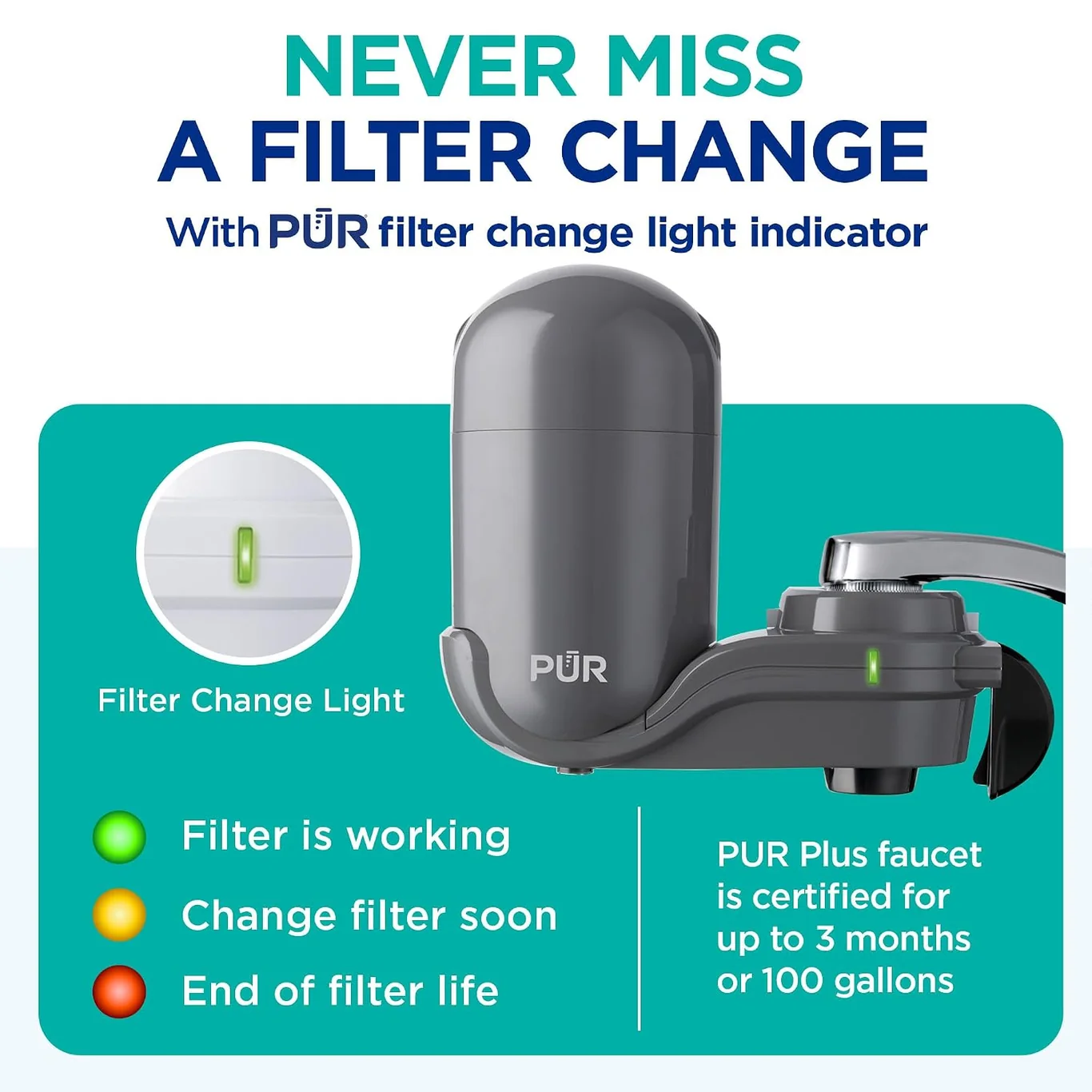
- A visible indicator light instead of having to remember or guess when to change the filter
- Lead reduction backed by an independent WQA certification rather than a manufacturer claim
PUR Plus Review: What This Faucet Filter Is and Who Makes It
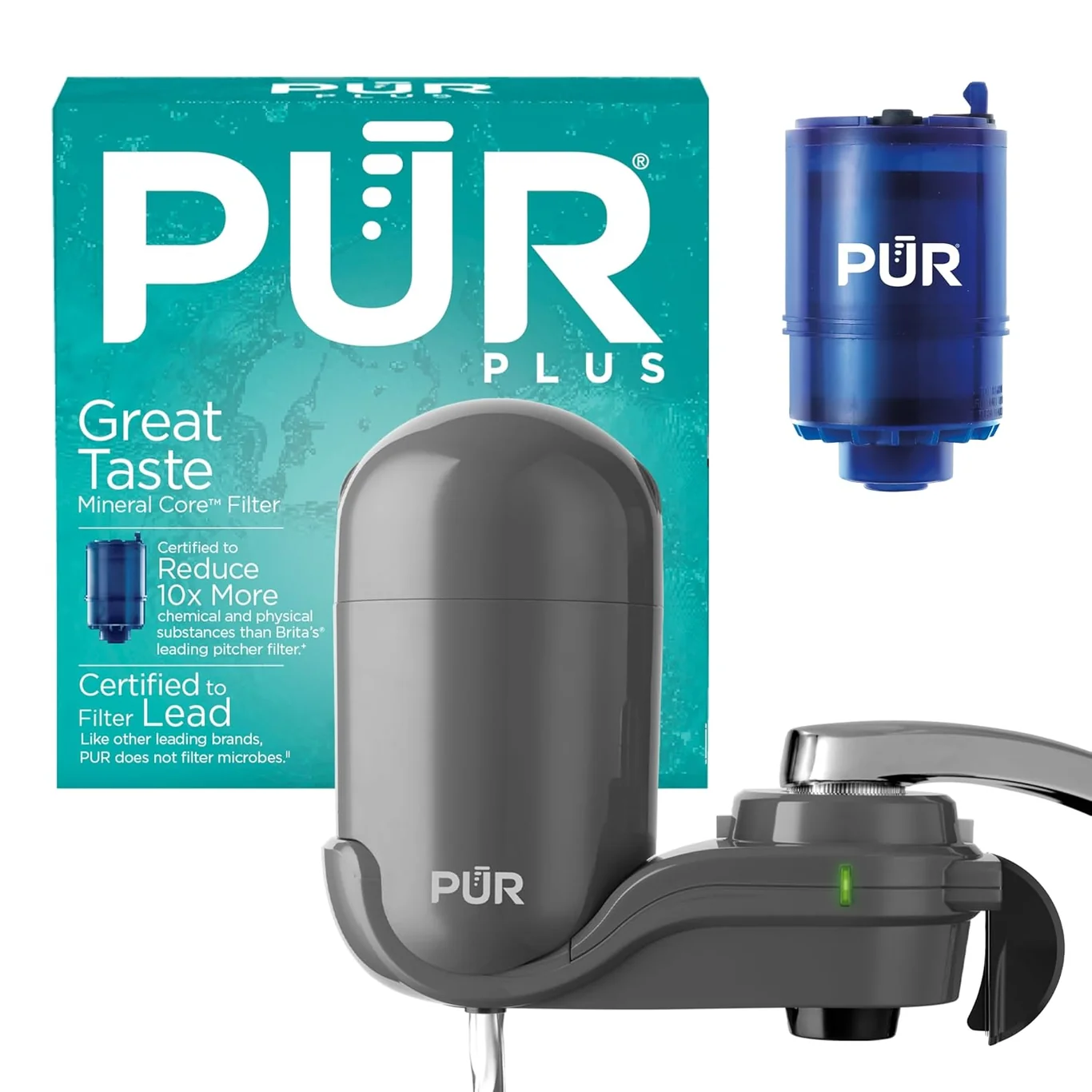
PUR has been in the water filtration business for over 35 years, and the PUR Plus Plastic Vertical Faucet Filtration System is the company’s clip-on answer to under-sink or pitcher-based filtration for anyone who does not want to commit to either. It attaches directly to a straight-down kitchen faucet spout and filters water on demand rather than in batches.
Buyers who are still deciding on format and want to compare all major approaches from faucet mounts to whole-home systems at once can start with my best water filtration system for home breakdown.
The purification method is ion exchange, and PUR backs the reduction claims with two separate certifying bodies rather than resting on brand reputation alone: NSF for the 70-substance reduction figure and WQA for lead specifically. I read that pairing as the reason this unit is worth taking seriously over a generic pitcher filter with no certification behind it at all.
Households that want multi-stage filtration and a dedicated holding tank rather than a clip-on faucet mount can compare the options in my best reverse osmosis system guide.
Specifications
| Specification | Detail |
| Filter Life Cycle | 3 months or 100 gallons |
| Maximum Supported Water TDS | 500 ppm |
| Operating Temperature Range | 34F to 100F |
| Unit Dimensions | 6.4″L x 2.8″W x 5.4″H |
| Unit Weight | 1.2 pounds |
| Purification Method | Ion Exchange |
| Contaminants Reduced | 70 chemical and physical substances |
| Model Number | FM2500V |
Key Features
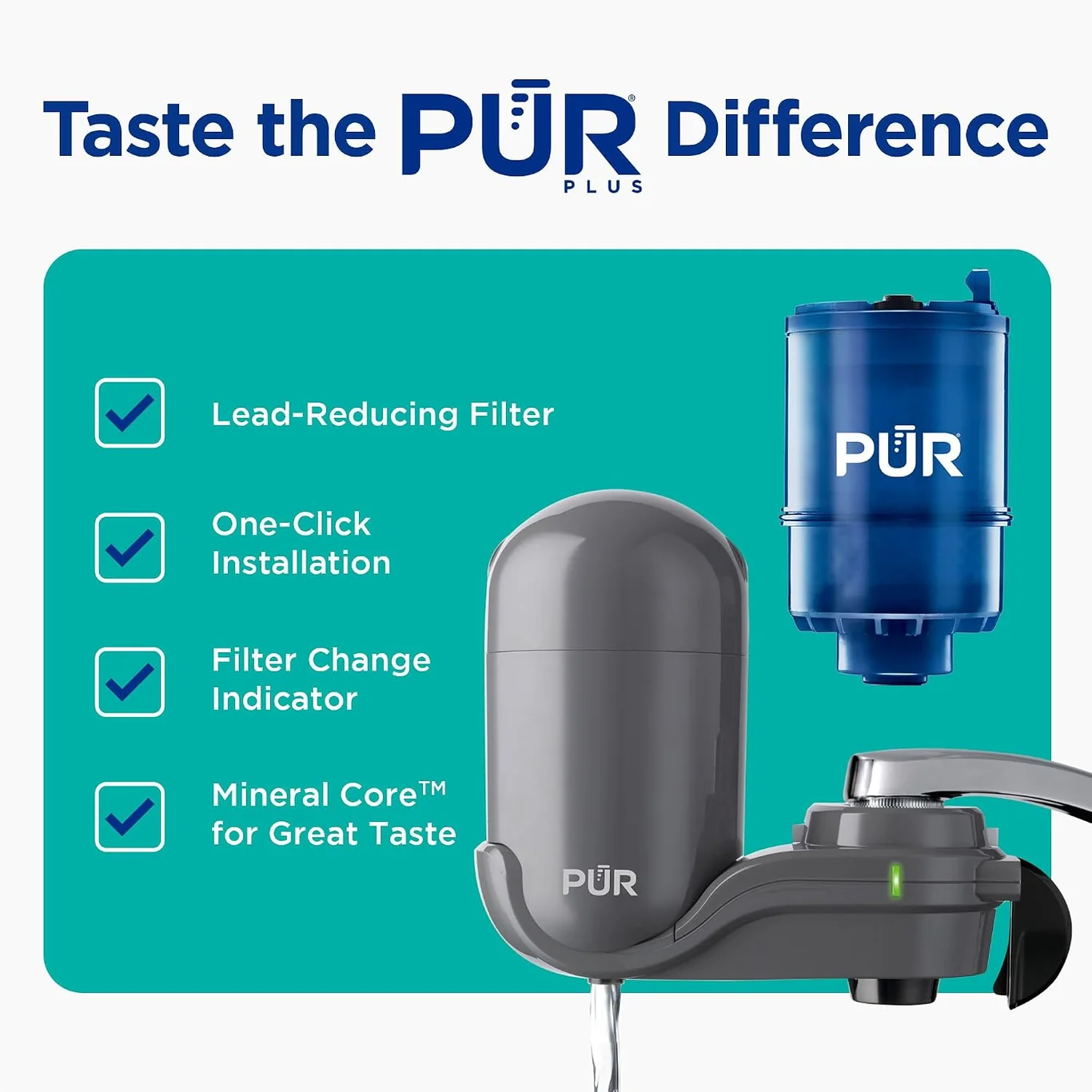
- Built-in change-filter indicator light, so you do not have to track the replacement date manually
- NSF certification against 70 chemical and physical substances, including microplastics and chlorine
- WQA-certified lead reduction, independently verified rather than a self-reported claim
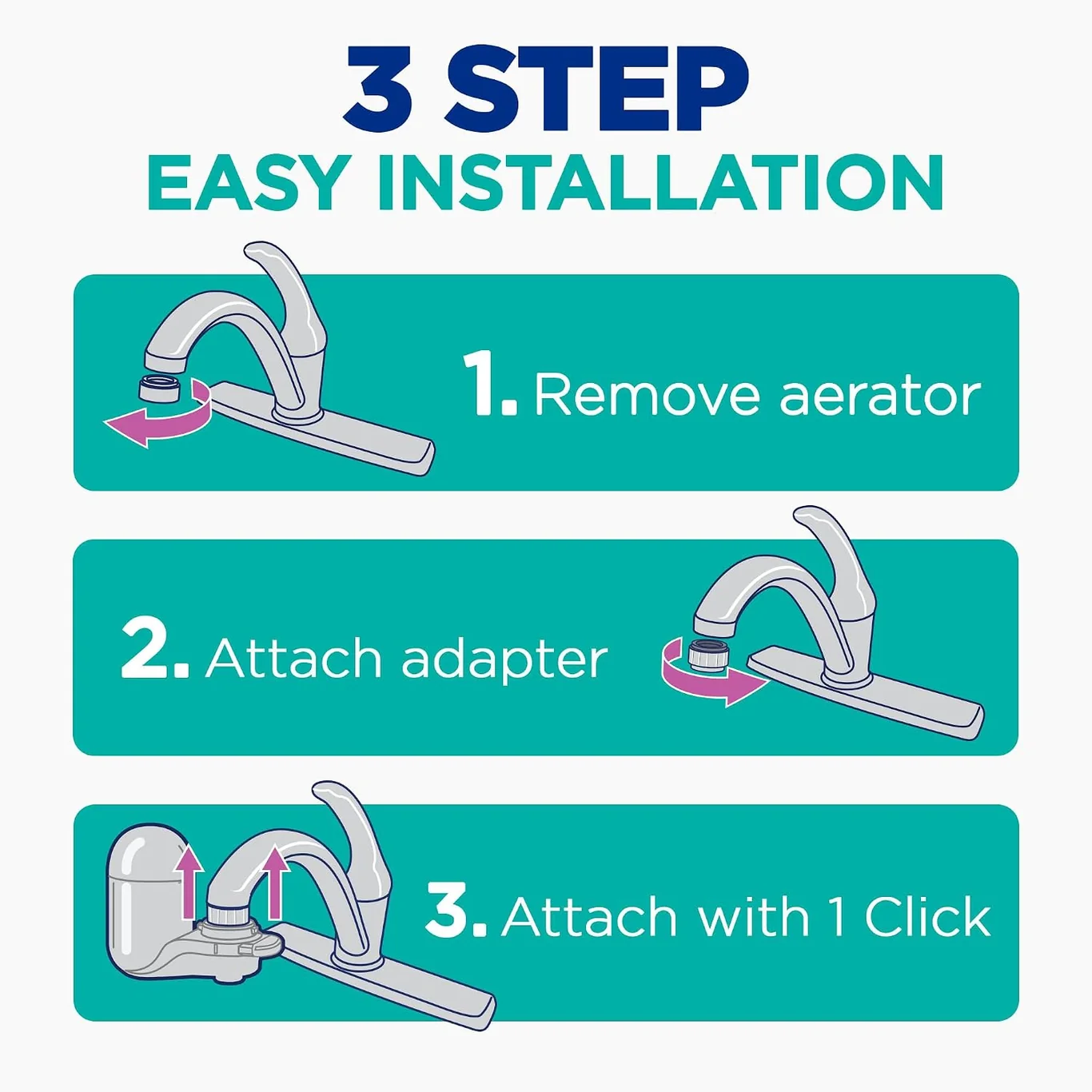
- Tool-free clip-on installation that also detaches in seconds for rinsing
- An on/off bypass lever that lets you skip filtering for dishwashing and save filter life for drinking water
What the PUR Plus Actually Removes
PUR describes the purification method as Ion Exchange, and two separate certifiers back specific claims about what that process pulls out of tap water. NSF certifies the filter to reduce 70 chemical and physical substances, including microplastics and chlorine, and WQA separately certifies this filter to reduce lead. I read a named-certifier claim differently than a marketing line, and this system gives me two certifications to check instead of one.
There is no NSF or WQA certification for PFAS reduction on this specific model, so I am not going to imply one exists just because the category is having a moment. HEPA-type language does not belong to this product category, and PUR does not use it here. For a wider view of how this model stacks up against the field, I would start with our full roundup of the best faucet water filters.
Living With the PUR Plus Day to Day
PUR rates the filter at 3 months or 100 gallons, whichever comes first, and I read that as an upper bound, not a promise. Owner reports back that up: one long-term case describes stretching cartridges out closer to every 20 to 24 months under only occasional use, while a separate owner in a hard-water area reports the built-in change-filter indicator light triggering after roughly 2 months instead of three. Hard water is the variable I would watch, since it can pull the real number down well before either limit.
Maintenance stays light day to day. Run a new cartridge for 5 to 10 minutes before first use to clear carbon fines, and give it a brief flush again if it sits unused for a while before drinking from it. The housing clips on and off without tools, which I have found matters more than it sounds once you actually need to rinse buildup off it.
Anyone who prefers a self-contained countertop unit that fills from any tap and requires no faucet attachment can compare the alternatives in my best countertop water filters guide.
Running cost sits mid-pack for the category. Replacement cartridges are widely stocked at grocery and hardware retailers, which keeps them convenient to source, though several long-term owners describe the cartridges as pricier than they expected relative to the unit’s low up-front cost. I would call that a relative cost tier rather than a bargain, and it is the spec I actually care about more than the unit price itself. For ways to keep that cost down, see our picks for the best replacement filter cartridges.
Pros
- NSF-certified to reduce 70 chemical and physical substances from tap water
- WQA-certified separately to reduce lead
- Tool-free clip-on and clip-off installation and cleaning
- Built-in change-filter indicator light instead of guesswork
- On/off bypass lever saves cartridge life during dishwashing
- Replacement cartridges are widely stocked at grocery and hardware retailers
- Ion exchange purification backed by two independent named certifiers
Cons
- Only fits a faucet with a straight-down spout; angled or pull-out faucets need the horizontal version instead.
Who Should Skip the PUR Plus
This system suits anyone with a straight-down kitchen faucet who wants a tool-free install and a visible reminder for when to change the cartridge. I would put it on my own kitchen faucet without a second thought if that faucet pointed straight down, and the on/off bypass lever is a real convenience I did not expect from a filter at this level, since it lets you skip filtering entirely for dishwashing and save cartridge life for drinking and cooking water.
Anyone with a faucet spout that angles noticeably away from straight-down, or a pull-out or handheld sprayer faucet, should skip this vertical model; the PUR PLUS Horizontal Faucet Filtration System is built for exactly that mismatch instead. I would also point anyone chasing the smallest possible footprint at the sink elsewhere, since the housing adds close to a foot of vertical clearance beside the faucet and reads as bulky next to a pitcher-format filter. Buyers who want no faucet modification at all and prefer a fully portable countertop option can compare the alternative in my Royal Berkey gravity-fed filter review.
Renters, anyone who cannot alter faucet hardware, and anyone who would rather filter a batch and store it in the fridge than filter on demand should look at our guide to the best water filter pitchers instead, starting with the PUR PLUS Pitcher Filter itself. I fill water bottles and cups for three kids most days, and one-pinky lever operation like this matters more to me in practice than a spec sheet line most buyers never read.
| Model | How it differs | Pick it instead if |
| PUR PLUS Plastic Vertical Faucet Filtration System | The model reviewed on this page: NSF- and WQA-certified, straight-down mount, LED change indicator. | You want a tool-free faucet mount with a visible change indicator and do not mind roughly a foot of clearance above the faucet. |
| PUR PLUS Horizontal Faucet Filtration System (Chrome) | PUR rates it to the same 3-month/100-gallon filter cycle and the same NSF/WQA certification profile as the vertical model, but the housing sits horizontal for an angled or offset faucet spout. | The vertical model’s straight-down fit requirement is the dealbreaker for your faucet. |
| PUR PLUS Pitcher Filter | IAPMO R&T certifies the pitcher filter to reduce lead, microplastics, chlorine, mercury, copper and zinc, with no faucet installation at all. | You rent, cannot modify the faucet, or prefer fridge-cold filtered water over tap-temperature filtered water. |
| Brita Elite Faucet Filter | Owner comparisons describe the Brita’s twist-tab activation as harder to operate one-handed than PUR’s lever, and its mechanical change gauge as less visible than PUR’s LED indicator. | You have a brand preference; owner comparisons in this data set otherwise favor PUR on day-to-day ergonomics. |
Common Problems With the PUR Plus
The most detailed complaint pattern in the review record is fit on an angled or non-vertical faucet: the housing is built for a spout that points straight down, and it tolerates up to roughly a 45-degree slope before it sits oddly and filtered water can splash out of the sink. I would test the fit against your own faucet’s angle before installing anything, since this is the problem that shows up most often and is the hardest one to fix after the fact.
For a look at how another faucet-mounted clip-on filter handles the same installation geometry, my PurePlus faucet filter review covers how a comparable model compares on fit and build.
A smaller number of owners traced a different issue, unfiltered-tasting water pouring out in the same wide stream as the unfiltered side, to slightly different tube or O-ring diameters between cartridge batches and between the horizontal and vertical housings. Swapping in a slightly larger O-ring resolved it in at least one documented case. I would treat this as an occasional quality-control inconsistency to watch for rather than a universal defect, since most units do not show it.
Buyers ready to move to a full multi-stage under-sink unit rather than a clip-on filter can compare a leading option in my iSpring RCC7 review.
Hard water shortening the real-world filter life below the rated cycle is the same pattern covered above, and it is worth repeating here as a problem rather than just a maintenance note: lime buildup in one case and an early change-light trigger in another both point to the same underlying cause. Cartridge cost adding up over time is a related complaint, though the owners raising it do not dispute that the filtration itself works. The on/off lever is also sensitive to accidental bumps on the vertical model, which can let hot water pass into the filter unintentionally if the unit gets knocked while the sink is running; I would keep that in mind if the filter sits somewhere kids reach for the tap.
Households that want under-sink filtration with an added alkaline remineralization stage rather than a clip-on faucet mount can compare the format in my iSpring RCC7AK review.
My Overall Verdict
The 3-month or 100-gallon claim reads like a hard ceiling, but I treat it as an upper bound rather than a guarantee, especially with hard water in the pipes. The installation trade-off is the more useful thing to understand before buying: the clip-on housing goes on in under a minute with no tools and comes off just as fast for cleaning, but that same geometry only sits right on a faucet that points straight down.
I expected the coverage and lifespan numbers to hold up evenly across households, and they do not: two named certifications back what the filter removes, but how long a cartridge actually lasts depends heavily on the water coming out of your tap. I would send anyone with an angled or pull-out faucet straight to the horizontal version, and anyone who would rather filter in batches and skip installation entirely to the pitcher instead.
And anyone ready to move to a permanently plumbed under-sink solution can compare the alternatives in my best under-sink water filter breakdown.
Final Verdict
I would install this on my own straight-down kitchen faucet without hesitation, run a new cartridge for the recommended few minutes before first use, and keep an eye on the change light rather than trusting the 100-gallon number blindly, which is the honest conclusion of this PUR Plus review.
Frequently Asked Questions
Is the PUR Plus water filter worth it?
You get two named certifications behind the filtration claims here, NSF for a broad list of contaminants and WQA for lead, which is more verification than most faucet filters offer. If your faucet has a straight-down spout and you want tool-free installation with a visible change-filter light, this system earns its place on your counter.
How long does a pur plus filter last?
PUR rates the cartridge you’re using for 3 months or 100 gallons, whichever comes first, though owner reports show hard water can shorten that window well before either limit. Treat the rating as an upper bound and let the built-in change-filter light, not the calendar, tell you when a swap is actually due.
What is the difference between PUR and PUR plus water filter?
PUR Plus names a filter tier inside PUR’s wider lineup, not a separate brand, and this vertical model pairs ion exchange filtration with the NSF and WQA certifications covered here. When you compare model names on a shelf, look for the Plus designation specifically, since that is what ties a listing to this certification record.
Does PUR Plus filter out microplastics?
Yes: NSF certifies this filter to reduce microplastics as part of the 70 chemical and physical substances covered under its certification, which is a named, checkable claim rather than marketing copy. If microplastics are the reason you’re shopping for a faucet filter, you can verify the exact listing yourself through NSF’s public certified-product database.
Is PUR Plus or Brita better?
Owner comparisons in this data set consistently favor PUR’s lever-based bypass and LED change indicator over Brita’s twist-tab activation and mechanical gauge for day-to-day ease of use. If ergonomics matter more to you than brand loyalty, that comparison record points toward PUR rather than Brita for this specific faucet-mount category.
References
- NSF International. Certified Product Listings for Drinking Water Treatment Units. nsf.org/consumer-resources/certified-products
- Water Quality Association. Lead Reduction Certification Overview. wqa.org/learn-about-water/water-treatment/lead-reduction
- U.S. EPA. Basic Information about Lead in Drinking Water. epa.gov/ground-water-and-drinking-water/basic-information-about-lead-drinking-water
- CDC. Water Treatment Options to Reduce Contaminants at Home. cdc.gov/healthywater/drinking/home-water-treatment.html
Medical Disclaimer: This content is for informational purposes only. It is not a substitute for professional medical advice, diagnosis, or treatment. If you have concerns about your water quality or air quality and their effects on your health, consult a qualified healthcare professional.